









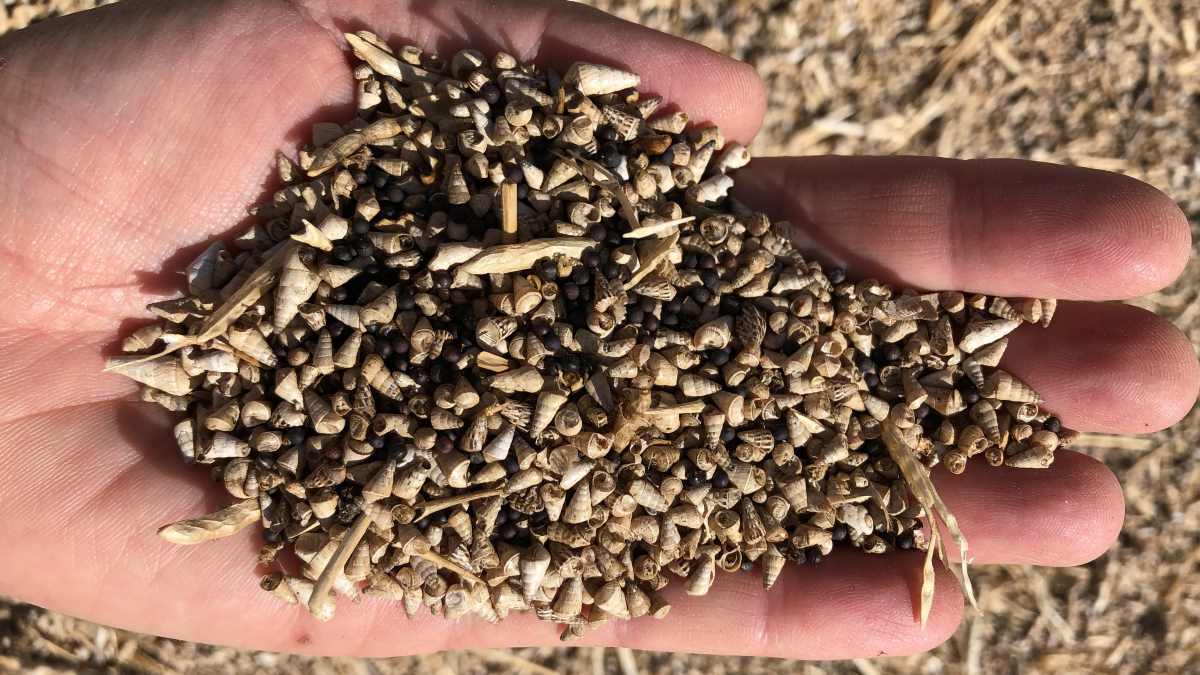

Scientists researching innovative ways to control invasive snails have discovered some unexpected vampiric qualities – they’re enthralled by the colour red and repelled by garlic.
The findings, published in a paper in Scientific Reports, could help lessen invasive snails’ cost to Australian grain growers. At the moment, snails cost the industry $170 million annually.
The preference for red is particularly unexpected as, according to senior author Dr Valerie Caron, an entomologist at CSIRO Health and Biosecurity, snails don’t have the best eyesight.
“We’ve been a little bit in shock since then, because … they’re not supposed to see colour, but they obviously prefer red,” she says.
“It’s probably because of contrast. We don’t know yet and we’re kind of investigating that, but we absolutely didn’t expect to find anything and then we found that!”
The research was carried out on 4 species – Theba pisana, Cernuella virgata, Cochlicella acuta and Cochlicella barbara – which are native to the Mediterranean region.


“The issue with these snails is not necessarily that they eat the plants. They do a little bit, but the main issue is that actually when it gets warmer they climb up to spend summer off the ground,” says Caron.
“So, they’ll be on plants or … fence posts, anything, and that coincides with the harvest. So, if you have snails at the top of your crop when you harvest the grain, well you harvest a lot of snails with it. It’s a huge problem for growers of grains and oil seeds.”
These snails can be as small as a grain of barley or wheat. Their shells clog harvesting machinery and are difficult to remove from contaminated grain, reducing its quality.
“There are different ways we have of controlling them, but nothing really works 100%. So, we’re trying to think outside the box and find a new way of controlling them,” says Caron.
In previous research, Caron and colleagues found the snails appear to prefer climbing on black posts to white ones. On a whim, they decided to test colour next.
“The idea was … before they climb on the crop, is it possible to potentially put something out there that they’ll be very attracted to, and then they would climb on that instead of climbing on the crop?” says Caron.


They found that, whether in the laboratory or the field, all 4 species prefer to climb a red post above all others.
The consensus on snail vision is that they can distinguish between light and darkness, so the new finding could be explained by the fact that red and black contrast the most with natural backgrounds.
The researchers consulted the limited literature for substances that could be used to drive snails away from the crops.
“There were slugs that could be repelled by garlic, so we tried garlic. We tried coffee, which can be a repellent for some insects. We tried coffee grounds. We tried copper, which is sold in some countries to put a barrier against garden snails,” says Caron.
“And we found that garlic is by far the winner. You could make a really effective barrier in the laboratory. We haven’t tried that in the field yet, but they just don’t want to cross the garlic.
“At the moment we’re doing new research … trying to figure out what molecule is the repellent part of the garlic. Because I can’t imagine kind of starting to spray garlic around the field … then your wheat will smell like garlic!”


These attracting and repelling techniques could be used during different points in the lifecycle of the snails.
Red posts could be used to attract them in the summertime when they climb off the ground to avoid hot soil temperatures. A garlic-derived compound could be deployed in the wetter months when the snails are on the move.
The next steps will be to evaluate whether this strategy is scalable to the field.
And as for whether the findings extend to the common garden snail, Caron says we don’t know yet.
“We haven’t worked on it … If we could find something [like garlic] that works for them as well, I’m sure people will be quite happy to protect their veggie patch, for instance. “But the idea of using the red post is really for those species that climb in summer. The garden snails don’t do that.”












Discussion about this post