









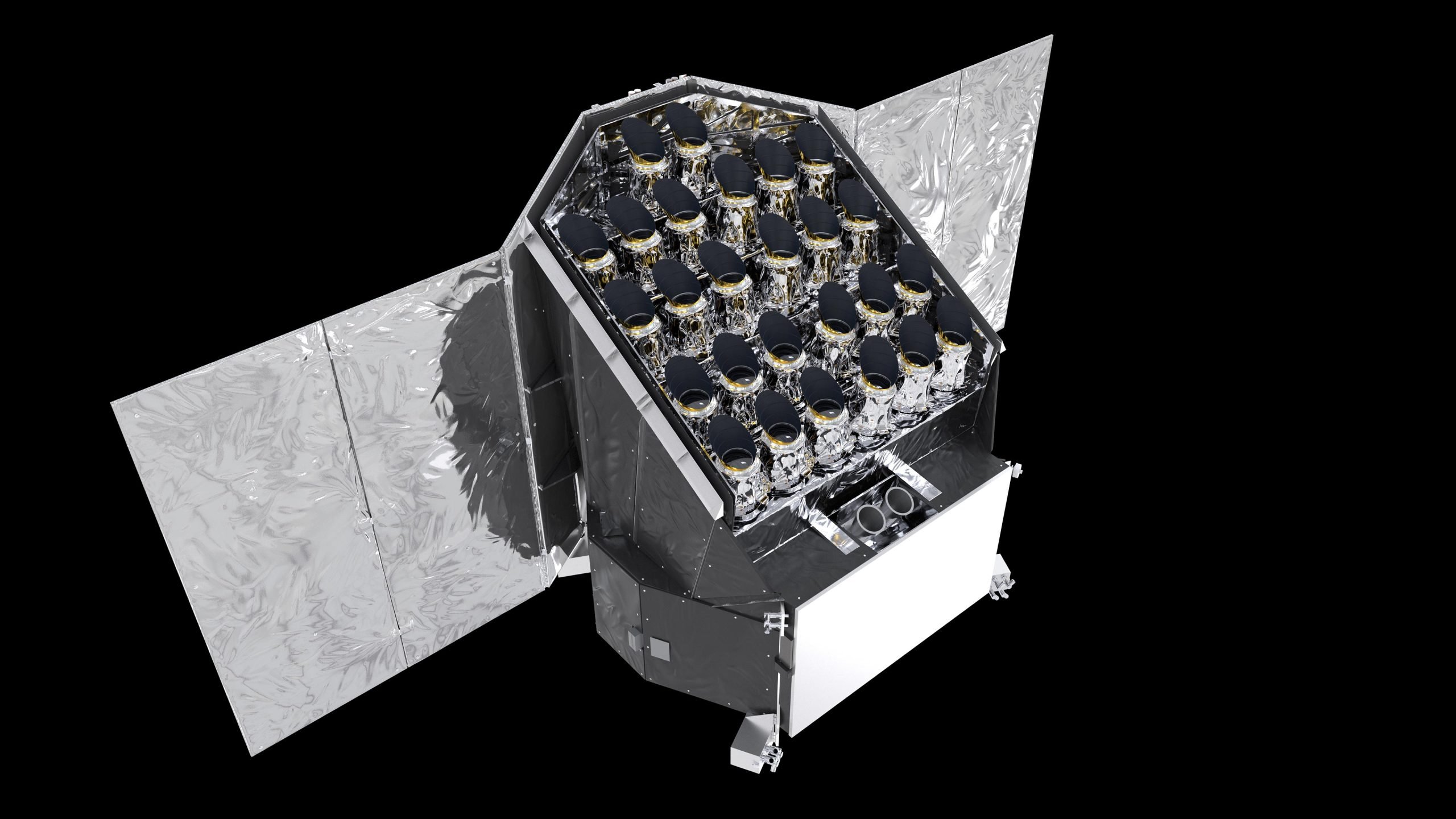
Artist’s impression of ESA’s Plato (PLAnetary Transits and Oscillations of stars) mission, the third medium-class mission in ESA’s Cosmic Vision program. Plato will use 26 cameras at once to observe terrestrial planets in orbits up to the habitable zone of bright Sun-like stars, and to characterize these stars. Credit: ESA/ATG medialab
Europe’s next major space mission, PLATO, aims to launch in December 2026.
This telescope is designed to search for Earth-like rocky planets around Sun-like stars that might be habitable.
Europe’s Next Big Space Mission
Europe’s next big space mission — a telescope that will hunt for Earth-like rocky planets outside of our solar system — is on course to launch at the end of 2026.
PLATO, or PLAnetary Transits and Oscillations of stars, is being built to find nearby potentially habitable worlds around Sun-like stars that we can examine in detail.
The space telescope will blast into orbit on Europe’s new rocket, Ariane-6, which made its maiden flight last week after being developed at a cost of €4 billion ($4.3 billion).
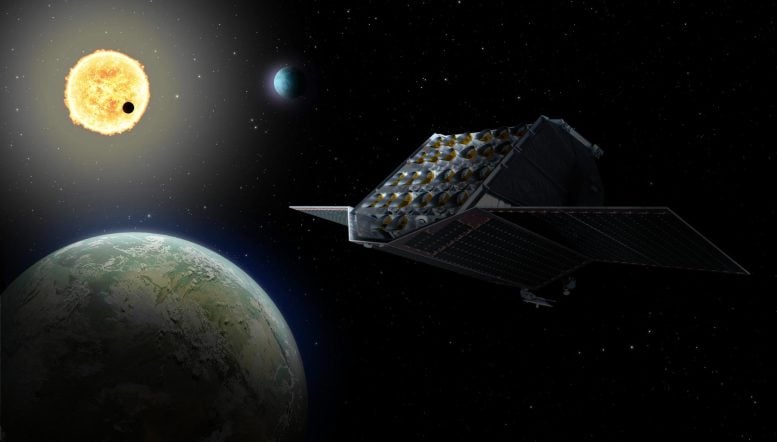
ESA’s mission Plato, PLAnetary Transits and Oscillations of stars, will use its 26 cameras to study terrestrial exoplanets in orbits up to the habitable zone of Sun-like stars. The mission will discover the sizes of exoplanets and discover exomoons and rings around them. Plato will also characterize their host stars by studying tiny light variations in the starlight it receives. Credit: ESA
Mission Objectives and Goals
Dr. David Brown, of the 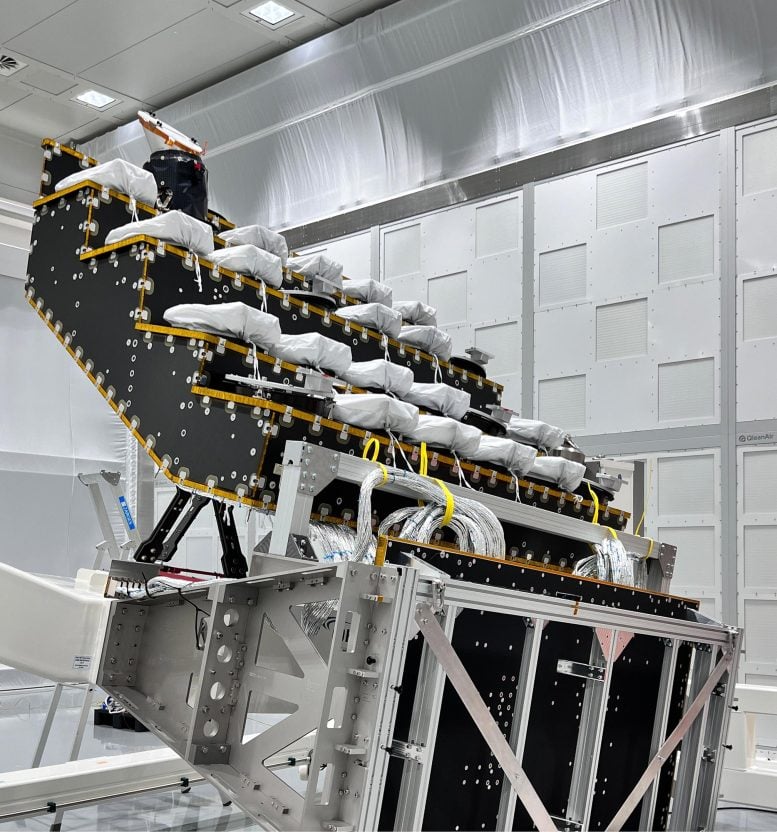
Ten of the final cameras have been built and tested and the first of these was mounted onto the optical bench – the surface which keeps all cameras pointed in the right direction – earlier this year. Credit: OHB System AG
Advanced Camera System
It has 24 ‘Normal’ cameras (N-CAMs) and 2 ‘Fast’ cameras (F-CAMs). The N-CAMs are arranged into four groups of six cameras, with the cameras in each group pointing in the same direction but the groups slightly offset.
This gives PLATO a very large field of view, improved scientific performance, redundancy against failures, and a built-in way to identify ‘false positive’ signals that might mimic an exoplanet transit, Dr. Brown explained.
“The planned observing strategy is to stare at two patches of sky, one in the North and one in the South, for two years each,” he added.
Manufacturing and Testing Progress
“The Southern patch of sky has been chosen, while the Northern patch won’t be confirmed for another few years.”
Several of the spacecraft’s components have finished their manufacturing programs and are close to completing their calibration tests. This includes the UK-provided Front-End Electronics (FEE) for the N-CAMs.
Built by the Mullard Space Science Laboratory of University College London, these operate the cameras, digitize the images, and transfer them to the onboard data processing.
Ten of the final cameras have been built and tested and the first of these was mounted onto the optical bench — the surface that keeps all cameras pointed in the right direction — earlier this year.
The mission is on track to launch in December 2026.









Discussion about this post