• Home
  • Insight
  • Blog
  • Business
  • Entertainment
  • Health
  • Politics
  • Shop
    • Gift Shop
    • Value Shop
    • Store
    • Bargain Shop
    • Discount
  • Sports
  • Tech
  • Travel
  • USA
  • Video
  • World
    • Asia
    • Africa
    • South America
    • North America
    • Europe
    • Oceania
Wednesday, November 18, 2026
No Result
View All Result
Subscribe Now
  • Home
  • Insight
  • Blog
  • Business
  • Entertainment
  • Health
  • Politics
  • Shop
    • Gift Shop
    • Value Shop
    • Store
    • Bargain Shop
    • Discount
  • Sports
  • Tech
  • Travel
  • USA
    Mary Peltola Emerges Victorious in Alaska Senate Race, Making History for Democrats

    Mary Peltola Emerges Victorious in Alaska Senate Race, Making History for Democrats

    Stranded in Conflict: Palestinians Navigate the Tenuous Balance of War and Peace Amid Ceasefire Efforts

    Stranded in Conflict: Palestinians Navigate the Tenuous Balance of War and Peace Amid Ceasefire Efforts

    Trump Administration Revokes Pay Increase for Head Start Educators

    Trump Administration Revokes Pay Increase for Head Start Educators

    Unexpected Triumph: Gay Candidates Achieve Unforeseen Victories in Challenging Races

    Unexpected Triumph: Gay Candidates Achieve Unforeseen Victories in Challenging Races

    Microsoft Outlook Experiences Prolonged Outage Affecting Users Nationwide

    Microsoft Outlook Experiences Prolonged Outage Affecting Users Nationwide

    Gunfire Erupts in D.C.: Authorities Search for Suspect Amid Rising Concerns Over Public Safety

    Gunfire Erupts in D.C.: Authorities Search for Suspect Amid Rising Concerns Over Public Safety

    LAUSD Takes Strong Action Against Hate Speech Following Racial Slur Incidents

    LAUSD Takes Strong Action Against Hate Speech Following Racial Slur Incidents

    Beloved Former Los Angeles Times Columnist Steve Harvey Passes Away at 80

    Beloved Former Los Angeles Times Columnist Steve Harvey Passes Away at 80

    Exploring Diversity: ‘Ten Lives’ Showcases the Varied Economic Journeys of Americans

    Exploring Diversity: ‘Ten Lives’ Showcases the Varied Economic Journeys of Americans

  • Video
  • World
    • Asia
    • Africa
    • South America
    • North America
    • Europe
    • Oceania
The Insight Post
  • Home
  • Insight
  • Blog
  • Business
  • Entertainment
  • Health
  • Politics
  • Shop
    • Gift Shop
    • Value Shop
    • Store
    • Bargain Shop
    • Discount
  • Sports
  • Tech
  • Travel
  • USA
    Mary Peltola Emerges Victorious in Alaska Senate Race, Making History for Democrats

    Mary Peltola Emerges Victorious in Alaska Senate Race, Making History for Democrats

    Stranded in Conflict: Palestinians Navigate the Tenuous Balance of War and Peace Amid Ceasefire Efforts

    Stranded in Conflict: Palestinians Navigate the Tenuous Balance of War and Peace Amid Ceasefire Efforts

    Trump Administration Revokes Pay Increase for Head Start Educators

    Trump Administration Revokes Pay Increase for Head Start Educators

    Unexpected Triumph: Gay Candidates Achieve Unforeseen Victories in Challenging Races

    Unexpected Triumph: Gay Candidates Achieve Unforeseen Victories in Challenging Races

    Microsoft Outlook Experiences Prolonged Outage Affecting Users Nationwide

    Microsoft Outlook Experiences Prolonged Outage Affecting Users Nationwide

    Gunfire Erupts in D.C.: Authorities Search for Suspect Amid Rising Concerns Over Public Safety

    Gunfire Erupts in D.C.: Authorities Search for Suspect Amid Rising Concerns Over Public Safety

    LAUSD Takes Strong Action Against Hate Speech Following Racial Slur Incidents

    LAUSD Takes Strong Action Against Hate Speech Following Racial Slur Incidents

    Beloved Former Los Angeles Times Columnist Steve Harvey Passes Away at 80

    Beloved Former Los Angeles Times Columnist Steve Harvey Passes Away at 80

    Exploring Diversity: ‘Ten Lives’ Showcases the Varied Economic Journeys of Americans

    Exploring Diversity: ‘Ten Lives’ Showcases the Varied Economic Journeys of Americans

  • Video
  • World
    • Asia
    • Africa
    • South America
    • North America
    • Europe
    • Oceania
No Result
View All Result
No Result
View All Result
Home Energy

Climate change is creating ‘new vulnerabilities’ for disease pandemics

by Theinsightpost
July 23, 2025
in Energy
0 0
0
Climate change is creating ‘new vulnerabilities’ for disease pandemics

Climate change is creating “new vulnerabilities” for pandemics, according to new research.

The study, published in Science Advances, investigates nine zoonotic diseases – infections transmitted from animals to people – with high potential to cause severe public-health emergencies.

These diseases include the Zika virus, Ebola and Severe Acute Respiratory Syndrome (SARS).

Overall, the research finds that 9% of the planet’s land area is currently at “high” or “very high” risk of an outbreak of these diseases.

The study authors find that higher temperatures, increased rainfall and water scarcity are “key drivers” of disease outbreaks.

However, the paper has received a mixed reception from other scientists. 

While one expert not involved in the study praises it for its novelty and rigour, another tells Carbon Brief that the research fails to capture some of the key drivers of zoonotic disease.

They tell Carbon Brief that “this idea that you can do a one-size-fits-all global risk assessment is just untrue”.

Zoonotic disease

There are more than 200 known “zoonotic diseases” – infections or diseases that are transmitted to humans from pets, livestock or wild animals.

Zoonotic diseases are spread when the pathogen that causes the disease – such as a virus, bacterium, fungus or parasite – moves from animals to humans. This can be through a bite, blood, saliva or faeces. 

Lyme disease, rabies and bird flu are examples of well-known zoonotic diseases. One of the most well-known, Covid-19, is thought to have killed hundreds of thousands of people since the SARS-CoV-2 virus was first recorded in humans in 2019.

Pathogens are typically carried by animals, called hosts. For example, dogs are the main hosts of rabies.

The World Health Organization (WHO) keeps a list of “priority diseases” for research and development. These are zoonotic diseases that have the potential to cause severe public health emergencies, such as epidemics – in which there is a sharp rise in cases in a specific region – and pandemics, where a disease occurs over a very wide area and crosses borders. 

The WHO updates its list regularly. It currently features the following zoonoses:

The number of new zoonotic diseases is increasing rapidly. 

Many different factors can influence the spread of zoonotic diseases. One of the most important is climate. Pathogens and the animals that carry them typically thrive in a warm and wet climate, so many zoonotic diseases are found in tropical regions.

The frequency of contact between humans and animals is another important factor. This means that when people live close to areas of high biodiversity, such as forests, there is a higher risk of zoonotic disease transmission.

Mapping risk

The authors of the new study collected data on “outbreaks” of the WHO priority zoonotic diseases over 1975-2020 from the Global Infectious Diseases and Epidemiology Network. 

They exclude Covid-19 from their analysis, although it is a WHO priority disease, because its “overwhelming prevalence” resulted in worldwide coverage, making it difficult to identify spatial patterns. 

The database defines an outbreak as two or more linked cases of the same illness, a number of cases that exceeds the expected number, or a single case of disease “caused by a pathogen that poses a significant threat to public health”, the study explains. 

The authors identified 131 outbreaks of infectious diseases with epidemic and pandemic potential over 1975-2020

The authors then used satellite data to identify nine “risk factors” that can affect the transmission of zoonotic diseases:

  • Annual maximum temperature
  • Annual minimum temperature
  • Water deficit
  • Annual total rainfall
  • Livestock density
  • Frequency of land-use change
  • Change in proximity between humans and forests
  • Biodiversity loss
  • Human population density

The authors used a “predictive model”, which makes use of machine-learning techniques, to combine these variables. This allows them to determine the risk of climate outbreaks from the WHO priority diseases in different regions.

Finally, the authors adjusted their results to account for a bias in how data on disease outbreaks is recorded. In developed countries and regions, diseases are more likely to be detected and recorded, while this is less likely in developing regions.

The map below shows the risk of a disease breakout across the world from the nine WHO priority zoonotic diseases. Darker colours indicate greater risk, while white indicates regions where not enough data was available.

Risk of a disease breakout across the world from the nine WHO priority zoonotic diseases. Darker colours indicate greater risk. Source: Fanelli et al (2025).

The map shows that the southern hemisphere of the planet has a higher risk of pandemic breakout than the northern hemisphere, “with the majority of those areas located in Latin America and Oceania”. Meanwhile, very little risk is seen in Europe and North America.

The authors find that 9% of the world’s land surface, home to around 130 million people, is at “very high” or “high” risk of outbreaks of the diseases. 

Lead author Dr Angela Fanelli is a researcher at the European Commission’s Joint Research Council. She tells Carbon Brief that “this study is the first to comprehensively examine the shared drivers of zoonotic diseases with epidemic and pandemic potential on a global scale”.

The authors also use data from the International Health Regulations to score countries based on their capacity to respond to zoonotic events at the animal-wildlife interface.

By integrating this data into their analysis, the authors developed an “epidemic risk index” which shows each country’s risk and capacity to respond to “zoonotic threats”. In this index, Papua New Guinea is ranked as the lowest – indicating the greatest risk of epidemics.

The full table is shown below, where a higher number indicates a greater risk of epidemics. 

‘New vulnerabilities’

The authors went on to analyse the different factors that influence the risk of zoonotic breakout. 

The charts below illustrate how, for most risk factors explored in the report, a higher value results in a greater risk score for zoonotic disease outbreak.

For example, the plot on the top left shows how higher maximum temperatures lead to a higher risk of disease outbreak.
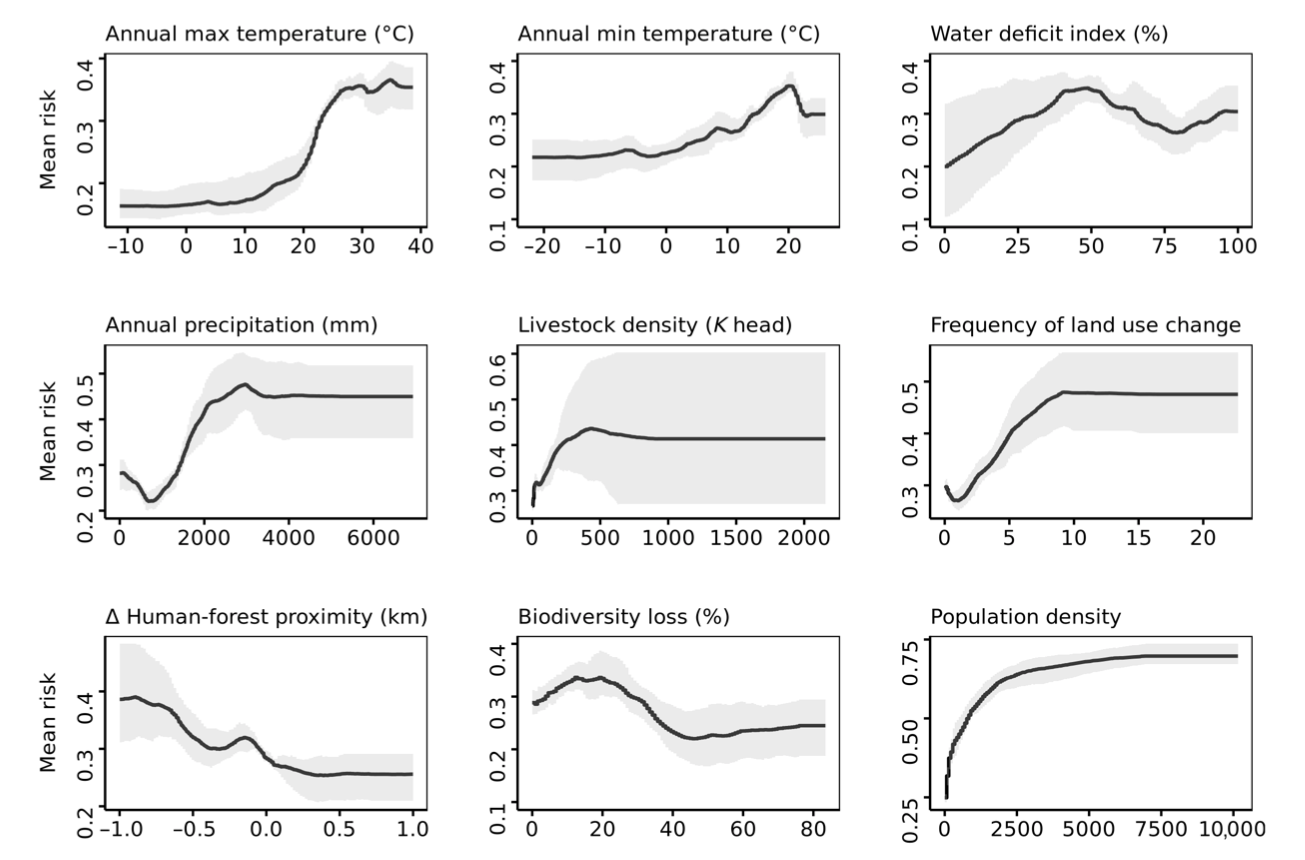
Risk of zoonotic disease outbreak for annual maximum temperature, annual minimum temperature, water deficit, annual precipitation, livestock density, frequency of land use change, change in the proximity of humans to forests, biodiversity loss and human population density. Source: Fanlli et al (2025).
Risk of zoonotic disease outbreak for annual maximum temperature, annual minimum temperature, water deficit, annual precipitation, livestock density, frequency of land use change, change in the proximity of humans to forests, biodiversity loss and human population density. Source: Fanelli et al (2025).

The paper notes that higher temperature and annual rainfall levels “elevate the risk of disease outbreaks”. It suggests that this is because host species are better adapted to hotter, wetter conditions. 

The paper also assesses water deficit, a measure that can capture the monthly differences between rainfall and potential evapotranspiration – the transfer of water from the ground into the air through a combination of evaporation and transpiration.

The authors find that “moderate water scarcity” is associated with the highest risk of outbreaks. This could be because moderate water scarcity can cause animals to group together around remaining water sources, allowing the pathogen to be transferred more easily, they suggest.

Meanwhile, they say that “excessively arid conditions” can cause the host population to die out, meaning the pathogen is unable to spread. 

Fanelli tells Carbon Brief that the study highlights “several key mechanisms by which climate change could increase the risk of disease outbreaks”.

Climate change, she says, can make host populations “more susceptible to disease outbreaks” and result in water shortages that “compromise water quality, hygiene and sanitation, further increasing the risk of disease outbreaks.”

The authors warn that the changing climate is “creating new vulnerabilities” for zoonotic disease transmission as it “reshapes the geographic distribution of risk”. 

The paper also finds that changes in land use can increase disease risk. When people cut down trees in areas of high biodiversity, they can suddenly come into contact with species that they do not usually interact with, providing an opportunity for pathogens to jump from humans to animals, the authors find.

Higher population densities of people or livestock are also linked to a higher risk of zoonotic diseases, because the pathogens are able to spread more easily. 

Mixed reception

The study has received mixed responses from scientists not involved in the work.

Dr Ibrahima Diouf, a postdoctoral researcher on climate and health at Senegal’s Cheikh Anta Diop University, tells Carbon Brief that the research “offers a more holistic perspective” than studies that focus on a single disease and has a “sound, innovative and transparent” methodology. 

He also praises the study for “bridg[ing] environmental modelling and public health planning”, and for capturing both hazard exposure and “national response capacity”. He says:

“This dual lens enables practical prioritisation of interventions. Countries like the Republic of Congo and Madagascar, which face both high risk and limited response capacity, emerge as key candidates for targeted support through regional or multilateral adaptation programmes.”

Dr Colin Carlson, an assistant professor of epidemiology at Yale School of Public Health, tells Carbon Brief that this type of work “has been done before”: 

“We’ve seen a lot of these studies that look at a hundred or so outbreaks and then use machine learning – an approach that will almost always find some kind of signal – to confirm their hypothesis that environmental degradation drives disease outbreaks.”

Carlson also criticises the study’s methodology, arguing that the variables the authors chose focus on “intact tropical rainforests and other tropical ecosystems” that are “hot, wet, biodiverse [and] populated”. He continues:

“That’s where a lot of disease outbreaks are, but that’s true as much because of poverty as because of the environment, if not more.”

Carlson tells Carbon Brief that “this idea that you can do a one-size-fits-all global risk assessment is just untrue”. 

He adds that the work contributes to a “narrative that spillover [of pathogens from animals to humans] is a problem of the global south – and that pandemics happen because the people living in these countries are somehow unengaged in outbreak prevention or unwilling to leave nature alone”. 

In Carlson’s view, this narrative is “wrong”. 

ShareTweetSend
Previous Post

Echo Chamber: These people are just speaking for the sake of it

Next Post

Werner Bronkhorst’s Tiny Beachgoers and Sailors Wade Through Chunky Blue Expanses — Colossal

Related News

Ed Miliband Engages Carbon Brief Readers: Insights from COP31 Question Session
Energy

Ed Miliband Engages Carbon Brief Readers: Insights from COP31 Question Session

November 12, 2026
COP31 Highlights Sharp 70% Decline in Climate-Finance Commitments Among Nations
Energy

COP31 Highlights Sharp 70% Decline in Climate-Finance Commitments Among Nations

November 11, 2026
Examining Global Participation: A Look at Countries Contributing the Most Delegates to COP31
Energy

Examining Global Participation: A Look at Countries Contributing the Most Delegates to COP31

November 10, 2026
Fossil-Fuel CO2 Emissions Expected to Decline by 2026 Amid Impact of Iran Conflict on Oil Consumption
Energy

Fossil-Fuel CO2 Emissions Expected to Decline by 2026 Amid Impact of Iran Conflict on Oil Consumption

November 9, 2026
Next Post
Werner Bronkhorst’s Tiny Beachgoers and Sailors Wade Through Chunky Blue Expanses — Colossal

Werner Bronkhorst's Tiny Beachgoers and Sailors Wade Through Chunky Blue Expanses — Colossal

Discussion about this post

Subscribe To Our Newsletters

    Customer Support


    1251 Wilcrest Drive
    Houston, Texas
    77042 USA
    Call-832.795.1420
    e-mail – news@theinsightpost.com

    Subscribe To Our Newsletters

      Categories

      • Africa
      • Africa-East
      • African Sports
      • American Sports
      • Arts
      • Asia
      • Australia
      • Business
      • Business Asia
      • Business- Africa
      • Canada
      • Defense
      • Education
      • Egypt
      • Energy
      • Entertainment
      • Europe
      • European Soccer
      • Finance
      • Germany
      • Ghana
      • Health
      • Insight
      • International
      • Investing
      • Japan
      • Latest Headlines
      • Life & Living
      • Markets
      • Mobile
      • Movies
      • New Zealand
      • Nigeria
      • Politics
      • Scholarships
      • Science
      • South Africa
      • South America
      • Sports
      • Tech
      • Travel
      • Travel-Africa
      • UK
      • USA
      • Weather
      • World
      No Result
      View All Result

      Recent News

      Vintage Photo of Robert Pattinson and Daniel Craig Gains New Significance Amid Bond Casting Developments

      Vintage Photo of Robert Pattinson and Daniel Craig Gains New Significance Amid Bond Casting Developments

      November 18, 2026
      Top 7 Retirement Threats and Effective Strategies to Navigate Them

      Top 7 Retirement Threats and Effective Strategies to Navigate Them

      November 18, 2026
      Charting the Future: Unveiling the TEFCA 2026-2027 Workplan and Innovative Monthly Metrics

      Charting the Future: Unveiling the TEFCA 2026-2027 Workplan and Innovative Monthly Metrics

      November 18, 2026
      Inevitable Buyer’s Remorse Looms Over Midterm Elections

      Inevitable Buyer’s Remorse Looms Over Midterm Elections

      November 18, 2026
      • Home
      • Advertise With Us
      • About Us
      • Corporate
      • Consumer Rewards
      • Forum
      • Privacy Policy
      • Social Trends

      Theinsightpost ©2026 | All Rights Reserved. Theinsightpost is an Elnegy LLC company, registered in Texas, USA

      Welcome Back!

      Login to your account below

      Forgotten Password?

      Retrieve your password

      Please enter your username or email address to reset your password.

      Log In

      Add New Playlist

      We are using cookies to give you the best experience on our website.

      You can find out more about which cookies we are using or switch them off in .

      No Result
      View All Result
      • Home
      • Insight
      • Blog
      • Business
      • Entertainment
      • Health
      • Politics
      • Shop
        • Gift Shop
        • Value Shop
        • Store
        • Bargain Shop
        • Discount
      • Sports
      • Tech
      • Travel
      • USA
      • Video
      • World
        • Asia
        • Africa
        • South America
        • North America
        • Europe
        • Oceania

      Theinsightpost ©2026 | All Rights Reserved. Theinsightpost is an Elnegy LLC company, registered in Texas, USA

      The Insight Post
      Powered by  GDPR Cookie Compliance
      Privacy Overview

      This website uses cookies so that we can provide you with the best user experience possible. Cookie information is stored in your browser and performs functions such as recognising you when you return to our website and helping our team to understand which sections of the website you find most interesting and useful.

      Strictly Necessary Cookies

      Strictly Necessary Cookie should be enabled at all times so that we can save your preferences for cookie settings.

      Cookie Policy

      More information about our Cookie Policy