
Almost three-quarters of the 72 five-year plans published by China this year include policies or targets related to climate change and energy, according to Carbon Brief analysis.
Five-year plans are an important part of China’s policymaking process, signalling key priorities and setting targets for the coming years.
The highest-level 15th five-year plan, which covers “economic and social development” for the period 2026-2030, was published in March 2026.
The government has subsequently published a number of thematic five-year plans at the national level that are specifically focused on climate and energy.
These include plans on renewable energy, responding to climate change and development of its fossil-fuel industries.
Furthermore, the large majority of national-level plans that are not directly connected to climate change also include climate policies – albeit at different levels of detail.
Carbon Brief has combed through all of the 15th five-year plans issued by central-government ministries that are currently available in public for any mentions of topics related to climate change.
The findings, summarised in the interactive tracker below, show that 54 of the 72 plans published so far include climate policies or targets.
For each plan, the tracker lists the most important targets and primary goals, as well as other notable policies and a link to the full text, or a summary if the full text is unavailable.
Using the tracker
Five-year plans are used to guide economic and social development across China.
The overarching plan is published in March at the beginning of each five-year cycle. It outlines the most important high-level targets and policies across all issues.
After the top-level plan, a series of other five-year plans are then published over a period of months or even years, each focused on individual sectors or themes.
In total, Carbon Brief has tracked the 72 plans published to date which cover the 15th five-year plan period, ranging from topics such as the coal industry and electric vehicles through to accounting methods and tourism.
It still remains unknown exactly how many plans for this five-year period are yet to be published – and on what topics – although Carbon Brief understands that the key plans relating to climate and energy have now likely been released.
The current five-year plan period is viewed as being particularly important for climate action, as it covers the years building up to China’s pledge to peak its carbon dioxide (CO2) emissions “before 2030”.
For each five-year plan, Carbon Brief’s tracker summarises all of the climate and energy targets classified as “primary” goals. (These goals are called 主要目标 in the policy documents.)
These include a combination of both numerical and non-numerical targets.
For example, in the overarching five-year plan, the numerical primary targets include cutting carbon intensity – the emissions per unit of GDP – by 17% across the five-year period.
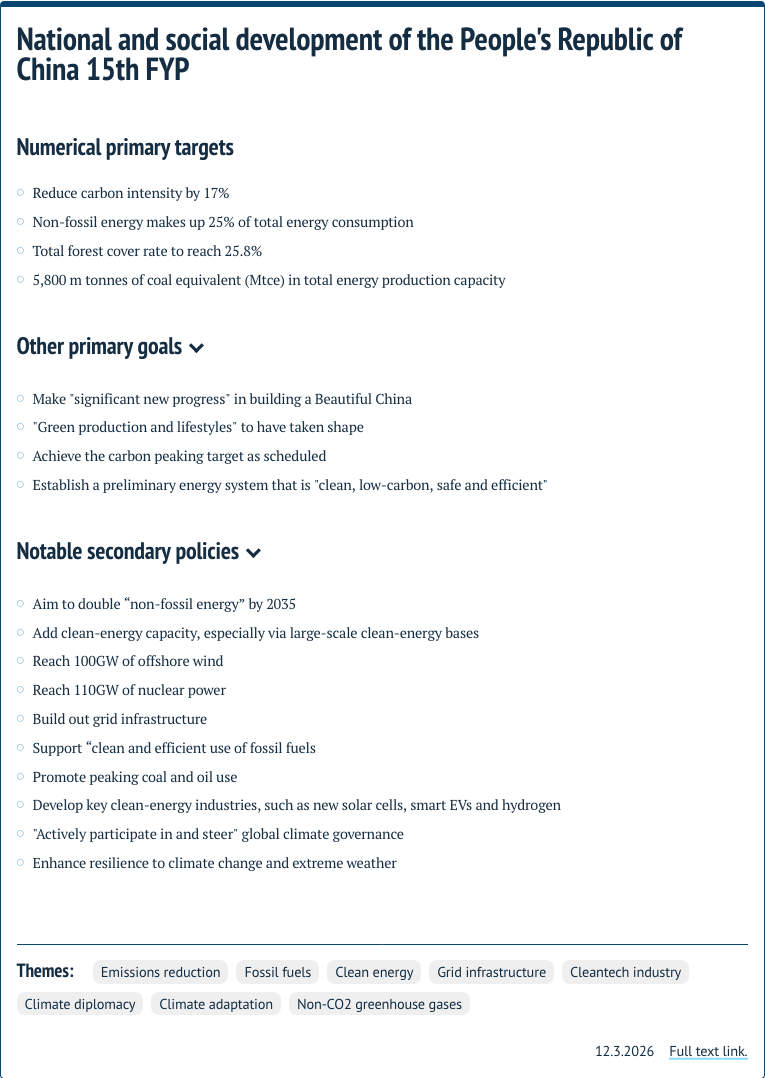
The targets from the overarching five-year plan, as well as others announced before March 2026 – such as the commitment to cut greenhouse gas emissions to 7-10% below peak levels by 2035 – are the basis for policymaking for the next five years.
However, the sectoral and thematic five-year plans provide more specific targets and detailed policy directions.
Non-numerical primary targets are listed on each card as other primary goals. For example, in the five-year plan for a “national meteorological development” these include “significantly enhanc[ing]” capabilities for monitoring, forecasting and warning of extreme weather, as well as making “major progress” in Earth system forecasting.
Primary goals are policies listed in the first section of the plans, either in the main body of the policy document as aims to be achieved for 2030, or in a table of numerical targets.
For each of the plans, the cards also list other notable policies related to climate change or the energy transition. For example, the policies below are all directives that are listed from the second section onwards of the five-year plan for coal. (For each heading on the cards, the full entry can be viewed by clicking the drop-down arrow.)
Unless otherwise specified, quantitative targets refer to 2030, relative to a 2025 baseline.
The five-year plans plans are sorted into four categories:
A full list of all of China’s 15th five-year plans mentioning climate change or energy can be found below.
The keyword search function and drop-down menu listing key topics can be used to search for plans that mention specific issues, such as coal, clean-energy technologies or climate diplomacy.
(See Carbon Brief’s glossary which decodes how China talks about energy and climate change. For example, terms such as “new energy vehicles” (NEVs), “carbon intensity” and “Beautiful China”.)
54 matching plans
Show 54 plans
The overarching plan
The 15th five-year plan released at the “two sessions” leadership meeting in Beijing in March 2026 signals the most important climate and energy targets China has set for 2030.
Key climate and energy 15th five-year plans
Several thematic plans have also been published on topics relevant to China’s energy transition. These plans list quantitative targets or policy directions related to climate change as important goals for 2030.
These documents are usually, though not always, published by government departments, such as the Ministry of Ecology and Environment (MEE), National Development and Reform Commission (NDRC) or National Energy Administration (NEA).
New-type energy system 15th FYP
Numerical primary targets
- Total energy production capacity to reach 5,800Mtce
- Total installed power capacity to reach 5,400 gigawatts (GW)
- Non-fossil energy sources’ share of total energy consumption to reach 25%
- Non-fossil power to reach 50% of power generation
- Reduce carbon emissions per unit of power generation by more than 10%
- Energy savings in energy-intensive industries to exceed 150Mtce
- Wind and solar to reach 50% of power capacity by 2030
- Installed capacity of biomass, solar thermal, geothermal and wave energy to reach 65GW
- More than 40m charging points to support more than 110m EVs
- Electricity to account for 35% of final energy consumption
- “West-to-East” power transmission capacity to reach 420GW
- “Power generation and energy storage regulation capacities” to grow by 40%
- Power demand response capacity to increase to more than 5%
- International patent applications to grow at a rate of more than 5% a year
- More than 100 demonstration projects for major first-of-a-kind energy technical equipment to be launched
Other primary goals
Notable secondary policies
Building a Beautiful China 15th FYP
Numerical primary targets
- Reduce carbon intensity by 17%
- Non-fossil energy to make up 25% of total energy consumption
- Reduce CO2 emissions per unit of production at industries included in China’s national carbon market by around 3%
- Total forest cover rate to reach 25.8%
Other primary goals
Notable secondary policies
National meteorological development 15th FYP
Other primary goals
Notable secondary policies
Eco-environmental monitoring 15th FYP
Other primary goals
Notable secondary policies
Green and low-carbon industrial development 15th FYP
Numerical primary targets
- Energy consumption per unit of industrial value-add to fall by 10% or more
- Carbon emissions per unit of industrial value-add to fall by 17% or more
- “Green factories” to produce 45% of all manufacturing output
- Build 500 zero-carbon factories
Other primary goals
Notable secondary policies
Renewable energy development 15th FYP
Numerical primary targets
- Renewable energy use to reach 1,800Mtce
- Total renewables capacity to reach 3,500GW
- Wind and solar capacity to reach more than 2,800GW
- Solar thermal capacity to reach 15GW
- Hydropower capacity to reach 570GW, of which 160GW is pumped storage hydropower
- Wave energy to reach 0.4GW
- Renewable generation to reach 6,000 terawatt-hours (TWh), of which 4,0000TWh is wind and solar
- Non-electricity use of renewables to reach 150Mtce
- Renewables-made hydrogen production to reach 2m tonnes
- “Firm capacity” to reach at least 8% of total capacity for wind and solar
- Reliable peak-shaving capacity from renewable sources to reach more than 300GW
- Wind and solar to supply more than 20% of total demand in peak periods during the summer and winter evenings
Notable secondary policies
Integrated transportation services development 15th FYP
Numerical primary targets
- “Green travel” in central cities to account for 76% of all travel
- New energy heavy-duty trucks to make up 20% of the entire fleet
Notable secondary policies
National response to climate change 15th FYP
Numerical primary targets
- Reduce carbon intensity by 17%
- Reduce CO2 emissions per unit of production at industries included in China’s national carbon market by around 3%
- Stregthen monitoring and control of non-CO2 greenhouse gases, with a reduction capacity of 30Mtce
Other primary goals
Notable secondary policies
New-type power system 15th FYP
Numerical primary targets
- Power to account for 35% of final energy consumption
- Total installed power capacity to reach 5,400GW
- Share of non-fossil capacity in the power mix to reach 65%
- Share of non-fossil sources in total power generation to reach 50%
- National power supply adequacy to exceed 1.1
- Capacity for interprovincial mutual support on power to reach 120GW
- Scale of ‘west-to-east’ power transmission to exceed 420GW
- Capacity of distribution networks to carry distributed new energy to reach 900GW
- Demand-side peak shaving capacity as a percentage of maximum load to exceed 5%
- Maximum regulation capacity of the virtual power plant to be at least 50GW
- Installed new-type power storage capacity to reach 300GW
- Vehicle-to-grid aggregated, adjustable charging capacity to reach 50GW
- Share of power that is market-traded to reach 70%
- Total volume of power that is traded interprovincially or interregionally to reach 2,000 terawatt-hours
- Average national power supply reliability rate for urban users to reach 99.99%
- Build 40m charging facilities
- More than 2,800GW of new energy to be integrated into the grid
- Build a charging network capable of supporting more than 110m EVs
Other primary goals
Notable secondary policies
Coal industry development 15th FYP
Numerical primary targets
- Increase share of coal produced by “large-scale, modernised coal mines” to 87%
Other primary goals
Notable secondary policies
Ecological protection 15th FYP
Numerical primary targets
- Forest cover rate to reach 25.8%
Other primary goals
Notable secondary policies
Oil and gas development 15th FYP
Numerical primary targets
- Domestic oil and gas supply to reach 440m tonnes of oil equivalent
- Annual CCUS carbon injection to reach 10m tonnes
- Gas reserves to grow to more than 13% of national consumption
Other primary goals
Notable secondary policies
Smart and connected new-energy vehicle industry development 15th FYP
Numerical primary targets
- NEVs to account for 70% of all passenger car sales
- NEVS to account for 40% of all new commercial vehicle sales
- Average fuel consumption of passenger vehicles to reach 3.3l/100km
- Average energy consumption of battery electric passenger cars to reach around 11.5kWh/100km
Other primary goals
Notable secondary policies
Electronic information manufacturing industry development 15th FYP
Other primary goals
Notable secondary policies
Other five-year climate policy documents
China has also published some policy documents covering 2026-2030 that are called five-year “action” or “implementation” plans, rather than five-year plans.
National meteorological disaster prevention plan (2026-2030)
Numerical primary targets
- Raise the national meteorological-disaster monitoring rate to 85%
- Extend the lead time for localised severe-weather warnings to over 50 minutes
- Lift the reach rate of early-warning information to 90%
- Raise public awareness of disaster-prevention knowledge to 85%
Other primary goals
Notable secondary policies
Action plan for peaking carbon emissions in the 15th FYP period
Numerical primary targets
- Carbon-dioxide emissions per unit of GDP will fall by 17% relative to 2025
- Share of non-fossil energy in total energy consumption to each 25%
Other primary goals
Notable secondary policies
Work plan for energy conservation and carbon reduction in public institutions during the 15th FYP period
Numerical primary targets
- Carbon emissions per unit of floor area in public institutions to fall 8.5%
- Energy consumption per unit of floor area to fall 5%
Other primary goals
Notable secondary policies
Implementation plan for promoting coordinated transformation of digitalisation and greening (2026-2030)
Other primary goals
Notable secondary policies
Other five-year plans
A number of five-year plans have been published that include “green and low-carbon” policies, even if the plan itself is on a topic not directly related to climate or energy topics.
These plans and policies are listed below.
Urban renewal 15th FYP
- “Accelerate the green transition of urban construction”
- “Vigorously develop green buildings”
- “Build sponge cities”
- “Deepen the development of climate-resilient cities”
- “Advocate for green and low-carbon travel”
Agriculture 15th FYP
- “Systematically advance R&D of new-energy agricultural machinery”
- “Implement emission reduction and carbon sequestration initiatives in agriculture and rural areas”
- “Implement carbon footprint management for agricultural products and advance carbon trading”
- “Develop green and low-carbon industrial chains”
- “Comprehensively enhance agricultural disaster prevention, mitigation and relief capabilities”
Building a modern emergency response system 15th FYP
- Improve emergency evacuation plans for extreme weather events
- Strengthen climate feasibility assessments
National archives development 15th FYP
- Deepen research on the “construction of green and low-carbon archives”
Employment 15th FYP
- “Tap into the employment potential of major engineering projects in areas…[including] new-energy systems”
Port modernisation 15th FYP
- A “green development model for ports will have taken initial shape”
- “Promote the application of energy-saving and low-carbon technologies in the port sector”
- “Promote provision of green and clean energy services”, such as bunkering of “liquid natural gas” (LNG), biodiesel and green methanol and ammonia
- “Support border regions” in developing the “import and processing” of energy and mineral resources from neighboring countries
Promotion and education on rule of law 9th FYP (2026-2030)
- “Thoroughly publicise laws and regulations related to…building a Beautiful China”
- “Vigorously publicise the ecological and environmental code”
Revitalisation and development of traditional Chinese medicine 15th FYP
- Develop “green factories” for the traditional Chinese medicine industry
National cultural heritage sector development 15th FYP
- “Improve work mechanisms for addressing climate change” in the sector
National health 15th FYP
- “Implement health adaptation actions in response to climate change”
Circular economy 15th FYP
- “Accelerate addressing shortcomings in the recycling of solid waste, such as the ‘new three’ [solar panel, electric vehicle and lithium-ion batteries] categories”
Tourism 15th FYP
- “Integrate the concept of green development throughout the entire process of tourism planning, development, and operations”
Prevention and control of solid waste pollution 15th FYP
- “Promote use of green and low-carbon technologies” for solid waste treatment and disposal
- Accelerate R&D around CCUS technologies for solid waste
- Help solid waste recovery projects enter the voluntary carbon market
- Strengthen environmental management of decommissioned new-energy equipment
Expanding consumption 15th FYP
- “Strengthen the production and promotion of green, low-carbon products”
- “Expand supply of green agricultural products; green home appliances and home furnishings; green building materials; and new energy vehicles”
- “Build green supply chains”
- “Build around 40m charging facilities nationwide” to support more than 100m electric vehicles
Protection of soil, groundwater and rural ecological environment 15th FYP
- Encourage use of low-carbon energy, such as solar and wind power, in rural wastewater treatment facilities and other infrastructure
- Encourage eligible projects to apply for the voluntary carbon market
- Continue to advance control of non-CO2 greenhouse gas emissions
- Enhance the capacity of farmland soil as a carbon sink
Protection and utilisation of forestry and grassland resources 15th FYP
- Increase the forest cover rate to 25.8% by 2030
- Raise forest stock volume to 22.4bn billion cubic metres
- Enhance the carbon sequestration and carbon sink capacity of forest ecosystems
- Promote participation of forest carbon sink projects in China’s voluntary carbon market
- “Advance desertification control and the integrated development of wind and solar power”
Disease prevention and control 15th FYP
- “Implement health adaptation measures in response to climate change and establish and improve a system for assessing environmental health risks”
Postal industry development 15th FYP
- “Prudently advance” energy conservation and carbon reduction in the industry
- Encourage express delivery companies to use low-carbon power
- Expand the use of new-energy vehicles
- Research carbon emission accounting methods for the industry
Protection and application of intellectual property rights 15th FYP
- “Strengthen the industrial application of patents in digital and green technologies, and promote steady growth in the effective volume of invention patents in core digital economy industries and in green and low-carbon technologies”
Safe development of the civil explosives industry 15th FYP
- “Promote green development in the industry”
- “Focus on developing new processes and equipment with low energy consumption and low emissions”
- “Accelerate the transition to clean energy”
Safe production of power 15th five-year action plan
- “Strengthen risk control for thermal power units in the context of energy transition”
- “Strengthen safety management of new energy power generation”
Civil aviation development 15th FYP
- By 2030, the industry’s “green and low-carbon development…will play a more robust role in serving major national strategies”
- “Coordinate the safe and orderly replacement of fossil fuels with the development of the aviation carbon market”
- “Steadily advance the sector’s energy transition”
People’s Bank of China 15th five-year reform and development plan
- “Improve the quality and effectiveness of financial support for green development and low-carbon transition”
Standardised development of a comprehensive integrated transport system 15th FYP
- Develop standards for EV charging, battery-swapping, new-energy heavy duty trucks and hydrogen refuelling
- “Advance special projects on green and low-carbon standardisation”
- “Promote development and utilisation of clean energy in transportation infrastructure”
- “Strengthen technical support” for metrology management in low-carbon sectors
Constructing a national comprehensive meteorological observation system 15th FYP
- Strengthen support capacity for climate-change response
- Upgrade the automation level of surface observation at existing atmospheric baseline stations, adding aerosols, greenhouse gases, ozone and other observed parameters
- Raise automation level of surface meteorological observation at existing climate observatories, adding CO2 and methane flux observation
- Develop multi-sphere observation products to support the monitoring and warning of climate change risks
Safety and emergency equipment industry development 15th FYP
- Prioritise the development of rescue equipment and specialised protective products suited to special climatic conditions
- “Promote integrated innovation in emerging technologies” such as new-energy sources to develop safety and emergency equipment
- Use innovation to “enhance the adaptability and operational reliability of products in complex environments”, including extreme weather
Small- and medium-sized enterprises development 15th FYP
- “Encourage small and medium-sized enterprises (SMEs) to embrace the concept of green development”
National livestock and veterinary industry development 15th FYP
- “Achieve new progress in the green transition”
Information communications sector development 15th FYP
- Promote end-to-end integration of “computing, storage, networking, power and carbon” resources
- Strengthen routine and automated monitoring of indicators such as energy efficiency, computing efficiency, and green electricity utilisation rates
- Achieve full-chain traceability of “green electricity and green computing power”
- Promote the refinement of the “green computing power” evaluation
Statistical reform and development 15th FYP
- “Establish a statistical accounting system for the total value of ecological products”
- Improve survey systems and strengthen monitoring and analysis to “develop new-quality productive forces” and expedite the “green transition”
- “Improve carbon emissions statistics and accounting”
- “Refine the annual and flash reporting systems for energy and carbon emissions at the national and provincial levels”
- “Establish a comprehensive and unified, all-encompassing carbon emissions statistics and accounting system”
- “Strengthen the integration” of statistics and accounting for energy and carbon
- “Improve statistical methods for energy consumption in raw materials”
- “Refine the statistical system for non-fossil energy consumption”
- “Enhance the timeliness of energy and carbon emissions data”
- “Strengthen interdepartmental collaboration” on carbon emissions data
- “Vigorously promote” information sharing between “tax authorities, market regulation agencies, the national carbon market and other entities”
Cultural and tourism development 15th FYP
- “Promote smart, green, and integrated [transformation]”
- “Prioritise [environmental] protection and green development”
- “Support star-rated hotels in transitioning toward green, low-carbon, and diversified services”
- “Refine the list of cultural ecological conservation areas and formulate and implement standards for the designation and evaluation of national-level cultural ecological conservation areas”
National crop production development 15th FYP
- Holistically develop agriculture that is technologically-advanced, “green”, high-quality and brand-oriented agriculture
- “Promote green, high-quality development of the crop-farming sector”
- “Make agricultural-condition and disaster monitoring and early warning more precise, and comprehensively strengthening agriculture’s capacity for disaster prevention, mitigation and relief”
- “Accelerate promotion of green, high-efficiency fertiliser technologies”
Pharmaceutical industry development 15th FYP
- Raise “green” manufacturing standards
- Encourage pharmaceutical companies to keep building their capacity to advance digitalisation and “green” transformation in tandem
- Guide pharmaceutical companies to meet the requirements for building “green” factories, “green” industrial parks and “green” supply chains
- “Encourage fields such as active pharmaceutical ingredients to carry out carbon-footprint assessment”
Publishing industry development 15th FYP
- Continuously refine the printing industry, strengthen the digital-printing industry and advance “green, low-carbon transition and development”
Light industry and textiles development 15th FYP
- Steadily raise “green development” level in the light industry and textiles sector by 2030
- Increase the number of “green factories” from 1,650 in 2025 to more than 2,000 by 2030
- “Accelerate green and low-carbon transition”
- “Formulate green and low-carbon technology roadmaps for key industries”
- “Drive food, textiles (including printing and dyeing) and papermaking industries to fully phase out coal-fired boilers of 35 tonnes of steam per hour and below”
- “Strengthen source-level control of energy conservation and carbon reduction for new projects, advance energy-saving and carbon-reduction retrofits and upgrades of existing projects, and continuously raise enterprises’ energy and carbon efficiency”
- Explore the establishment of a traceability management system and “green-product labelling”
- Deploy “green, low-carbon retrofit and upgrade priorities” across 12 industries
Discussion about this post