









Latin America Infrastructure Investment Opportunities Highlighted at Paris InfraWeek
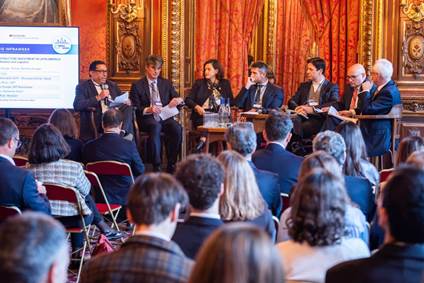
Development leaders convened at the tenth edition of Paris InfraWeek, co-hosted by Santander and Dentons, to discuss the potential of Latin America’s infrastructure sector. Credit: Hervé Thouroude.
During the session titled “Infrastructure Investment Opportunities in Latin America,” industry experts expressed a positive outlook regarding the region’s infrastructure landscape. Participants noted that the existing infrastructure gap presents a significant opportunity for private capital investments, with perceived risks being less severe than commonly believed.
The gathering attracted a range of stakeholders, including development financiers, investors, and established companies operating in Latin America, such as Veolia, Groupe ADP, Meridiam, the World Bank Group, Proparco, and STOA.
In the opening panel, speakers outlined emerging areas of demand, focusing on long-term projects related to energy, digitalization, logistics, water supply, and fiber-optic networks. They emphasized that while demand is clear, attracting financing remains a critical challenge.
According to the Inter-American Development Bank (IADB), there is a pressing need for nearly $1.6 trillion in infrastructure investment in Latin America and the Caribbean from 2025 to 2030, amounting to around 3.5% of the regional GDP each year. Transportation is projected to account for 40% of this requirement, followed by water and sanitation, electricity, and telecommunications.
In contrast, current investment levels are roughly 1.7% of GDP, constrained by decreased public spending. The IADB indicates that the region is investing only about half of what is necessary. Given this situation, private capital emerges as a vital resource to bridge the funding gap.
The panelists acknowledged that strengthening investment relations between Europe and Latin America could prove beneficial. The EU-Mercosur trade agreement, finalized in January after protracted negotiations, has been provisionally implemented since May 1, although final approval from the EU’s Court of Justice is still pending.
A subsequent discussion delved into the reasons for the slow flow of capital into the region. Tom Ceusters, Director of Treasury Asset Management at the World Bank Group, highlighted a significant discrepancy between perception and reality regarding investment risks.
Laurence Boone (Santander CIB), Tom Ceusters (World Bank Group), and David Syed (Dentons) participated in the discussions. Credit: Hervé Thouroude.
Ceusters referenced the GEMs database, which compiles lending data from 29 development banks over three decades, revealing that actual default rates are around one-third of what credit ratings suggest. This insight has liberated approximately $600 billion in lending capacity across development banks.
“The initial perception was fundamentally erroneous,” Ceusters remarked.
David Syed, Partner and Head of Sovereign Advisory Europe at Dentons, who facilitated the discussion, pointed out that current market pricing reflects a cautious approach but leaves room for optimism. “There’s substantial potential for growth, as we have accounted for the worst-case scenario,” he stated.
When addressing the competition between the U.S. and China for resources and capital, Boone emphasized that security concerns and a trend towards domestic production have increased the demand for infrastructure investment, presenting new opportunities for investors.
Using rising defense expenditures in Europe as an example, she stated, “Investing in defense, which could represent 5% of GDP for NATO, equates to a similar demand in infrastructure.”
The closing panel addressed the question of mobilizing capital, focusing on risk-sharing and the role of development lenders. Boone asserted that collaboration is essential, stating, “We must unite our efforts to unlock greater capital availability.”










Discussion about this post