









Tragic Loss Amidst Rising Humanitarian Crisis in Gaza
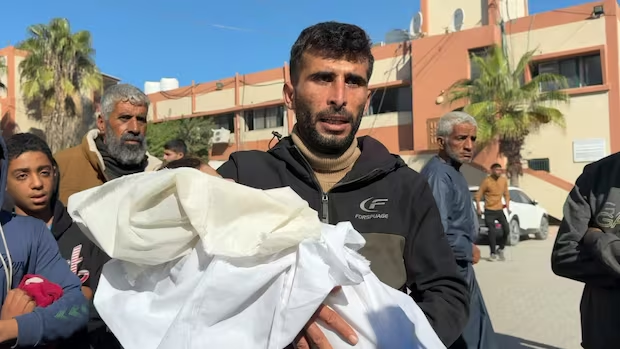
In a heartbreaking scene, Ahmed Arqiq traversed through a sea of mourners, holding the lifeless body of his nine-month-old son, Kinan, swathed in a white blanket. As he made his way, onlookers offered their condolences while he quietly uttered prayers for his child.
Arqiq, 37, recounted the harrowing moments of the previous night when he rushed Kinan to the Kuwait Specialty Hospital in Khan Younis at 4 a.m., only to discover that it was too late.
“He was wrapped up, but his head, clothes, and pants were all soaked in water,” Arqiq shared with CBC News freelance videographer Mohamed El Saife, holding up his son’s death certificate as he reflected on the tragic events.
Severe Weather Contributes to Humanitarian Crisis
This disaster follows a period of heavy rainfall that recently battered parts of Gaza, leading to widespread flooding and damaging shelters. One storm resulted in the collapse of a sand embankment, claiming the lives of five individuals.
Many families, including the Arqiqs, have been living in makeshift tent cities for years after being displaced from their homes due to the ongoing conflict that erupted in 2023.
As heavy rains inundated the Gaza Strip in the week preceding the infant’s death, numerous areas became submerged, leaving residents stranded in meters of water. For the Arqiq family, this meant Kinan’s clothes and blankets remained wet, unable to provide him with proper warmth.
Kinan, the youngest of three children, ultimately succumbed to hypothermia—the first reported death from this condition this season in Gaza. “My son died from the cold,” Arqiq lamented. “His mother wanted to nurse him and found him dead.”
Medical Insights on the Tragedy
Dr. Jamal Al-Hams, the medical director at the Kuwaiti Hospital, stated that Kinan was pronounced dead upon arrival. He emphasized that the infant had no pre-existing medical conditions, attributing the cause of death to the severe cold exposure experienced in their tent.
“He was living in very bad conditions,” Dr. Al-Hams noted, highlighting the grim reality faced by many in the region. Winter temperatures in Gaza can drop to as low as seven degrees Celsius during the night, exacerbating the plight of vulnerable families.
In a press release on Tuesday, Shaun Hughes, the UN World Food Programme country director for Palestine, warned of a “deepening” crisis regarding shelter, sanitation, and food security in Gaza.
Urgent Need for Humanitarian Aid
Despite a year-long fragile ceasefire between Israel and Hamas, the flow of humanitarian aid in Gaza remains inadequate compared to the overwhelming demand. Hughes stated, “When you’re in Gaza, it does not feel like a ceasefire.”
The Israeli military continues to control approximately 70 percent of the Gaza Strip, complicating food production for Palestinians. “Fishing in the sea is prohibited and also life-threatening due to the risk of gunfire,” Hughes explained, noting that unemployment rates exceed 80 percent, leaving many without alternatives for survival.
Recently, over 93,000 tents and 8,600 trucks filled with winter supplies have entered Gaza as part of an Israeli military initiative to provide winterization support. However, many organizations assert that this assistance is still insufficient.
“Without proper shelter and critical relief items, hypothermia deaths will occur,” warned Karl Baker, head of the UN International Organization for Migration’s Gaza program, emphasizing the vulnerability of children in these conditions.
Back at the Kuwaiti Hospital, Ahmed Arqiq laid his son’s body in the hospital’s courtyard, where a funeral prayer was held. Family, friends, and community members gathered to pay their respects before Kinan was laid to rest.
“He was like a flower,” Arqiq said, tears streaming down his face as he mourned the loss of his beloved child.







Discussion about this post