









Exploring the Volcanic Wonders of Southern Italy
Southern Italy, from the historic ruins of Pompeii to the stunning eruptions of Stromboli, stands out as a captivating region to explore the immense power of volcanoes. A recent nine-day expedition by GeoWorld Travel took geology enthusiasts on an unforgettable journey through Europe’s most iconic volcanic landscapes, showcasing how volcanic activity has influenced both the topography and human history of the area.
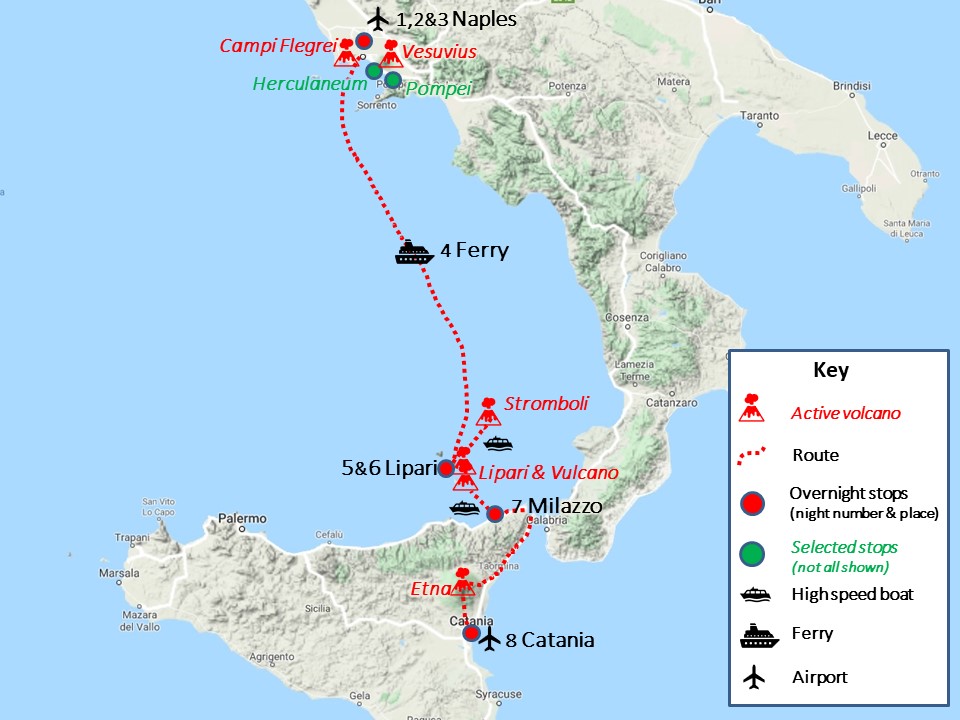
Under the guidance of geologist James Cresswell, the journey commenced in Naples, traversing through the enchanting Aeolian Islands and culminating on the majestic slopes of Mount Etna in Sicily.
Throughout the adventure, participants delved into ancient Roman cities, scaled volcanic craters, analyzed striking geological formations, and experienced the breathtaking phenomenon of an erupting volcano.
Day One: Arrival in Naples
The expedition began in Naples, a vibrant city located near Mount Vesuvius, one of the most renowned volcanoes globally. This city served as an intriguing introduction to the geological history of southern Italy, revealing a landscape shaped by millennia of volcanic activity. As the group assembled in Naples, excitement built for the geological wonders awaiting them.
Day Two: Mount Vesuvius and Herculaneum
The first full day featured an expedition to Mount Vesuvius, perhaps Europe’s most famous volcano. Its catastrophic eruption in AD 79 obliterated the Roman towns of Pompeii and Herculaneum, providing one of the most dramatic instances of volcanic destruction in history. Today, Vesuvius is under constant surveillance, with hundreds of thousands of residents living in its vicinity. The group hiked into Vesuvius National Park, ascending toward the summit, where they were greeted by the vast crater, active fumaroles, and stunning views of Naples.
Later, the group explored the remarkably preserved remains of Herculaneum, learning how the town was buried beneath thick layers of pyroclastic flows—swift currents of superheated gas, ash, and debris. This unique burial preserved a myriad of artifacts, including wooden structures and organic materials, offering an extraordinary glimpse into the past. Walking through the excavated streets was a profoundly moving experience.
Day Three: Campi Flegrei and the Volcanic Landscapes of Naples
West of Naples lies Campi Flegrei, an expansive volcanic caldera that presents a stark contrast to the towering cone of Vesuvius. Much of this volcanic system is submerged, with the land featuring numerous craters, cones, and geothermal features. The group explored Monte Nuovo, a scoria cone formed by a 1538 eruption, and admired views over Lago Averno, a crater lake steeped in ancient lore as a gateway to the underworld.
One notable geological site was the ancient Roman market in Pozzuoli, known as the Temple of Serapis. The columns of this structure bear holes drilled by marine mollusks, indicating that the land once sank below sea level before rising again. This remarkable evidence of geological change was famously documented in Charles Lyell’s *Principles of Geology*.
Day Four: Pompeii and Journey to the Aeolian Islands
Pompeii offered another extraordinary perspective on the eruption of Vesuvius in AD 79. Unlike Herculaneum, which was entombed by deep pyroclastic deposits, Pompeii was initially covered by falling ash before being engulfed by subsequent volcanic flows. This led to varied preservation conditions, making the two sites fascinating to compare. Walking through the streets, homes, and public buildings of Pompeii provided insight into the lives of its inhabitants nearly two millennia ago.
The group also visited Villa Regina, another ancient villa buried in the eruption, where excavations revealed layers of volcanic material, including accretionary lapilli—small, rounded pellets formed during explosive eruptions. Following this, they moved on to Oplontis, a luxurious Roman settlement adjacent to Pompeii.
With their explorations of the Naples region complete, the group boarded an overnight ferry to Lipari, marking the beginning of their journey through the volcanic Aeolian Islands.
Day Five: Lipari, Pumice, and Obsidian
As dawn broke over the Aeolian Islands, the group arrived at Lipari, the archipelago’s largest island. Here, they investigated volcanic deposits linked to Monte Pilato, discovering pumice and obsidian—two distinct volcanic materials. Pumice, formed from rapidly cooling gas-rich magma, is incredibly lightweight, while obsidian, a natural volcanic glass, results from the quick cooling of lava.
Exploring the coastal scenery revealed layers of ash and lava exposed in cliffs, while views from Lipari provided stunning panoramas of the surrounding volcanic landscape.
Day Six: Stromboli, the Lighthouse of the Mediterranean
Stromboli was a highlight, earning its nickname as the *Lighthouse of the Mediterranean* due to its consistent eruptions over millennia. Famous for its Strombolian eruptions, characterized by explosive gas bursts propelling lava fragments into the air, the volcano provided a mesmerizing spectacle. After a morning in Lipari, the group traveled by boat to Stromboli, where they explored before observing the volcano’s activity. As night fell, the eruptions created a breathtaking display, marking an unforgettable experience in the journey.
Day Seven: Vulcano, the Original Volcano
The island of Vulcano holds historical significance as the namesake for all volcanoes. Arriving by hydrofoil, the group explored its volcanic landscape and hiked to the summit crater, where fumaroles emitted hot gases, leaving sulfur deposits around the vents. The summit offered panoramic views of the Aeolian archipelago before the group continued to Milazzo on Sicily for their next adventure.
Day Eight: Mount Etna, Sicily
The expedition concluded at Mount Etna, one of the world’s most active volcanoes and a prominent feature of Sicily’s landscape. The group utilized specialized transport to navigate the higher volcanic terrains with a local guide. Mount Etna provided a fitting finale to the journey, allowing participants to compare various styles of volcanic activity observed throughout the trip.
Day Nine: Departure from Catania
After nine days of exploration through Italy’s geological wonders, it was time to depart from Catania. This journey had taken the group from the ancient remnants of Vesuvius to the dynamic volcanic landscapes of the Aeolian Islands and the towering Mount Etna.
A heartfelt thank you is extended to all participants who made this journey memorable. The photographs captured throughout the trip serve as a vivid reminder of the extraordinary geology found in southern Italy.
Discover Italy’s Classic Volcanoes with GeoWorld Travel
Interested in experiencing these remarkable volcanic landscapes firsthand? GeoWorld Travel offers specialized small-group geology tours that combine expert geological insights with captivating history and breathtaking destinations, providing a deeper understanding of the landscapes we explore.
Learn more about our Italian volcanoes tour and other geological adventures at www.GeoWorldTravel.com.






Discussion about this post