









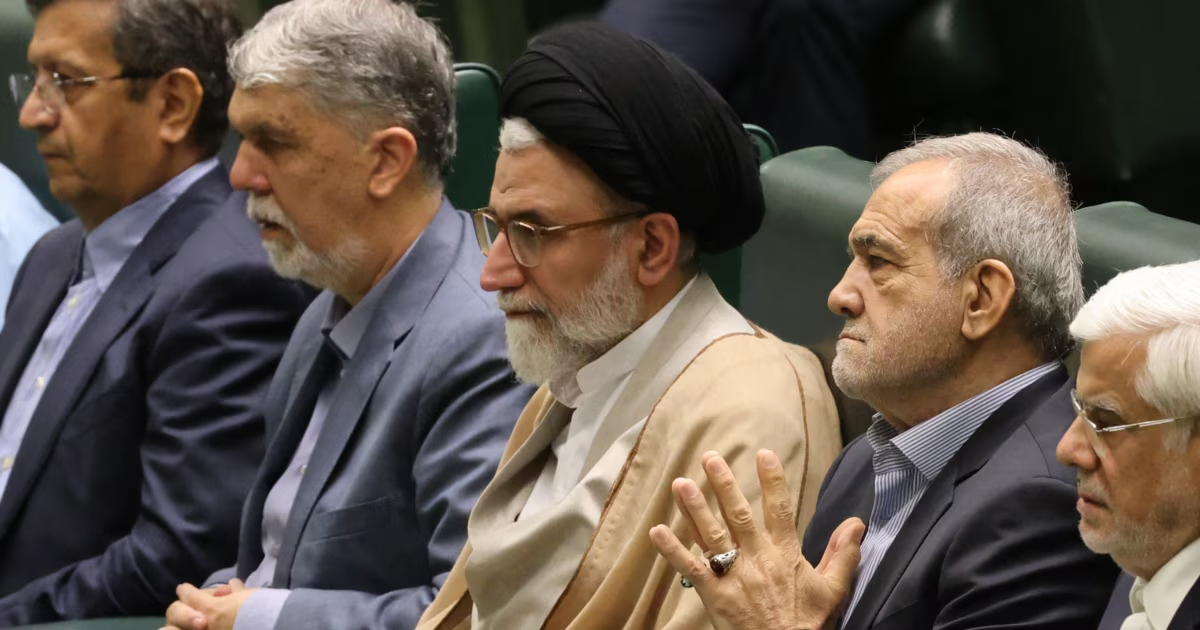
Iran’s Parliament Proposes Significant Change to Intelligence Minister Qualifications
The Iranian parliament is poised to eliminate a longstanding requirement stipulating that the country’s intelligence minister must be a qualified Islamic jurist. If enacted, this amendment would enable the appointment of a non-cleric to lead the Intelligence Ministry for the first time since its establishment in 1984.
On November 15, lawmakers cast their votes with a tally of 192 in favor and 49 against the proposed bill, alongside four abstentions. This legislative move comes in the wake of a series of security lapses, notably the assassination of Intelligence Minister Esmail Khatib in a March Israeli airstrike. Since then, the ministry has been without a permanent leader, and the identity of the current caretaker remains undisclosed.
Proponents of the bill argue that it would expand the pool of potential candidates for the ministerial position. However, the legislation also grants Supreme Leader Mojtaba Khamenei direct authority to appoint heads of two newly established bodies within the ministry, which nominally reports to the president. Khamenei, who ascended to the role following the death of his father in a U.S.-Israeli strike in February, has not made public appearances for several months, prompting speculation regarding his health.
“It has become evident that having a cleric at the helm of the Intelligence Ministry has resulted in significant setbacks for both the ministry and the security of the Islamic Republic,” remarked Hossein Razzagh, a political activist and former political prisoner, in an interview with RFE/RL’s Radio Farda.
Details of the Proposed Bill
The current requirement traces back to a 1983 law mandating that the intelligence minister be just and pious, possess a background in politics and management, and not be affiliated with any political party. Because this requirement is part of ordinary legislation rather than the constitution, parliament holds the authority to amend it independently.
Amir Hayat-Moqaddam, the deputy chairman of the National Security and Foreign Policy Committee, has stated that the existing rule has excessively restricted the selection of qualified candidates.
Abbas Goudarzi, spokesman for the parliament’s presiding board, noted that to offset the removal of the religious qualification, the bill includes the establishment of an Intelligence Protection Organization and an Ideological-Political Organization within the ministry, with their leaders appointed by the Supreme Leader.
While the intelligence minister would still be nominated by the president and require parliamentary approval, the nominee would also need prior consent from the Supreme Leader. The bill is yet to undergo a substantive vote and must secure endorsement from the Guardians Council, which reviews candidates for elections and possesses veto power over legislation.
Opposition exists within the establishment, with some lawmakers cautioning that removing the clerical requirement could grant the government undue influence over the leadership of a critical ministry.
An opinion piece from the hard-line Mashregh news site contended that a minister lacking expertise in Islamic jurisprudence would be unable to determine the religious permissibility of surveillance and interrogation methods. The article argued that abolishing this requirement would eliminate a religious safeguard rather than enhance expertise.
Historically, every permanent intelligence minister since the ministry’s inception has been a cleric. Razzagh emphasized that officials established the ministry under the guidance of a mujtahid—an Islamic jurist—in the 1980s to ensure that those involved in security operations had ready access to religious rulings on matters ranging from wiretapping to torture and even lethal actions.
Context of Security Breaches
This legislative push follows a series of alarming security incidents attributed to Israeli infiltration efforts.
Notable events include the 2018 theft of classified documents related to Iran’s nuclear program, the 2020 assassination of nuclear scientist Mohsen Fakhrizadeh, and the 2024 killing of Hamas leader Ismail Haniyeh in Tehran.
Israeli strikes in June 2025 resulted in the deaths of several high-ranking military and security officials, including Mohammad Kazemi, the intelligence chief of the Islamic Revolutionary Guards Corps (IRGC), and Amir Ali Hajizadeh, the commander of the IRGC Aerospace Force. The ongoing conflict initiated on February 28 also led to the deaths of the then Supreme Leader and Defense Minister Aziz Nasirzadeh, followed by Khatib’s assassination a few weeks later.
Razzagh highlighted that the Islamic Republic is seeking to reform the ministry’s structure to ensure its continued existence, criticizing Khatib and his predecessors for focusing on domestic repression while neglecting external threats.
He attributed the issues to overlapping agencies within the security apparatus, noting that various entities, including the IRGC Intelligence Organization, police, Basij paramilitary force, and judiciary, maintain their own intelligence divisions. In 2018, the ministry claimed that a group of detained environmentalists were not spies, yet the IRGC intelligence unit continued to detain them.
Razzagh suggested that the bill might represent an initial step toward sidelining competing agencies or consolidating them under the ministry to create a “centralized security power” that could intensify domestic repression.
Concerns About Effectiveness
Despite the proposed changes, Razzagh expressed skepticism regarding the ability of the intelligence service to effectively counter foreign infiltration. He traced the root of the problem back to a principle established by Ayatollah Mohammad Beheshti after the 1979 Islamic Revolution, which prioritized loyalty over expertise.
While acknowledging that there are competent individuals among the ministry’s interrogators and officials, Razzagh noted that those who rise to higher positions often lack essential intelligence skills. “It is evident that they are devout individuals, or at least project a pious image,” he stated, allowing them to ascend to senior roles.
The bill may signal a potential shift in direction, but whether it will achieve the desired outcomes for officials remains uncertain. “If the Islamic Republic could enact such measures effectively, it would have done so a long time ago,” Razzagh concluded.







Discussion about this post