
• Home
  • Insight
  • Blog
  • Business
  • Entertainment
  • Health
  • Politics
  • Shop
    • Gift Shop
    • Value Shop
    • Store
    • Bargain Shop
    • Discount
  • Sports
  • Tech
  • Travel
  • USA
  • Video
  • World
    • Asia
    • Africa
    • South America
    • North America
    • Europe
    • Oceania
Wednesday, October 7, 2026
No Result
View All Result
Subscribe Now
  • Home
  • Insight
  • Blog
  • Business
  • Entertainment
  • Health
  • Politics
  • Shop
    • Gift Shop
    • Value Shop
    • Store
    • Bargain Shop
    • Discount
  • Sports
  • Tech
  • Travel
  • USA

    Washington state man charged with helping Canadian mass shooter plan for attack

    Border Security, Public Safety, and American Sovereignty with Markwayne Mullin

    Students injured as NJ high school bleachers collapse in scary scene

    California man in incest case busted in Mexico; teen daughter rescued

    Cornell president calls gang rape allegations ‘deeply disturbing’ : NPR

    France’s violent student protests raise warning for America: ‘A cautionary tale’

    Birmingham’s WBHM Public Radio Station Forced to Use “Gulf of America”

    Eminem gets online backlash from fans over Kid Rock Christian album collab

    Trump leans into Iran war, admits it could cost Republicans the midterms

  • Video
  • World
    • Asia
    • Africa
    • South America
    • North America
    • Europe
    • Oceania
The Insight Post
  • Home
  • Insight
  • Blog
  • Business
  • Entertainment
  • Health
  • Politics
  • Shop
    • Gift Shop
    • Value Shop
    • Store
    • Bargain Shop
    • Discount
  • Sports
  • Tech
  • Travel
  • USA

    Washington state man charged with helping Canadian mass shooter plan for attack

    Border Security, Public Safety, and American Sovereignty with Markwayne Mullin

    Students injured as NJ high school bleachers collapse in scary scene

    California man in incest case busted in Mexico; teen daughter rescued

    Cornell president calls gang rape allegations ‘deeply disturbing’ : NPR

    France’s violent student protests raise warning for America: ‘A cautionary tale’

    Birmingham’s WBHM Public Radio Station Forced to Use “Gulf of America”

    Eminem gets online backlash from fans over Kid Rock Christian album collab

    Trump leans into Iran war, admits it could cost Republicans the midterms

  • Video
  • World
    • Asia
    • Africa
    • South America
    • North America
    • Europe
    • Oceania
No Result
View All Result
No Result
View All Result
Home Business Asia

A Higher Education Bubble Stretches China’s Blue-Collar Economy – The Diplomat

by Theinsightpost
July 19, 2023
in Business Asia
0 0
0
A Higher Education Bubble Stretches China’s Blue-Collar Economy – The Diplomat

Advertisement

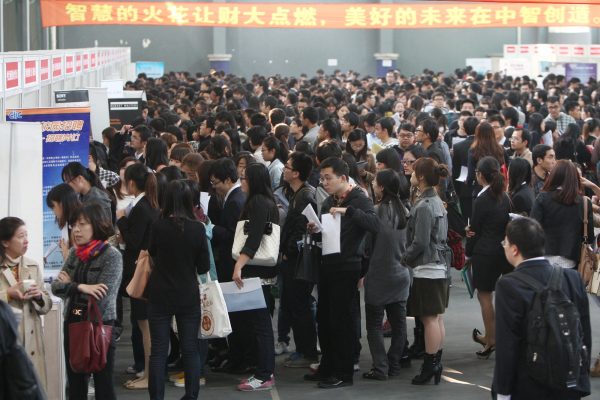
Despite China’s recovery from the depth of the COVID-19 pandemic, the headline jobless rate for young workers between the ages of 16 and 24 remains unnervingly high. In May, youth unemployment edged to 20.8 percent, a new record.

With a record number of 11.58 million students graduating college this summer, the stress is set to worsen.

This gap between a broad, albeit slowing, economic rebound and persistent pressure on youth employment reflects a structurally imbalanced labor market. It is the outcome of a relentless push to expand college education in China that far outpaced economic reform. Without parallel growth in service industries that attract college graduates, the surplus of tertiary degree holders will continue to dampen productivity.

The irony is that the most educated generation in China’s modern history now looks set to become an increasing burden for the country, misplaced in an economy struggling to absorb them. This should not be a surprise, however, because the main rationale driving the college expansion was never really about the utility of education itself.

Diplomat Brief

Weekly Newsletter

Get briefed on the story of the week, and developing stories to watch across the Asia-Pacific.

Get the Newsletter

Rather than a calculated move to transform the workforce, Beijing’s decision in 1999 to substantially expand higher education was chiefly a response to weakened export markets.

Enjoying this article? Click here to subscribe for full access. Just $5 a month.

The leadership used new campus constructions to spur domestic demand in the face of the Asian Financial Crisis. Universities’ need for land and facilities made them the preferred stimulus conduit in the years preceding China’s infrastructure-building frenzy.

Higher education was also a way to divert high school graduates from an already squeezed job market, given that Beijing was simultaneously undertaking large-scale layoffs from state-owned enterprises to prepare for entry into the World Trade Organization.

While signs had already emerged in the early 2000s that recent college graduates would struggle to find suitable jobs, efforts to scale up higher education went into overdrive.

Advertisement

Throughout the decade, the “marketization of education” policy reduced the government’s budgetary outlays for universities, prompting schools to seek profits and raise tuitions.

By the late 2000s, financing the expansion had saddled many universities with heavy debts. But college enrollment was now effectively a measure of political success for local officials. For underprivileged rural populations, education was their ticket to social mobility.

The political logic behind the expansion overwhelmed other considerations. As a result, the acceptance rate among post-secondary institutions in China soared from 33 percent in 1998 to over 92 percent in 2021. Enrollment rates for tertiary education went from just 26.5 percent in 2010 to just under 60 percent in 2022. By comparison, the college enrollment rate for students with high school diplomas in the United States remained at around 40 percent throughout the 2010s.

The higher education boom sharpened the competition for a finite pool of urban white-collar jobs in management and professional services, despite these fields remaining marginal to China’s economic growth.

Regional inequality and enduring Confucian beliefs about manual labor being inappropriate for the educated class also reinforced the preference for office work in large cities, notwithstanding China’s socialist status.

Thus, Beijing’s proven record of salvaging growth by bolstering manufacturing and industrial output has generally not provided sufficient opportunities befitting the expectations of college graduates. The prescription expands factory floors and construction sites – not exactly where the educated young think they belong.

In 2021, excluding the agriculture-based primary sector, the share of national employment in blue-collar jobs was still around 70 percent, according to official numbers.

Enjoying this article? Click here to subscribe for full access. Just $5 a month.

To address this shortage of corporate jobs, the government must support a relatively underdeveloped service sector.

The World Bank reports that in 2021, service businesses accounted for 53 percent of the annual GDP in the country. That is lower than the world average of 64 percent and far below the 78 percent in the United States. China’s perennial trade deficits in services reflect this comparative disadvantage.

Although services have become the largest source of employment in China since 2011, the progress was largely driven by customer-focused divisions such as delivery and ride-hailing. These are informal, labor-intensive gigs that college graduates likewise tend to eschew.

Advertisement

Recent policy shocks have exacerbated the structural mismatch. Before the pandemic, with decent growth prospects and ample demand for knowledge workers, companies in the platform economy, after-school tutoring, and real estate development used to recruit fresh graduates in droves, tempering the youth unemployment stress to an extent. But all three industries have contracted significantly, having been the target of regulatory tightening in the past two years, and the employment path forward has narrowed further.

Meanwhile, the state’s grip on key parts of the economy is a hurdle to harnessing the educated workforce.

More than 1 million students, for example, obtained a bachelor’s degree in finance each year from 2018 to 2020, according to China’s Ministry of Education. But China’s state bank-dominated financial system lacks the diversity of its Western counterparts, where non-bank institutions play a vital role in raising capital for companies large and small.

With onerous restrictions on foreign and private firms, the financial field is too guarded to create enough opportunities for the legions of young aspirants. Moreover, the deleveraging campaign amid economic headwinds has forced Chinese banks to face default risks, weak credit demand, and profit losses, all of which hampered their ability to hire.

The fierce competition for white-collar positions is also out of step with national economic imperatives, given the growing rivalry with the United States. For the Chinese leadership, technological self-reliance calls for fast industrial modernization. Washington’s embrace of muscular industrial policies has further cemented Beijing’s own determination to foster advanced manufacturing as a strategic mainstay.

To that end, Beijing is ramping up investment in vocational schools to cultivate skilled laborers to make hardware, manage sophisticated machineries, and oversee increasingly automated assembly lines.

But this threatens to become a “race to the bottom” driven by state intervention, which risks sapping the service sector’s vitality even more. If that turns out to be the case, the economy will continue to have inadequate demand for those trained in humanities and financial markets, despite their supposedly valuable college degrees.

ShareTweetSend
Previous Post

For effective implementation of education reforms: Commit more funds at local level – Dr Boakye-Yiadom

Next Post

Bank of America says buy this A.I. leader in workflow automation

Related News

Business Asia

A Tajik Bank Shuts Side Door for Russian Cardholders – The Diplomat

October 4, 2026
Business Asia

Trouble in Shangri-La? Why Bruneians Are Going to Australia for Illegal Migrant Work – The Diplomat

October 3, 2026
Business Asia

Time for ASEAN to Revive its Customs Union Vision – The Diplomat

October 2, 2026
Business Asia

Australia as an AI Middle Power – The Diplomat

October 1, 2026
Next Post
Bank of America says buy this A.I. leader in workflow automation

Bank of America says buy this A.I. leader in workflow automation

Discussion about this post

Subscribe To Our Newsletters

    Customer Support


    1251 Wilcrest Drive
    Houston, Texas
    77042 USA
    Call-832.795.1420
    e-mail – news@theinsightpost.com

    Subscribe To Our Newsletters

      Categories

      • Africa
      • Africa-East
      • African Sports
      • American Sports
      • Arts
      • Asia
      • Australia
      • Business
      • Business Asia
      • Business- Africa
      • Canada
      • Defense
      • Education
      • Egypt
      • Energy
      • Entertainment
      • Europe
      • European Soccer
      • Finance
      • Germany
      • Ghana
      • Health
      • Insight
      • International
      • Investing
      • Japan
      • Latest Headlines
      • Life & Living
      • Markets
      • Mobile
      • Movies
      • New Zealand
      • Nigeria
      • Politics
      • Scholarships
      • Science
      • South Africa
      • South America
      • Sports
      • Tech
      • Travel
      • UK
      • USA
      • Weather
      • World
      No Result
      View All Result

      Recent News

      Boxing legend Mike Tyson talks going to juvie and trading cigarettes for cookies as a young boy

      October 7, 2026

      Hogbetsotso 2026 to promote tourism, local businesses

      October 7, 2026

      Mikel Arteta’s new contract: The challenges facing Arsenal boss as he enters ‘step five’ of his project | Football News

      October 7, 2026

      Spotify expands audiobooks to over 180 markets

      October 7, 2026
      • Home
      • Advertise With Us
      • About Us
      • Corporate
      • Consumer Rewards
      • Forum
      • Privacy Policy
      • Social Trends

      Theinsightpost ©2026 | All Rights Reserved. Theinsightpost is an Elnegy LLC company, registered in Texas, USA

      Welcome Back!

      Login to your account below

      Forgotten Password?

      Retrieve your password

      Please enter your username or email address to reset your password.

      Log In

      Add New Playlist

      We are using cookies to give you the best experience on our website.

      You can find out more about which cookies we are using or switch them off in .

      No Result
      View All Result
      • Home
      • Insight
      • Blog
      • Business
      • Entertainment
      • Health
      • Politics
      • Shop
        • Gift Shop
        • Value Shop
        • Store
        • Bargain Shop
        • Discount
      • Sports
      • Tech
      • Travel
      • USA
      • Video
      • World
        • Asia
        • Africa
        • South America
        • North America
        • Europe
        • Oceania

      Theinsightpost ©2026 | All Rights Reserved. Theinsightpost is an Elnegy LLC company, registered in Texas, USA

      The Insight Post
      Powered by  GDPR Cookie Compliance
      Privacy Overview

      This website uses cookies so that we can provide you with the best user experience possible. Cookie information is stored in your browser and performs functions such as recognising you when you return to our website and helping our team to understand which sections of the website you find most interesting and useful.

      Strictly Necessary Cookies

      Strictly Necessary Cookie should be enabled at all times so that we can save your preferences for cookie settings.

      Cookie Policy

      More information about our Cookie Policy

      Clear examples do more than decorate an explanation: they show how an idea behaves under recognizable conditions. In education and software documentation alike, strong illustrations begin with a defined goal, then reveal the steps, assumptions, and result without unnecessary detail. A practical test example should state the input, expected output, and boundary condition, because these elements show whether a rule works beyond the simplest case. Including a contrasting case also helps readers distinguish a valid application from a tempting but incorrect one, while concise notes explain why the outcomes differ. When examples are updated with current data and checked against the underlying rule, they remain useful across classrooms, product guides, and professional training.