









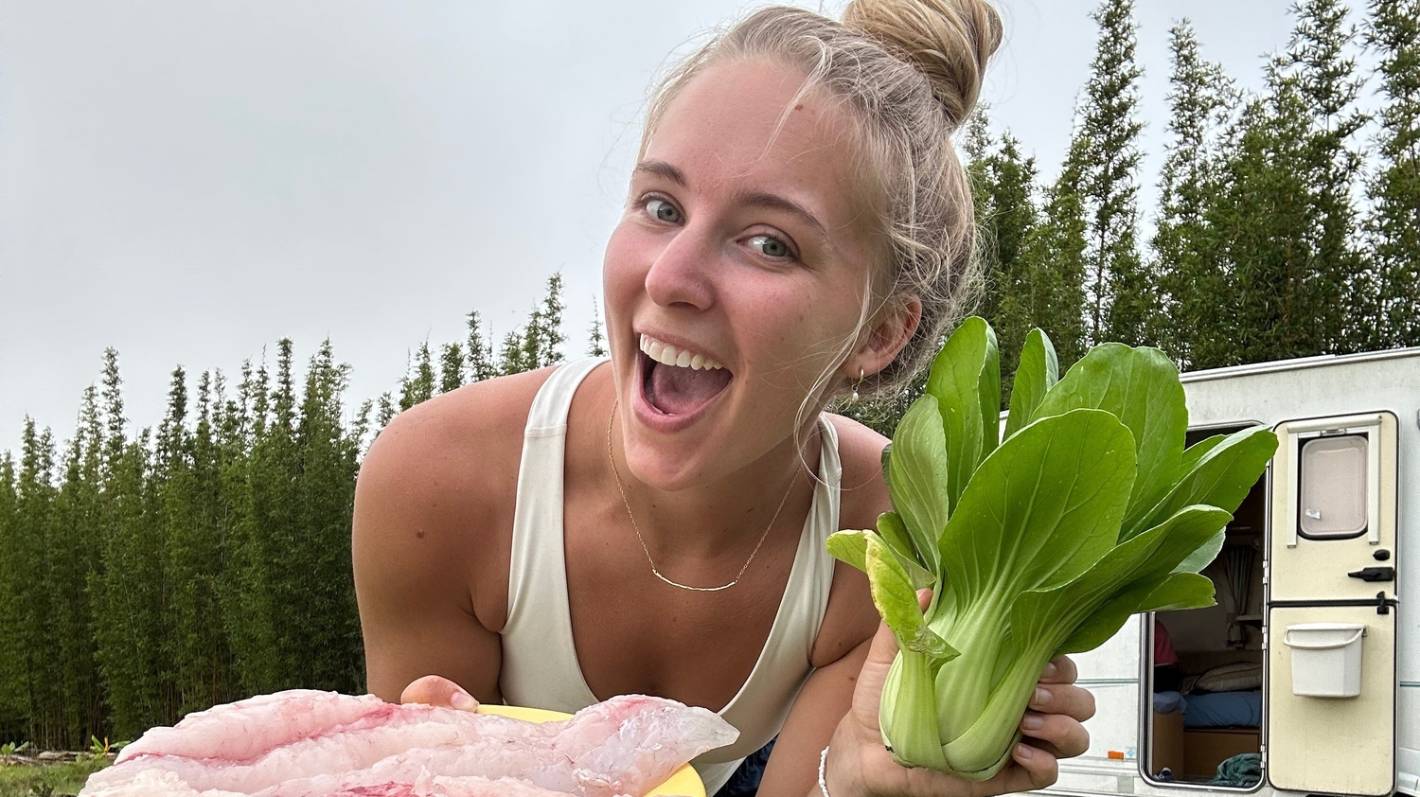
Ashley Diedenhofen is a long way from “home” – on a piece of land in Houhora right up in the very tip of the North Island.
The American, who hails from San Diego, is roughing it, but those aren’t her words. She’s in her element living with Kiwi boyfriend Viktor in a caravan in a field, with no running water or electricity, yet. There is a generator they could fire up, but they have only used it once since Diedenhofen arrived at the beginning of December.
If they feel dirty, they head off for a swim, and neighbours have offered their shower, but they don’t need it very often. “I’m lucky, my hair stays pretty clean,” she says.
The TikToker is also managing to keep up with her social media posts, which are mainly focused on sustainability, minimising food waste and encouraging people to be more connected to their immediate environment – she keeps her phone charged through the car. She has more than 178,000 followers on TikTok, 65,500 on Instagram and 30,000 on Youtube.
READ MORE:
* Four generations have enjoyed this original Mahia ’50s bach, but it’s time to go
* Single mum’s ‘massive’ heritage renovation of her former student digs is listed
* Designer’s own Mid-century cottage at Rotorua restored after ‘terrible mistake’ 70s remodel
Caravan living does bring its challenges, however. “Last night we were swamped with mosquitoes inside, and spent about an hour trying to get rid of them all,” Diedenhofen says. “And there’s not much room for extra things. I feel like I’m wearing the same dress, shorts and jacket every day. But you don’t need a million pieces of clothing – I just have the staples, and one nicer dress.”
Supplied
Ashley Diedenhofen, who hails from San Diego, is living a sustainable lifestyle in a caravan in Northland with her Kiwi boyfriend – her “little house on the prairie era”.
Supplied
Home is an old caravan that is not connected to electricity.
Storing rainwater is a priority, and rain is never considered a bad thing, because it gives them a chance to refill their new tank. They have a chilly bin, and they catch fish, which needs to be eaten within 24 hours. And they trade services with neighbours in exchange for vegetables. Their own vegetable garden is only just starting out. Otherwise, all food needs to be non-perishable.
“Not having a fridge has definitely been a learning curve,” Diedenhofer says. “I am learning what will last better. Sometimes, the neighbours will offer their freezer. We are not relying on the neighbours, but this a very strong community with people helping each other out. When we needed a little plumbing work, one of the neighbours who is a plumber helped us, and in return Viktor helped him out with one of his projects.”
Diedenhofen, a science and sustainability educator, is something of a whizz when it comes to not wasting food. She regularly posts TikTok and Insta videos offering hints and tips. And Viktor’s grandmother features in one of her posts, showing us how to make bananas last longer: “She turned out to be a natural.”
Supplied
Ashley and Viktor are busy planting a lot of native species on the land.
For the record, “Nona’s” tip was to separate the bananas and store flat in the coolest spot in the house. They should last a week in summer with no bother.
Other videos include tips on what to do with leftover vegetables before you go on holiday, three things to do with spinach before it gets nasty, and how to use every bit of a pumpkin.
With no television, evenings are often spent reading. “We hotspotted [a device] with our phones during the World Cup.”
And lighting? “The sun in summer sets pretty late, but we can use our phone lights, and we have one head torch.”
Diedenhofen says Viktor and his brothers bought the land together, and are busy carrying out landscaping and planting lots of native trees. They are also working on building accommodation units, so other people can come and enjoy their slice of paradise – they are optimistic they will be ready this time next year.
As an educator, Diedenhofen has short-term work commitments in the US, so will head back at the end of February. She will later return to Houhora, and will likely spend more time “flip-flopping between the two”. She is also hoping to spend time at sea this year on a research vessel.
Supplied
Caravan life is not especially glamorous.
“I love going to different places and having different experiences, and sharing these.” And she says it’s always about trying to make the best of the situation, and using what’s on hand, like sea grass to fertilise the new plants at Houhora.
Meanwhile, she loves her new life in New Zealand. “It’s so very green here, especially compared to California, and it’s not just because we have had a drought in California. The plants are a richer green up here. There seems to be a big push in New Zealand to restore a lot of the native plants. I would like to take that mindset back to California too.”
Supplied
Viktor is milling logs on the property. He and his brothers plan to build accommodation units for rental.
Supplied
Ashley and Viktor live “close to the land”.










Discussion about this post