
• Home
  • Insight
  • Blog
  • Business
  • Entertainment
  • Health
  • Politics
  • Shop
    • Gift Shop
    • Value Shop
    • Store
    • Bargain Shop
    • Discount
  • Sports
  • Tech
  • Travel
  • USA
  • Video
  • World
    • Asia
    • Africa
    • South America
    • North America
    • Europe
    • Oceania
Saturday, August 29, 2026
No Result
View All Result
Subscribe Now
  • Home
  • Insight
  • Blog
  • Business
  • Entertainment
  • Health
  • Politics
  • Shop
    • Gift Shop
    • Value Shop
    • Store
    • Bargain Shop
    • Discount
  • Sports
  • Tech
  • Travel
  • USA

    Opinion | What It Took to Dismantle the Most Powerful Company in the World

    Trump Brands Anti-Genocide Group “Terrorist”

    Fans in Dollywood react to death of music star, actor and beloved figure Dolly Parton at 80

    Tim Curry’s devilish charm was irresistible

    USS Abraham Lincoln heads to Thailand for brief stop after lengthy deployment at sea

    Immigrant Grocery Store Owners Sue NY Mayor Mamdani over Socialist Grocery Scheme

    Homeless agency has posh digs while ‘clients’ live in squalor

    3 rescued belugas make 2,500-mile journey to SeaWorld San Diego

    Thousands in northwest Indiana still without power nearly two weeks after storm : NPR

  • Video
  • World
    • Asia
    • Africa
    • South America
    • North America
    • Europe
    • Oceania
The Insight Post
  • Home
  • Insight
  • Blog
  • Business
  • Entertainment
  • Health
  • Politics
  • Shop
    • Gift Shop
    • Value Shop
    • Store
    • Bargain Shop
    • Discount
  • Sports
  • Tech
  • Travel
  • USA

    Opinion | What It Took to Dismantle the Most Powerful Company in the World

    Trump Brands Anti-Genocide Group “Terrorist”

    Fans in Dollywood react to death of music star, actor and beloved figure Dolly Parton at 80

    Tim Curry’s devilish charm was irresistible

    USS Abraham Lincoln heads to Thailand for brief stop after lengthy deployment at sea

    Immigrant Grocery Store Owners Sue NY Mayor Mamdani over Socialist Grocery Scheme

    Homeless agency has posh digs while ‘clients’ live in squalor

    3 rescued belugas make 2,500-mile journey to SeaWorld San Diego

    Thousands in northwest Indiana still without power nearly two weeks after storm : NPR

  • Video
  • World
    • Asia
    • Africa
    • South America
    • North America
    • Europe
    • Oceania
No Result
View All Result
No Result
View All Result
Home Science

Astronomers get closer to solving the lingering mystery of fast radio bursts

by Theinsightpost
June 15, 2024
in Science
0 0
0
Astronomers get closer to solving the lingering mystery of fast radio bursts

Fast radio bursts (FRBs) are intense, short-lived blasts of radio waves hailing from beyond the Milky Way that can emit the same amount of energy in just thousandths of a second that the sun takes three days to emit.

However, despite their power and the fact that around 10,000 FRBs could erupt in the sky over Earth every day, these blasts of radiowaves remain mysterious. One of the biggest puzzles surrounding FRBs is why most flash once and then disappear while a tiny minority (less than 3 percent) repeat the flash. This has led scientists on a quest to discover the mechanisms that launch FRBs. Some even believe different celestial objects can produce both repeating and non-repeating FRBs.

Scientists from the University of Toronto used the Canadian Hydrogen Intensity Mapping Experiment (CHIME) to focus on properties of polarized light associated with 128 non-repeating FRBs. This revealed the one-off FRBs seem to originate in faraway galaxies that are much like our own Milky Way, as opposed to the extreme environments that launch their repeating cousins. The results could bring scientists closer to cracking the lingering celestial puzzle of FRBs at last.

Related: Hubble Telescope finds surprising source of brightest fast radio burst ever

“So far, when we’ve thought about FRBs, we’ve only looked at them in the same way that we would look at a star in the sky, thinking about how bright it is, maybe figuring out how away far it is, things like that,” research lead author Ayush Pandhi, a Ph.D. student at the Dunlap Institute for Astronomy & Astrophysics and the David A. Dunlap Department of Astronomy & Astrophysics at the University of Toronto, told Space.com. “However, FRBs are special because they also emit polarized light, meaning the light coming from these sources is all oriented in one direction.”

The key difference about this research is it really drilled down on the investigation of polarized light.

Polarized light is made up of waves that are orientated in the same way — vertically, horizontally, or at an angle between those two directions. Changes in polarization could explain the mechanism that launched the FRB and thus reveal what its source was. Polarization can also reveal details about what environments the FRB needed to traverse before reaching our detectors on Earth. This study represented the first large-scale look at the non-repeating 97% of FRBs in polarized light. 

Sign up to our newsletter for the latest updates on rocket launches, skywatching events and more!

There has been a gap in non-repeating FRB research because it is much easier to observe repeating FRBs as astronomers already know where they are going to occur, meaning it is possible to point any radio telescope at that patch of sky and wait. With non-repeating FRBs, astronomers must have a telescope that can look at a large area of the sky all at once because they don’t really know where the signal will come from.

“They could pop up anywhere in the sky. CHIME is unique in that sense because it looks at such a large patch of the sky all at once,” Pandhi said. “Also, people have not really looked at that polarization yet because it’s much harder to detect just on a technical level.

“Other studies have looked at the polarization of maybe 10 non-repeating FRBs, but this is the first time where we’ve looked at more than 100. It allows us to reconsider what we think FRBs are and see how repeating and non-repeating FRBs may be different.”

To repeat or not to repeat?

In 2007, astronomers Duncan Lorimer and David Narkevic, who was Lorimer’s student at the time, discovered the first FRB. It was a non-repeating burst of energy that’s now commonly referred to as the “Lorimer Burst.” Five years after this, in 2012, astronomers discovered the first repeating FRB: FRB 121102. Then, more repeating bursts gradually revealed themselves.

Astronomers naturally wonder whether there is a different phenomenon behind these two types of FRBs. And Pandhi ‘s team indeed found that non-repeating FRBs seem to be a little different from repeating FRBs, as most of the former seem to come from galaxies like our own Milky Way.

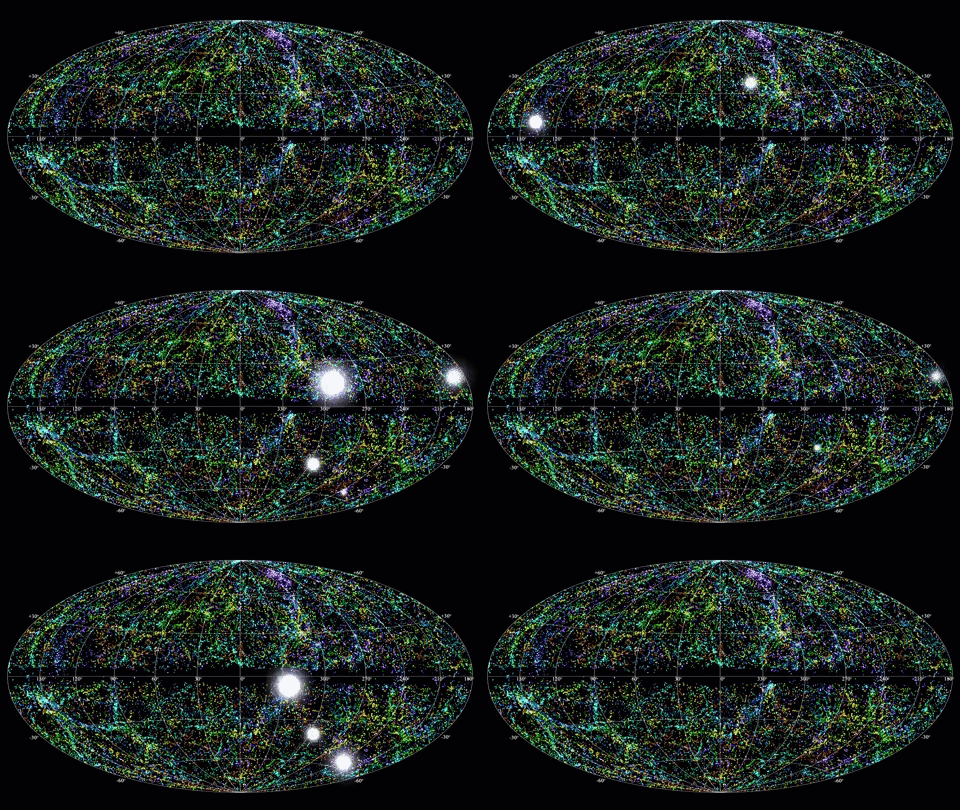
An illustration of the CHIME observatory capturing signals of an FRB. (Image credit: Photo credit: CHIME. Illustration: Dunlap Institute.)

While the origins of FRBs are shrouded in mystery, these bursts of radiowaves can act as messengers of the environments they pass through while racing to Earth. That information is encoded in their polarization.

“If the polarized light passes through electrons and magnetic fields, the angle at which it’s polarized rotates, and we can measure that rotation,” Pandhi said “So if an FRB passes through more material, it’ll rotate more. If it passes through less, it’ll rotate less.”

The fact that the polarization of non-repeating FRBs is less than that of repeating FRBs indicates the former seems to pass through less material or weaker magnetic fields than the latter. Pandhi added that, while repeating blasts of radiation seem to be coming from more extreme environments (like the remains of stars that have died in supernova explosions) their non-repeating brethren seem to emerge in slightly less violent environments.

“Non-repeating FRBs tend to come from environments that have either weaker magnetic fields or less stuff around them than repeating FRBs,” Pandhi continued. “So repeating FRBs seem to be a little bit more extreme in that sense.”
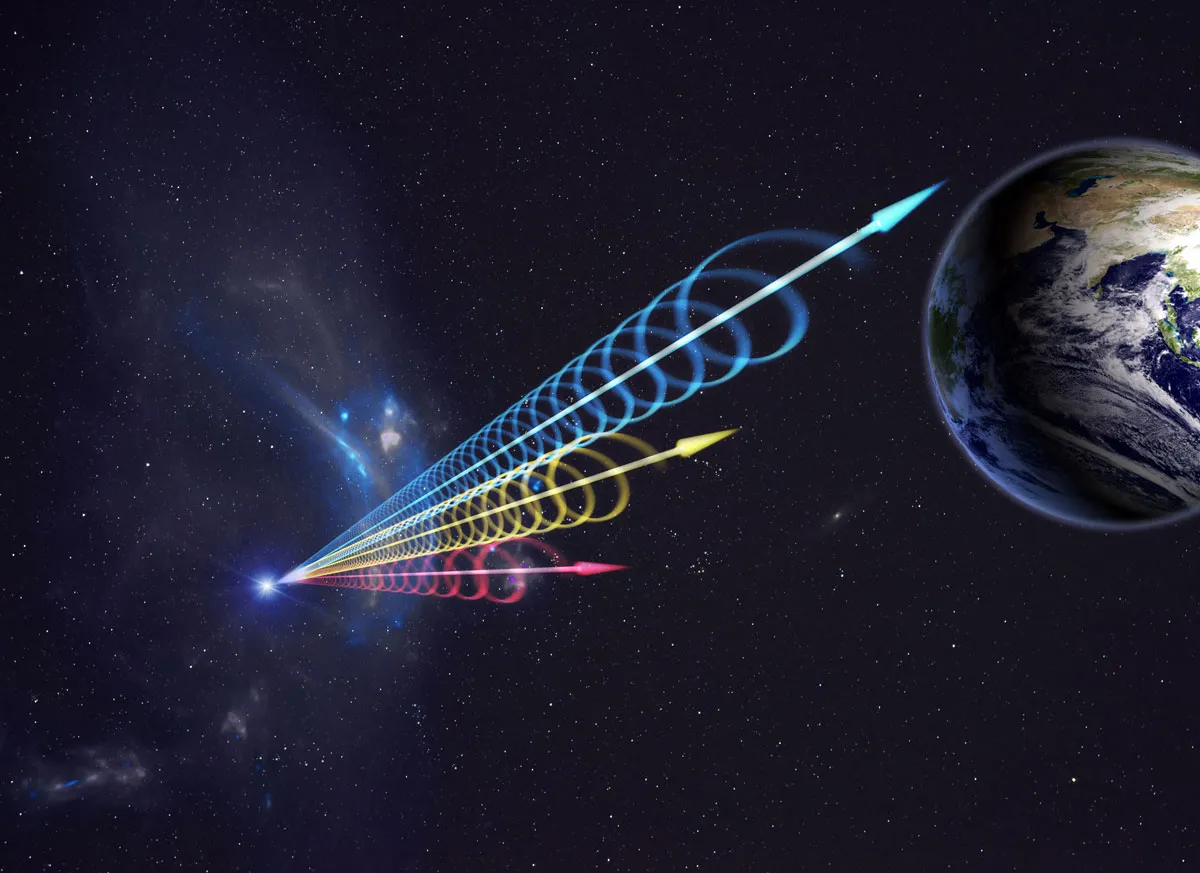
earth on the top right corner with red, yellow and blue wavelengths reaching it from a fast radio burst.

An artist’s impression of a fast radio burst (FRB) reaching Earth, with colors signifying different wavelengths. (Image credit: Jingchuan Yu, Beijing Planetarium)

Are neutron stars off the hook?

One of the big surprises this research delivered for Pandhi was that the polarization of non-repeating FRBs seems to clear one of the major suspects behind their launch: highly magnetized, rapidly spinning neutron stars, or “pulsars.”

“We know how pulsars work and we know the types of polarized light we expect to see from a pulsar system. Surprisingly, we don’t see that much similarity between FRBs and pulsar light,” Pandhi said.”If these things are coming from the same type of object, you might expect that they have some similarities, but it seems that they’re actually pretty different.”

In terms of figuring out what objects launch FRBs, Pandhi thinks expanding our understanding of the polarization of these bursts of radiowaves could help narrow down theoretical predictions.

“If we’re confused between multiple different theories, we can now look at the polarized light and say, ‘Okay, well, does this rule out any theories that we haven’t already ruled out?'” he said. “It provides another parameter, or even a few extra parameters, to help us rule out theories about what they could be until we have one that sticks.”

Pandhi continued by explaining that this study has laid the groundwork for future FRB investigations; he, himself, is working on a way to disentangle polarization of FRBs that occurred in the Milky Way from those that occurred in their other galaxies and closer to the source of their emission.

This should help us better understand the mechanisms behind the launch of FRBs, but for Pandhi, it is the mysterious nature of these cosmic blasts of energy that ensures he will be investigating them for some time to come. 

“I mean, what’s more mysterious than explosions happening thousands of times per day all over the sky, and you have no idea what’s causing them?” Pandhi said. “If you’re a little bit of a detective who likes to solve mysteries, FRBs are just a mystery that is just begging to be solved.”

The team’s research was published on Tuesday (June 11) in the Astrophysical Journal.

ShareTweetSend
Previous Post

9 Reasons Why Primavera Sound is a Bucket List Barcelona Festival

Next Post

Olympics reassigns a 1900 medal — and its winner — from Britain to France : NPR

Related News

Science

See last night’s ‘blood moon’ eclipse from around the world

August 28, 2026
Science

Cackle! Pop! Roar! Reptiles have a lot to say.

August 27, 2026
Science

Listen: What you need to know about the ‘explosive diarrhea’ parasite

August 26, 2026
Science

Extreme Heat and Extreme Cold Drive an Increase in Fatal Overdoses

August 25, 2026
Next Post
Olympics reassigns a 1900 medal — and its winner — from Britain to France : NPR

Olympics reassigns a 1900 medal -- and its winner -- from Britain to France : NPR

Discussion about this post

Subscribe To Our Newsletters

    Customer Support


    1251 Wilcrest Drive
    Houston, Texas
    77042 USA
    Call-832.795.1420
    e-mail – news@theinsightpost.com

    Subscribe To Our Newsletters

      Categories

      • Africa
      • Africa-East
      • African Sports
      • American Sports
      • Arts
      • Asia
      • Australia
      • Business
      • Business Asia
      • Business- Africa
      • Canada
      • Defense
      • Education
      • Egypt
      • Energy
      • Entertainment
      • Europe
      • European Soccer
      • Finance
      • Germany
      • Ghana
      • Health
      • Insight
      • International
      • Investing
      • Japan
      • Latest Headlines
      • Life & Living
      • Markets
      • Mobile
      • Movies
      • New Zealand
      • Nigeria
      • Politics
      • Scholarships
      • Science
      • South Africa
      • South America
      • Sports
      • Tech
      • Travel
      • UK
      • USA
      • Weather
      • World
      No Result
      View All Result

      Recent News

      Death toll rises to 579; Australians from Sydney, Melbourne remain missing; China, Nepal resume rescues

      August 29, 2026

      Seestar S50 Pro Smart Telescope Launches

      August 29, 2026

      Magpies legend and AFL games record holder Scott Pendlebury set to join Gold Coast Suns for 2027

      August 28, 2026

      AI Can Help One of K-12’s Biggest Challenges: Middle School Reading

      August 28, 2026
      • Home
      • Advertise With Us
      • About Us
      • Corporate
      • Consumer Rewards
      • Forum
      • Privacy Policy
      • Social Trends

      Theinsightpost ©2026 | All Rights Reserved. Theinsightpost is an Elnegy LLC company, registered in Texas, USA

      Welcome Back!

      Login to your account below

      Forgotten Password?

      Retrieve your password

      Please enter your username or email address to reset your password.

      Log In

      Add New Playlist

      We are using cookies to give you the best experience on our website.

      You can find out more about which cookies we are using or switch them off in .

      No Result
      View All Result
      • Home
      • Insight
      • Blog
      • Business
      • Entertainment
      • Health
      • Politics
      • Shop
        • Gift Shop
        • Value Shop
        • Store
        • Bargain Shop
        • Discount
      • Sports
      • Tech
      • Travel
      • USA
      • Video
      • World
        • Asia
        • Africa
        • South America
        • North America
        • Europe
        • Oceania

      Theinsightpost ©2026 | All Rights Reserved. Theinsightpost is an Elnegy LLC company, registered in Texas, USA

      The Insight Post
      Powered by  GDPR Cookie Compliance
      Privacy Overview

      This website uses cookies so that we can provide you with the best user experience possible. Cookie information is stored in your browser and performs functions such as recognising you when you return to our website and helping our team to understand which sections of the website you find most interesting and useful.

      Strictly Necessary Cookies

      Strictly Necessary Cookie should be enabled at all times so that we can save your preferences for cookie settings.

      Cookie Policy

      More information about our Cookie Policy