









Dutton targets Labor on jobs summit and power prices
Peter Dutton to Anthony Albanese:
Prior to the last election, Labor promised a $275 cut to power bills on many occasions. Since the election, you never mentioned it. Last week the government promised to return to industry-wide bargaining which will mean more strikes and will drive up the costs of living for families in our country. Why are Australian families paying the price for the prime minister’s new priorities?
Albanese:
I thank the leader of the opposition for his questions. Spraying across a range of issues because they can’t decide which tactic to land on. Perhaps one of those was from the Liberal party and one from the National party. A bit like last week when they couldn’t agree whether they should attend jobs and skills summit. A bit like that. Some were in, some were out. There was a common theme. Which is that those opposite, they seek to forget the fact that they have just been in government for almost a decade. They think that 21 May was ground zero. They think 21 May was when the Federation was formed.
But in fact, in March, in March those opposite sat on an increase in wholesale electricity prices. They sat on it and consistently with their attitude and approach towards transparency in government, they didn’t tell anyone.
They didn’t tell anyone. Because it is not surprising that they didn’t tell anyone because we know now that I didn’t have one energy minister, did they? They didn’t have one. Perhaps one of the energy minister’s knew exactly what was occurring. But nonetheless, the people who didn’t know where the Australian people.
The people who didn’t know with the Australian people. Then they have the hide, they have the hide to come in here and ask an incoherent babble of the question, an incoherent babble of the question.
Dutton tries a point of order to call Albanese a liar. Albanese asks him to withdraw it. Dutton, a master of knowing what grabs the TVs like to run, repeats that he alleged Albanese was a liar and that he withdraws it. Tony Burke gets involved. And then eventually we get back to the answer:
Albanese:
What we did is put out a coherent policy. A coherent policy after a decade of inaction. After 22 policy announcements and none of them delivered. But what we know is there was a 23rd.
The 23rd policy was put up in March of an increase that they are responsible for which came to a fact because it was deliberately delayed by the then government until after the election. We stand by our modelling that we put out. We stand by the fact that renewables are the cheapest form of new energy.
It is not really rocket science. You don’t need an economics degree or a science degree to know that if the market changes from a more expensive level of energy to a cheaper level of energy, you get cheaper energy prices. I know that might be beyond those opposite but that is exactly what the Australian people know. That is why they got solar panels on their roofs.
Key events
Jenny Ware (member for Hughes) has a question for Tony Burke:
I refer to media reports of the minister’s letter to the Fair Work Commission welcomed by the New South Wales rail, tram and bus Union. Can the minister explained to the house why he has intervened in the New South Wales rail dispute in support of unions and further strikes?
Burke has been waiting for this one and seems to actually relish being able to answer it.
Burke:
First of all, it is not unusual for ministers for workplace relations to write to the Fair Work Commission. Not unusual at all. Not unusual for them to write to the Fair Work Commission in order to update the Fair Work Commission on what is happening with legislation.
Later today, we will debate the family and domestic violence leave bill. The Fair Work Commission received two letters in advanced of that coming to the house letting them know, because they have an impact on their workload.
A completely normal thing to do.
…That is something that actually happens quite routinely. The difference, though, between the letters and correspondence that used to go to the Fair Work Commission and what goes to the Fair Work Commission now is a big difference. So when, for example, the former minister Christian Porter wrote to the Fair Work Commission, he wrote to them to be able to cut penalty rates. That was how he wrote to them.
When each time came around… I have written four times. I have written to them with respect to the annual wage review, the aged care wage review, family and the violence leave and with respect to unilateral termination of agreements.
On all four times, none of those letters of the previous government would have written. I get that because all of them advanced wages and conditions, every single one. And because of the annual wage review, did so in areas that disproportionately helped narrow the gender pay gap. Both of them.
So with respect to the specific letter that the member asks about, first of all, I don’t know what application from the New South Wales government she is referring to because there isn’t one on that issue.
It actually doesn’t exist but I am not exactly sure what I meant to be intervening on. But if you look at the timing of this versus the timing of the letters that went with respect to family and domestic violence leave, on each case, the Fair Work Commission was advised once a decision of government had been made.
It is a respectful thing to do, the appropriate thing to do. Those opposite but not be used to concepts where people are notified of something that is relevant to them.
I am sure Josh [Frydenberg]would have loved the letter being told, by the way I am Treasurer as well. I am sure there is a whole lot of notification that respectful notification that those opposite maybe they should have happened previously. But what has happened here is completely orderly and the right thing to do.
David Littleproud to Catherine King:
How many of the foot-and-mouth vaccines promised to Indonesians have now been administered?
King:
Thank you for the question and as you know, this government has been in office for 100 days and has actually implemented a program to actually prevent foot-and-mouth disease coming into this country.
As you know, as I have said to previous questions before, in order to make sure that we are able to deliver vaccines to Indonesia to assist them to get on top of this, and it is in our country ‘s interest to make sure that occurs, we need to make sure that we have the right viral load.
We know what we’re doing in relation to that. And we can deliver it. In terms of the actual number, I will come back to the Minister.
In terms of the actual number, in terms of that. What I would remind the minister of, when I would remind the minister of, on the 11 May, you knew the foot-and-mouth disease would be an issue in this country and you …
Paul Fletcher makes a point of order, but King has concluded her answer (the minister did not answer the question).
Jim Chalmers gets a little gift when Angus Taylor asks him a question
Can the Treasurer guarantee that bargaining and industrial action will not raise the cost of living for Australians?
Chalmers:
Are we writing these questions for the member’s opposite? Asking a question about wages and the cost of living after a decade of deliberate wage suppression and wage stagnation under those opposite.
The changes that we are working through in consultation with employers and with unions and with the broader Australian community is about seeking more and better agreements and not more conflict.
If those opposite had their way, Mr Speaker, we would have another decade of stagnant wages and ordinary working Australians falling further and further behind.
Our efforts at the jobs summit, whether it is the minister for industrial relations or the areas we have paid close attention to is about getting wages moving again in this economy. The defining failure of those opposite and the dregs of the former government which sit before me, wages for a decade barely shifted and meant that ordinary Australian people …
Taylor:
It was a very specific question about the impact of industrial action on the cost of living. Not wages.
There is no point of order.
Chalmers:
Ordinary Australians and their living standards have been going backwards. That is because those opposite for almost a decade and offers delivery when after people’s wages and job security and working conditions. Even admitted in a breath of candour that low wages was deliberate design feature of the economic policy. We take a different approach.
We take a different approach to wages. We think stagnant wages are a defining feature of the failure of those opposite to manage the economy in the interests of working people. What we want to do and what the jobs summit was about, what our government is about, what our prime minister is about and our cabinet is about is about getting wages moving again in this economy. People find it too difficult to keep up with the skyrocketing cost of living. So the changes that we are consulting on committee changes which were discussed at the jobs and skills summit are all about looking for more agreement not more conflict.
I understand, Mr Speaker, that when the shadow treasurer demanded an invite to the jobs and skills summit, I know that it was humiliating for him when mum and dad said he couldn’t go. I know it was humiliating for them. That doesn’t excuse the kinds of rubbish questions which attempted to whitewash and gloss over the fact that those opposite were responsible for a decade of stagnant wages. We think something has to change when it comes to wages in this country. Because we don’t want to cut ordinary working people going further and further and further behind. There is an appetite in this country to get wages moving again we want to be part of the solution, not part of the problem.
If you lot had your way, would have another decade of what wage stagnation and ordinary Australian people copping it in the neck.
Dixer on the indexation increase to social security payments
Amanda Rishworth claims:
Of course, this government knows that pensioners and those on Social Security payments are [facing] cost of living pressures. That is why it is so important as a government we give them every little bit of help we can. Today our government has announced extra cost of living relief for those on social security payments.
Once again – the government made no such decision. Coalition governments claimed credit for indexation increases too – and used them as proof that they were doing something about raising the Jobseeker rate – and were rightly criticised then. Nothing has changed. The government is not giving “every little bit of help we can”. It has not made any decision. The bi-annual indexation review is the reason for the increase. It is a large increase because inflation is at a three decade high. That is the reason for the increase. It is not because the government decided to raise the rate.
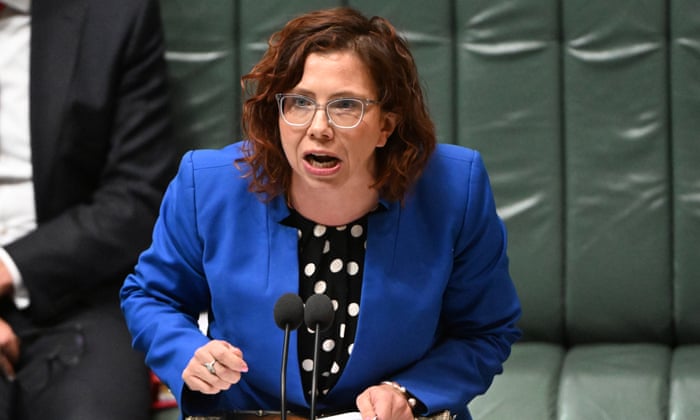
Greens MP Max Chandler-Mather gets the first crossbench question
There are almost 2 million households in mortgage stress and 2.7 million Australians in rental stress with 1 million of those paying more than 50% of their income on rent. Many are one rent increase away from eviction. Will you put aside your own status as a landlord and put the Greens proposal for a two-year rent freeze and an interest rate [freeze] on the agenda for the next meeting of the national cabinet?
Anthony Albanese:
I am very pleased that I am back in public housing, it has to be said. A lot better than my first public house.*
The fact is that a range of people are certainly under stress in terms of the housing affordability.
Finding it difficult to get into the market and finding it difficult to pay the rent and pay the bills. That is why we have a housing Australia Future Fund. We recognise, we recognise that what we need to do is have a comprehensive plan to deal with housing issues in this country.
We have a housing Australian Future Fund that will create 30,000 additional social housing units.
And indeed, on Thursday and Friday, at the summit, we had one of the initiatives was to use the national housing infrastructure facility to encourage investment in affordable housing from the private sector and from superannuation funds. This is a fund of some $575m. Where we will hope to leverage that fund in order to attract investment from those, including the superannuation sector who are looking for those long-term returns.
That is why it makes sense to use that facility and it is another initiative on top of that we have $100m additional that we will put into emergency housing. We know that too many people get turned away from emergency housing, particularly victims of family violence. Too many women and children are turned away each and every day.
We will take these policies seriously, I say to the Greens political party that they can do a lot better if they can point to one area in one time in my constituency or others in which actually is supported in affordable housing strategy.
In which they supported the sort of plans that are being put in place with cooperation of private sector and public sector a particularly local government and they would be a good thing.
I welcome this support in the Inner West Council but in others as well. Where Greens representatives have consistently voted against projects like the project right next to Marrickville Station where they said we couldn’t have medium density houses though, we couldn’t have medium density there and voted against the project. Even though what it did was give people in affordable housing opportunity to get to work but from that trade line of Marrickville.
*I am not sure referring to the Lodge or Kirribilli as ‘public housing’ is quite the line the prime minister thinks it is. Just given the amount of complaints we have all seen about public housing – mould, lack of repairs, no insulation, broken plumbing, waiting lists that stretch into years … pointing out that the prime minister’s residences are paid for by the public is not exactly comparable, even if you did grow up in public housing.
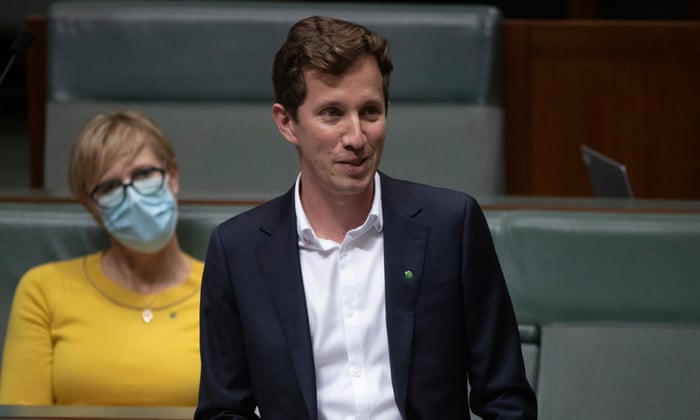
Sussan Ley gets the next question
It wasn’t a great week for Ley last week – she was criticising the jobs and skills summit on TV by saying she was in Lismore when she was in Sydney (she had been in Lismore, but it was the day before), but she’s back:
I refer to the prime ministers captain’s calls to invite CFMEU boss to his talkfest. Mr Chris Cain has been previously charged with common assault, has described John Setka as one of the most fair dinkum people in the country and on Thursday said that if you are not at the table and you are part of the menu. Will the prime minister apologise for inviting this misogynist thug, or was a payback for millions in dirty CFMEU donations?
Anthony Albanese:
I thank the deputy leader of the opposition for her question about the fact that they were trade unionists at the summit. We had presentations from the Australian Nursing Federation. They were the people who stood on the frontline the pandemic. The people who protected people in the health sector. We heard from United Workers Union about the work that took place in terms of childcare during the pandemic. Heard from them about the need to deal with skill shortages. We heard from unions in the tax sector about the work that was required there.
Peter Dutton:
Mr Speaker it is again on relevance. All of those unions who were there had a legitimate reason to be there, who are good people. This question is about the thugs of the CFMEU that go around breaking arms and misogynistic behaviour…
Tony Burke gets up again and there is argy bargy before Albanese gets back on the floor and repeats what a success the summit was.
The first dixer is on the jobs and skills summit.
Another dixer that could (and has been) a media release.
Moving on.
Dutton targets Labor on jobs summit and power prices
Peter Dutton to Anthony Albanese:
Prior to the last election, Labor promised a $275 cut to power bills on many occasions. Since the election, you never mentioned it. Last week the government promised to return to industry-wide bargaining which will mean more strikes and will drive up the costs of living for families in our country. Why are Australian families paying the price for the prime minister’s new priorities?
Albanese:
I thank the leader of the opposition for his questions. Spraying across a range of issues because they can’t decide which tactic to land on. Perhaps one of those was from the Liberal party and one from the National party. A bit like last week when they couldn’t agree whether they should attend jobs and skills summit. A bit like that. Some were in, some were out. There was a common theme. Which is that those opposite, they seek to forget the fact that they have just been in government for almost a decade. They think that 21 May was ground zero. They think 21 May was when the Federation was formed.
But in fact, in March, in March those opposite sat on an increase in wholesale electricity prices. They sat on it and consistently with their attitude and approach towards transparency in government, they didn’t tell anyone.
They didn’t tell anyone. Because it is not surprising that they didn’t tell anyone because we know now that I didn’t have one energy minister, did they? They didn’t have one. Perhaps one of the energy minister’s knew exactly what was occurring. But nonetheless, the people who didn’t know where the Australian people.
The people who didn’t know with the Australian people. Then they have the hide, they have the hide to come in here and ask an incoherent babble of the question, an incoherent babble of the question.
Dutton tries a point of order to call Albanese a liar. Albanese asks him to withdraw it. Dutton, a master of knowing what grabs the TVs like to run, repeats that he alleged Albanese was a liar and that he withdraws it. Tony Burke gets involved. And then eventually we get back to the answer:
Albanese:
What we did is put out a coherent policy. A coherent policy after a decade of inaction. After 22 policy announcements and none of them delivered. But what we know is there was a 23rd.
The 23rd policy was put up in March of an increase that they are responsible for which came to a fact because it was deliberately delayed by the then government until after the election. We stand by our modelling that we put out. We stand by the fact that renewables are the cheapest form of new energy.
It is not really rocket science. You don’t need an economics degree or a science degree to know that if the market changes from a more expensive level of energy to a cheaper level of energy, you get cheaper energy prices. I know that might be beyond those opposite but that is exactly what the Australian people know. That is why they got solar panels on their roofs.
There is a moment of reflection for Mikhail Gorbachev and then we are into the questions (Peter Dutton had also spoken and paid his respects on behalf of the opposition)
Question time
Before the questions, the prime minister is, on indulgence, paying tribute to the last leader of the USSR (which was never united) Mikhail Gorbachev.
Gorbachev didn’t mean to bring about the end of the USSR, but his reforms led to its collapse and Baltic states fighting to win back their independence. (Anthony Albanese does mention this, particularly the blood spilled in Georgia and Lithuania. It is my duty as a Lithuanian-Australian to inform you that the red in the Lithuanian tri-colour flag, is for the blood spilled in defending the nation)
It is the downhill slide into question time – so brace yourself for that

Paul Karp
Greens against proposed change to better off overall test
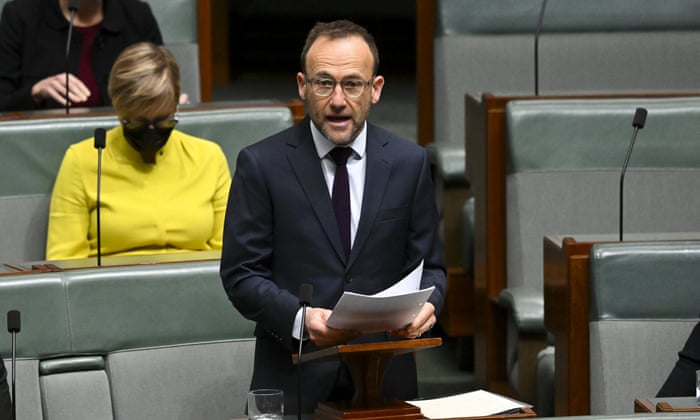
The Greens leader, Adam Bandt, has warned his party does not approve of changes to the better off overall test that would allow workers to be paid less than the award.
One of the surprises out of the jobs and skills summit was the Australian Council of Trade Unions agreeing the test needed to be “simpler and fairer”, with changes to include removing the ability for hypothetical shift patterns to block a pay deal.
Bandt told reporters in Canberra the Greens “don’t support making it easier for big corporations to steal wages”. He noted that only the better off overall test had allowed the retail and fastfood workers union to get agreements struck down that removed young workers’ penalty rates.
Bandt said that – what might be a worker in a hypothetical worse position one day – can become a “real worker” worse off the next, with pay deal approved when “nobody is in that position” followed by the employer hiring according to a new roster pattern.
The test for the Greens is that “nobody receives less than the award”, he said, citing Tony Burke’s simple test last parliament that the better off overall test shouldn’t change if it meant people were worse off.
Teal MP says government cannot have it both ways on climate and fossil fuels
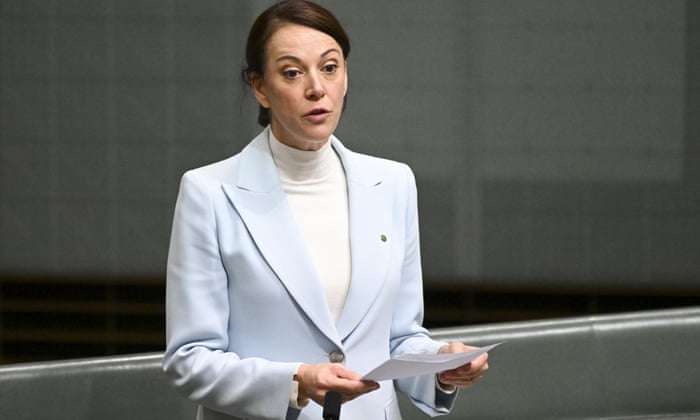
Independent MP Dr Sophie Scamps has given her support to the Greens climate trigger legislation:
The science is clear, we must stop burning fossil fuels such as oil, coal, and gas if we are to avert the worst impacts of climate change. It is estimated there are over 100 new coal and gas projects up for assessment under the EPBC Act. We need to ensure the impact from the emissions that these projects will create are assessed and that approvals under our national environmental law are not just a smokescreen that provide fossil fuel companies cover to continue profiteering while destroying Australia’s environment.
The Albanese government cannot have it both ways. They cannot say the climate wars ‘are over’ and legislate our emissions reduction targets while also refusing to act on the root cause of climate change – fossil fuels.
It is time our national environmental laws were strengthened. And the first step in doing so, is ensuring every major project is assessed for its future climate change impacts – our environment, our economic prosperity and our future depends on it.







Discussion about this post