










Final budget outcome released
And because today just doesn’t have enough going on, the final budget outcome has also been released.
The final budget outcome is when Treasury looks at the actual data and corrects the estimates about debt, spending, incomings, that sort of thing.
Here is what the treasurer, Jim Chalmers, said in a statement:
The Final Budget Outcome for 2021-22 shows an improved budget position last year off the back of a near-term boost in revenues and delays in payments and projects.
It shows that billions of dollars that were promised by our predecessors were not delivered – much of which will now need to be funded in 2022-23 and beyond.
The budget underlying cash deficit was $32.0bn (1.4% of GDP) in 2021-22.
The improvement is the result of higher-than-expected receipts of around $27.7bn and lower-than-budgeted-for payments of $20.1bn.
Despite this improvement, Australians are still burdened with a multibillion-dollar deficit and a trillion dollars of debt which is getting more and more expensive to service.
There are no guarantees that all of the factors driving the improved outcome will be sustained over the longer term.
More than half of the $27.7bn boost to receipts was due to higher‑than‑expected company taxes – largely the result of commodity prices remaining higher for longer than assumed – and a lower-than-expected take-up of Covid-19 business support, such as temporary full expensing and loss carry back.
Payments were $20.1bn lower than expected largely due to delays in contracting Covid-19 spending, supply chain disruptions and capacity constraints delaying road and rail infrastructure projects, along with lower-than-expected demand for health, NDIS and aged care services.
More than half of these payment delays will spill over to future years.
Key events
Sarah Martin
The Treasurer, Jim Chalmers, and finance minister, Katy Gallagher, have held a press conference about the final budget outcome.
The headline figures are an underlying cash deficit of $32.0 billion, which is a reduction in the underlying cash deficit of $47.9 billion compared with that estimated in the 2022-23 March Budget.
This was a result of higher receipts of $27.7 billion and lower payments of $20.1 billion.
Chalmers said despite the improvement in the tax take, the budget was still in a difficult position, and next month’s budget would require some difficult decisions.
The budget is less than four weeks away now it will be a pretty solid budget focused on cost of living relief with an economic dividend, investing in people, their skills their energy and their future and starting to deal with this legacy of waste and rorts which has been a hallmark of budgets for too long now,” Chalmers said.
He said that the budget would deliver on investments, without fuelling inflation and “making the job of the Reserve Bank even harder.”
He also spoke about the end to the fuel excise cut tonight, saying it could not be continued as a permanent measure.
We don’t think it’s responsible to put another $6 billion a year on the national credit card to provide this relief in an ongoing way. We think there are other better ways to provide that cost of living relief,” he said.
We don’t pretend that this won’t make things more difficult for a lot of Australian motorists. Our responsibility to the Australian people is to manage the budget responsibly.”
But we can’t afford to find every bit of cost of living relief indefinitely that people would like us to. That’s just the reality of the situation.”
He said that people should not expect an immediate increase in the price per litre, saying it depended on how much fuel service stations had under the ground bought at the cheaper price, and said the ACCC would be monitoring the situation closely.
Why the trip down memory lane? Well, Sally McManus believes that in coming months, those talking points, which started in 1983 as a campaign to destroy unions, will once again whirr up, as the conversation for IR changes continues.
McManus:
Firstly – The “Wage price spiral”. This one is straight out of the 1970’s. This has been completely disproven but they will still pump this up. It is clear that wage increases have absolutely nothing to do with our current inflation problem. In addition, a repeat of the 1970s is impossible because the economy is totally different, and the wage system of that time has been comprehensively dismantled, impossible to recreate and no one is even proposing its return.
Secondly, the hypothetical scenarios of strikes across small “mum and dad” businesses.
This one is pure fantasy. The facts are that such strikes have never occurred in our history. Even when union membership was at 60% and when days lost to industrial disputes in our country was at its highest – it did not occur. It will not occur now. The truth is the public can see the rising profits of big business, and the increasingly obscene pay packets of CEOs. So, some big business lobby groups have to manufacture ridiculous scenarios regarding threats to small business because they do not want the public looking at them.
Lastly, the use of the term “Union thug”. 55% of union members in Australia are now women.
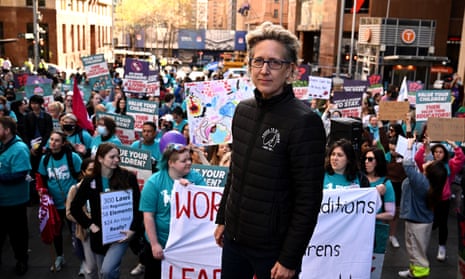
The average union member is a 36 year old nurse and the largest union is her union, the ANMF. Consider the facts and how divorced from reality these claims are. Anyone who wants to understand who the union movement is in 2022 has only to look at the faces of those who have actually been on strike this year – teachers, nurses, aged care and childcare workers. Many are young women of colour. Workers who have been disrespected and under paid.
The facts and the reality are very different.
Sally McManus continues with that history lesson:
In a speech in 2014, the then employment minister Eric Abetz compared the call to destroy workers’ rights to the moment that Martin Luther pinned his revolutionary leaflet to the door of a church, ushering in, as Mr Abetz told the audience, the ‘30-year war’.
This was not a view that bubbled up organically from the Australian public, from social trends, or even from employers.
Neither was it the natural consequence of globalisation.
This was an idea born in 1983, formed into an organisation in 1986 and pursued by elements of the Liberal party ever since.
Their ‘30 year’ war.
Nick Minchin, giving a speech to this society in 2006, actually said the quiet bit out loud: ‘ … the great majority of the Australian people do not support what we are doing on industrial relations. They violently disagree.’
Their 30-year campaign has seen WorkChoices, many royal commissions, special legislation to target unions and workers, and relentless demonisation.
It has delivered what it was designed to deliver:
• Falling real wages
• Workers not sharing in productivity
• Profound levels of job insecurity
• Growing and glaring income and wealth disparities
• One of the most gender segregated workforces in the OECD, a major part of our shameful gender pay gap.
Campaigns by the union movement to abolish WorkChoices and the introduction of the 2009 Fair Work Act helped to stem the tide but not reverse it.
But the legacy of the attack on unions has become starker in the last decade – 10 years of wage stagnation and now dramatically declining real wages which low unemployment, increased productivity and bumper profits are not shifting.
Sally McManus on where the ‘union thug’ attitude came from
Let’s head back to 1983, McManus says, and a wee lad named Gerard Henderson.
In that year Gerard Henderson, a staffer to John Howard, wrote an article attacking the system of cooperation between employers and unions and called for the dismantling of bodies that fostered and regulated the different interests of workers and employees.
This call was taken up a few years later and became a campaign proper in a meeting organised by four men in Toorak.
This occurred in February 1986, a meeting which led to the creation of the HR Nicholls Society – those four men in Toorak, they were John Stone, Peter Costello, Barrie Purvis and Ray Evans.
To quote from an article in 2007 by Michael Bachelard in the Age and the Sydney Morning Herald – in Evans’ words, they wanted nothing less than freedom in the labour market, their agenda involved abolishing the commission, the award system and possibly minimum wages.
If there was to be a minimum wage, it would be set very, very low. Anything above it would be agreed by bargaining in an environment very unfriendly to unions.
Individual contracts would be encouraged and would take precedent over collective, negotiated agreements.
The heart of this campaign is a belief that employers should have free rein to decide everything, so workers’ rights and anybody such as the industrial commission that gets in the way must be removed. So, of course, the very existence of unions goes against their idea of absolute employer prerogative.

Paul Karp
More from Sally McManus at the press club
Sally McManus drew a comparison between the Albanese government’s consultation at the jobs and skills summit and that of the Morrison government at the start of the pandemic – particularly through a gendered lens.
McManus said the government did bring unions into the tent at the start of the pandemic. But this had odd results:
I remember how surprised some in the government were at the attitude of union leaders. They were continually confounded about our responses and our commitment to working together for the common good. Some of those in government even assumed we would use the crisis to organise disruption and set up a high-level rapid response group should this occur. This group was a distraction and a waste of time as it had nothing to do. It was clear that they had come to believe their own rhetoric about us, which meant they did not understand us at all – fellow Australians who wanted to serve the common good and work together to save lives, jobs, and to keep people safe. It surprised me how big the gap was between reality and their imaginations.
ACTU’s Sally McManus is delivering her National Press Club address
She is recounting her experiences during the height of the pandemic:
The new government’s jobs and skills summit was a glimpse of Australia at its best.
Different views and perspectives being brought together to consider what is needed for the greater good. This makes a big change from the previous government.
One of the things I clearly remember about the emergency phase of the pandemic in 2020 and the almost daily meetings with the then-government, was nearly every meeting was almost exclusively with men in suits. I remember asking myself, ‘Where is everyone else?’
And why couldn’t they see that this was a problem? It was just so stark. Nearly all the pandemic leaders and decision-makers on Zoom in the safety of their comfortable homes making decisions for people whose lives were so different from theirs, the essential and frontline workers, people who were stood down, families suddenly without any income, and people risking their own health to go to work.
The government was doing something that had not done before – it was taking advice from the representatives of these workers, it was taking advice from unions. This was a huge difference after decades of marginalising workers’ voices.
For those looking for the legislation, you can find it here
More concerns about public hearing restrictions in anti-corruption commission legislation
The Australia Institute’s National Integrity Committee of Former Judges have welcomed the fact Australia finally has legislation for a national anti-corruption commission in the parliament.
But they have concerns over the restrictions on public hearings.
The Hon David Harper AM KC, former judge at the Victorian supreme court of appeal, said:
This legislation provides for a commission, independent of government, with broad powers and the ability to receive referrals from the public and hold public hearings. However, we have always emphasised the importance of public hearings and will consider further how the draft legislation deals with these.
The draft legislation released today is a vital step towards improving integrity in the public sector.
So it seems that so far, everyone welcomes it, but there are concerns over the threshold for the public hearings.
Cross-party senators move to establish inquiry on abortion access in Australia
The Greens are moving to establish a senate inquiry looking at abortion access in Australia today, which is also International Safe Abortion Day. Senator Larissa Waters said there needed to be a forensic look at what access was available in Australia:
Abortion remains expensive and inaccessible for many, especially those who already face massive healthcare barriers, including First Nations people and people from culturally and linguistically diverse backgrounds.
In the wake of Roe v Wade, the federal government should look at what it can do to eliminate Australia’s barriers to accessible and affordable abortion.
Access to safe, legal abortion remains a postcode lottery in Australia, with different rules, costs and availability depending on where you live. Some people are having to travel for hours at significant expense to access this basic healthcare service.
In remote and regional areas like Townsville and Mackay, many women are forced to travel long distances, at significant expense, to access sexual and reproductive health services including long-acting contraception, medical and surgical abortions and counselling.
The Greens support calls for national consistency on abortion laws, provided they are best practice, which would be ascertained through the inquiry.
Waters, the independent ACT senator David Pocock and the Liberal MP Bridget Archer joined with the advocacy group Fair Agenda to call for more action to address barriers to abortion access:
Fair Agenda is calling on the Albanese government to lead a national review of sexual and reproductive health care access, to make a plan to address barriers to abortion care in Australia. And for immediate action to improve abortion access nationwide – by putting medical abortion care on Medicare with an appropriate subsidy of $500.

Josh Butler
Labor: Coalition accusation of racism over abolition of cashless debit card is ‘laughable’
The social services minister, Amanda Rishworth, said it was “laughable” that the Coalition had accused Labor of racism over abolishing the cashless debit card, hitting back that the former government’s plans had seen a high proportion of Indigenous people placed on the income management tool.
The government’s bill passed the House of Representatives this morning, formalising the abolition of the cashless debit card. Earlier this week, the Northern Territory’s Coalition senator Jacinta Price accused the government of “racism” due to its plans to keep CDC participants in the NT and Cape York on a different income management program, rather than allowing them to opt-out of income management entirely.
Asked about these comments at a press conference on Wednesday, Rishworth denied the claims.
I find it quite amusing that a government that compulsorily put everyone on a working age payment, I don’t know how they picked the sites, but the sites they picked with the cashless debit card put a significantly higher proportion of Indigenous people on the card.
I think that is quite laughable and really playing politics with this. We need to transition safely off income management, we’re starting with the cashless debit card.
Rishworth said Labor aimed to eventually make all income management voluntary, not compulsory. The government will now undertake an 18-month consultation process on the future of income management.
She said the process would look, community by community, at how voluntary or compulsory measures should be used as well as considering local decision-making by community bodies.

Peter Hannam
ABS data shows retail sales rose slightly in August
There are more signs that Australian consumers haven’t lost their spend-thrifty ways, with retail sales for August rising 0.6% for the month, according to the ABS.
While less than half the 1.3% rise in July, the result was better than the meagre 0.2-0.3% increase expected by some of the big banks.
From a year earlier, sales were almost one-fifth higher from that age ago when NSW, Victoria and the ACT (we never forget the ACT) were in lockdown. Memories.
Australia’s retail sales are up 0.6% for the month, and more than 19% up from a year earlier (when half the country was in a lockdown). (Source: ABS) pic.twitter.com/Hw1dFK1lOX
— Peter Hannam (@p_hannam) September 28, 2022
Anyways, retail spending has now risen for eight months in a row, with cafes, restaurants and takeaway food services up 1.3% for the month. (Much of that might have been the higher prices we’re all paying.)
The ABS noted that department store sales were up 2.8% to a record level, with spending on household goods rising 2.6% or the most since March 2022. We also noted yesterday that the weekly ANZ/Roy Morgan survey of consumer sentiment was also showing a perkiness not so diminished by five consecutive interest rate rises by the RBA and a six one expected next Tuesday.
Clothing, footwear and personal accessory retailing recorded its largest fall this year, down 2.3%, the ABS said. Perhaps people saw the La Nina portents and said, “spring and summer: cancelled”.
Anyway, the money market turmoil of early this week seems to have settled a bit, including those interest rate predictions.
The ‘market mania’ of earlier this week seems to have taken a bit of a breather. Investors, though, are maintaining their expectations the RBA has about 200 basis points of rises in the cash to go (including 50bp next Tuesday) on the way to about 4.3% by June. pic.twitter.com/zXthOFFkOi
— Peter Hannam (@p_hannam) September 28, 2022
However, the Australian dollar has lately started sliding again, and is now not far above 64 US cents, and Australian shares have given up early gains to be down about one-third of 1%. The pound is also not that far off its record lows against the Greenback.










Discussion about this post