
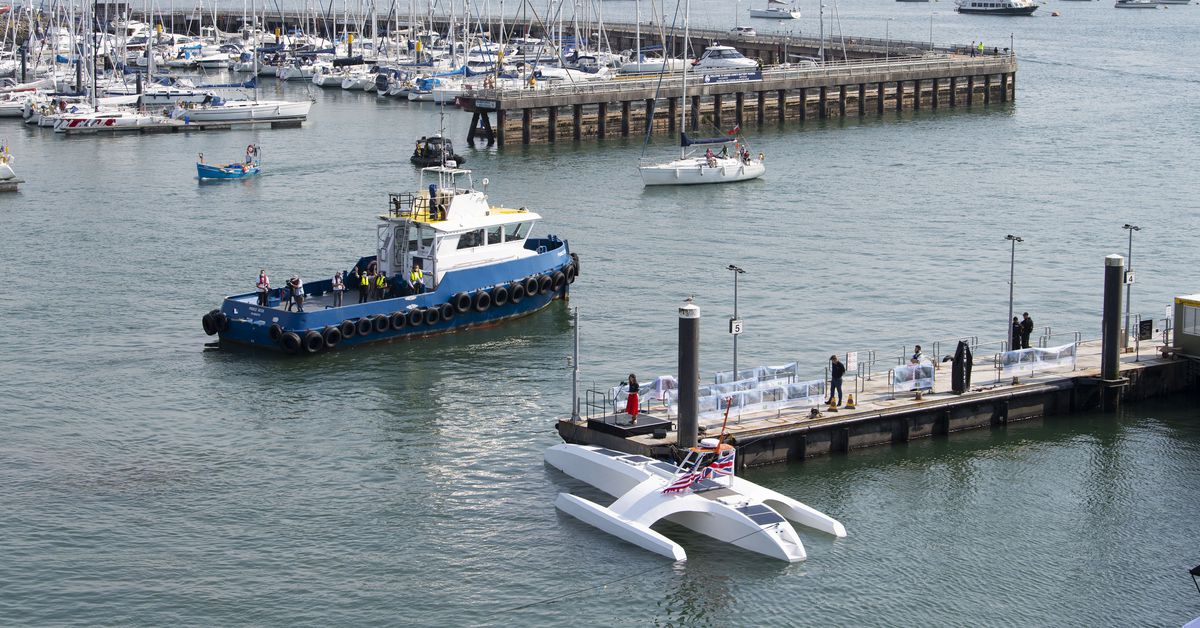
The Mayflower Autonomous Ship finally arrived on the coast of Nova Scotia last month, marking the end of its long trek across the Atlantic. While the modern Mayflower is far from the first vessel to make that voyage, this small robotic boat is the largest to ever do so navigated by artificial intelligence with no humans aboard. A few technical hiccups notwithstanding, its trip is the latest evidence that the future of the high seas could be autonomous.
Slowly, self-steering ships are becoming a reality. In Norway, an autonomous battery-powered container vessel is shuttling fertilizer between a factory and a local port, and pending a successful trial, it could be fully certified within the next two years. A commercial tanker called the Prism Courage recently traveled from Texas, through the Panama Canal, to South Korea, guided by software from Avikus, a subsidiary of HD Hyundai, a shipbuilding operation that was spun off of the car group. There are even some boats meant to transport humans that can now operate on their own: A self-driving water taxi created by the artificial intelligence startup Buffalo Automation was ready to ferry people across the Tennessee River in downtown Knoxville, at least as of April.
Not all robo-boats are created equal. Some current AI sailing software is assistive, and requires at least some form of monitoring from a person onboard, while more advanced technology can operate a ship entirely independently, without any need for humans. Regardless, this new generation of autonomous vessels stands to make people a more marginal part of life at sea. Because many self-steering boats are still relatively new, there’s not yet enough evidence to prove that the technology that powers these ships is as capable as human navigators. Still, these vehicles could not only make it easier to traverse the world’s waterways, but also do so with a smaller carbon footprint than crewed boats.
“A computer can be optimizing for fuel savings and integrating a lot of different inputs around how fast they need to be moving through the water to reach their destination on time, what the weather conditions are like, how the vessel is operating, [and] how the engines are operating,” Trevor Vieweg, the chief technology officer at Sea Machines Robotics, a startup that designs self-driving boat tech, told Recode. “By using those same technologies, we can reduce carbon emissions — and fuel burn overall.”
To navigate independently, an autonomous boat typically needs a wide variety of sensors, including cameras and radar, as well as data from other sources, like GPS. These sensors are positioned around the vessel, and help a ship plan its route and sense nearby obstacles, like, for example, a floating log or a chunk of an iceberg. As with self-driving cars, autonomous ships can be classified into several levels based on how well their tech can perform without human help. The International Maritime Organization, the United Nations agency that regulates shipping, has proposed a spectrum of autonomy starting with Level 1 ships, which would be operated by humans but might allow AI to make some unsupervised decisions, and ramping up in sophistication to Level 4 ships that could sail completely independently, with no human involvement or decision-making required.
Advocates say these ships are less susceptible to human error — ship and boat accidents are somewhat common — and could allow boat operators to assign workers to other tasks where they can be more productive. Artificial intelligence could also navigate ships more efficiently, and make better calculations about routes and speeds. The hope is that by saving time and, perhaps most importantly, fuel, ocean vessels can cut down on their energy consumption, which remains a significant contributor to climate change. In the absence of full autonomy, some experts have even suggested that software could enable humans to steer boats remotely, which would come with several benefits. For instance, remotely piloted ships would reduce the risk of spreading illness through international cargo transport, which has been a concern throughout the Covid-19 pandemic.
Right now, ships with autonomous capabilities represent a tiny fraction of the many vessels in operation today. But in the future, self-steering ships could make all sorts of water-based activities more convenient. For example, the Mayflower Autonomous Ship, which was supported in part by IBM, was designed to study the ocean’s health, record audio of marine life, and take samples of microplastic. The boat doesn’t include a deck, bathrooms, or bunks, and much of the space inside is occupied by its technology, like its onboard computers, batteries, and motors.
“Not having humans on board frees up/eliminates the space occupied by them and supplies necessary to sustain human presence, as well as the power that the ship requires to carry the weight entailed,” said Ayse Atauz Phaneuf, the president of ProMare, the marine research organization that worked on the project. “Unmanned vehicles such as the Mayflower Autonomous Project will be able to spend considerably longer time at sea, accessing significant yet distant parts of the ocean.”
Phaneuf told Recode that the vehicle, and others like it, could eventually make ocean research expeditions much less expensive to launch. In addition to making it easier to study the ocean, autonomous ships could also make it more convenient to transport freight. In Japan, a partnership between a non-profit and freight transportation companies successfully showed earlier this year that autonomous container ships could travel between ports throughout the country. The demonstration was meant to prove that these vehicles could eventually help cut down on the shipping industry’s need for workers, especially as Japan confronts an aging population. There are also organizations like One Sea, which has brought together shipping and AI companies to promote autonomous ocean transportation, and to advance the technology involved.
There are those environmental benefits, too. HD Hyundai’s navigation tech works by using artificial intelligence to determine a ship’s routes and speeds, and the software also factors in the height of nearby waves and the behavior of neighboring vessels. The company says by using this AI, the Prism Courage — the commercial tanker that traveled through the Panama Canal — boosted its fuel efficiency by about 7 percent, and cut down on its greenhouse gas emissions by 5 percent. While that might not sound like a lot, those savings could add up quickly.
Autonomous ships do face headwinds. One industry expert we spoke to said that smaller boats, like survey vessels and ferries, are more likely to incorporate autonomous technology than the large, container ships that make up the bulk of the world’s freight transportation. Some critics, including Maersk’s CEO, have argued that the savings that might come from autonomous software may not be enough to incentivize large shipping companies to invest in the tech, especially since many ocean carriers don’t use particularly large crews in the first place (a typical cargo ship might have just 20 workers aboard). Another concern is that autonomous software could make these ships more vulnerable to cyberattacks, though non-autonomous shipping operations have already been hacked.
And finally, there’s also the extremely complicated matter of international maritime law, which may not be prepared for the arrival of artificial intelligence.
“How should we deal with the liability issue where an autonomous system, although properly designed and maintained, acts unpredictably?” Melis Ozdel, the director of the University College London Centre for Commercial Law, told Recode. Of course, there are many ways autonomous vessels could upend life at sea, whether it’s the possibility of a robo-boat crashing into a cruise full of tourists, or the uncertain fate of pirates who might capture a ship, only to discover that it’s actually remote-controlled.
AI ships have already shown they can work, at least sometimes, though the technology that powers these vessels is still being developed and may require years to fully take off. Still, all signs indicate that these next-generation boats do have advantages. Eventually, sailing might look a little less like weeks out at sea and a little more like monitoring a ship from the comfort of an office, conveniently located on land.
This story was first published in the Recode newsletter. Sign up here so you don’t miss the next one!


Discussion about this post