



• Home
  • Insight
  • Blog
  • Business
  • Entertainment
  • Health
  • Politics
  • Shop
    • Gift Shop
    • Value Shop
    • Store
    • Bargain Shop
    • Discount
  • Sports
  • Tech
  • Travel
  • USA
  • Video
  • World
    • Asia
    • Africa
    • South America
    • North America
    • Europe
    • Oceania
Thursday, July 30, 2026
No Result
View All Result
Subscribe Now
  • Home
  • Insight
  • Blog
  • Business
  • Entertainment
  • Health
  • Politics
  • Shop
    • Gift Shop
    • Value Shop
    • Store
    • Bargain Shop
    • Discount
  • Sports
  • Tech
  • Travel
  • USA
    TX Rep. Brandon Gill Mocks James Talarico Over Fauci Action Figure Post

    TX Rep. Brandon Gill Mocks James Talarico Over Fauci Action Figure Post

    NBA players are ‘being taught’ to flop

    NBA players are ‘being taught’ to flop

    Industry was warned for years about chemical ‘runaway’ dangers. Then came near-catastrophe in O.C.

    Industry was warned for years about chemical ‘runaway’ dangers. Then came near-catastrophe in O.C.

    Trump administration seeks government-wide NDAs to stop leaks : NPR

    Trump administration seeks government-wide NDAs to stop leaks : NPR

    Dog discharges shotgun inside truck, striking woman at Nebraska traffic light

    Dog discharges shotgun inside truck, striking woman at Nebraska traffic light

    Toshifumi Suzuki, Japan’s ‘God’ of Convenience Stores, Dies at 93

    Toshifumi Suzuki, Japan’s ‘God’ of Convenience Stores, Dies at 93

     Judge Sanctioned CoreCivic for Destroying Video in ICE Death Suit

     Judge Sanctioned CoreCivic for Destroying Video in ICE Death Suit

    Suspect dead after opening fire near White House security checkpoint, Secret Service says

    Suspect dead after opening fire near White House security checkpoint, Secret Service says

    Trump trashes Colbert’s high-rated finale as “no ratings”

    Trump trashes Colbert’s high-rated finale as “no ratings”

  • Video
  • World
    • Asia
    • Africa
    • South America
    • North America
    • Europe
    • Oceania
The Insight Post
  • Home
  • Insight
  • Blog
  • Business
  • Entertainment
  • Health
  • Politics
  • Shop
    • Gift Shop
    • Value Shop
    • Store
    • Bargain Shop
    • Discount
  • Sports
  • Tech
  • Travel
  • USA
    TX Rep. Brandon Gill Mocks James Talarico Over Fauci Action Figure Post

    TX Rep. Brandon Gill Mocks James Talarico Over Fauci Action Figure Post

    NBA players are ‘being taught’ to flop

    NBA players are ‘being taught’ to flop

    Industry was warned for years about chemical ‘runaway’ dangers. Then came near-catastrophe in O.C.

    Industry was warned for years about chemical ‘runaway’ dangers. Then came near-catastrophe in O.C.

    Trump administration seeks government-wide NDAs to stop leaks : NPR

    Trump administration seeks government-wide NDAs to stop leaks : NPR

    Dog discharges shotgun inside truck, striking woman at Nebraska traffic light

    Dog discharges shotgun inside truck, striking woman at Nebraska traffic light

    Toshifumi Suzuki, Japan’s ‘God’ of Convenience Stores, Dies at 93

    Toshifumi Suzuki, Japan’s ‘God’ of Convenience Stores, Dies at 93

     Judge Sanctioned CoreCivic for Destroying Video in ICE Death Suit

     Judge Sanctioned CoreCivic for Destroying Video in ICE Death Suit

    Suspect dead after opening fire near White House security checkpoint, Secret Service says

    Suspect dead after opening fire near White House security checkpoint, Secret Service says

    Trump trashes Colbert’s high-rated finale as “no ratings”

    Trump trashes Colbert’s high-rated finale as “no ratings”

  • Video
  • World
    • Asia
    • Africa
    • South America
    • North America
    • Europe
    • Oceania
No Result
View All Result
No Result
View All Result
Home Science

Can the James Webb Space Telescope see galaxies over the universe’s horizon?

by Theinsightpost
July 15, 2024
in Science
0 0
0
Can the James Webb Space Telescope see galaxies over the universe’s horizon?

Since it began sending data back to Earth in 2022, the James Webb Space Telescope (JWST) has greatly impacted astronomy, and one of its most revolutionary achievements is the observation of some of the most distant galaxies ever seen. However, because light doesn’t travel instantly — but rather moves at about 300 million meters (985 million feet) per second in a vacuum — we don’t see those galaxies as they are today, but as they were billions of years ago. 

Moreover, our universe is estimated to be 13.8 billion years old. So, we should assume that the most distant galaxy we could ever hope to see is no more than 13.8 billion light-years away. (One light-years is the distance light travels in a year). That point should be a “cosmological horizon” of sorts — beyond which no telescope should be able to see. And, because nothing can travel through space faster than c, that means there should be no way a galaxy further than 13.8 billion light years away, and getting more distant all the time could affect Earth. Right? 

Wrong. If only the universe were that simple.

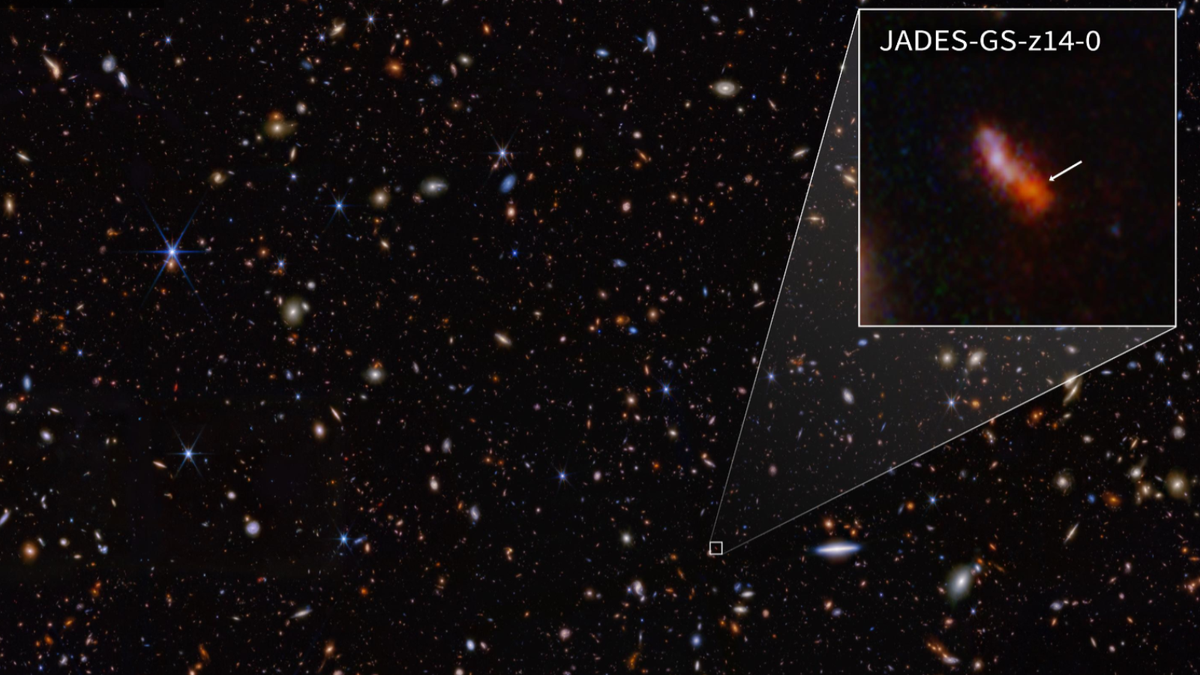
The redshifted spectrum of JADES-GS-z14-0 as measured by the JWST’s NIRSpec instrument (Image credit: NASA, ESA, CSA, J. Olmsted (STScI). Science: S. Carniani (Scuola Normale Superiore), JADES Collaboration.)

“A cosmological horizon is a maximum distance from which one could possibly retrieve information,” Jake Helton, a University of Arizona astronomer who is also part of the JWST Advanced Deep Extragalactic Survey (JADES) team, told Space.com.

“There are a few different cosmological horizons,” Helton continued, “which have different definitions and depend on various cosmological quantities. The most relevant here is the cosmological horizon which is the maximum distance from which light could have traveled to us in the age of the universe. This defines
the edge of the observable cosmos.”

Related: James Webb Space Telescope spots the most distant galaxy ever seen (image)

In March of 2024, JADES scientists revealed the powerful telescope had spotted JADES-GS-z14-0, the most distant and early galaxy humanity has ever seen. The paradox, however, is that JADES-GS-z14-0 is located about 33.8 billion light years away. 

Breaking space news, the latest updates on rocket launches, skywatching events and more!

How can we see light from an object so distant the universe isn’t old enough to have allowed it to have reached us? Doesn’t JADES-GS-z14-0’s position 33.8 billion light-years away mean we see it as it was 33.8 billion years ago, something that would surely challenge the estimation of the age of the universe?

Not so. Again, this is evidence that the universe has a way of turning sensible and logical conclusions on their heads. 

“How can a distant galaxy like JADES-GS-z14-0 ever be observed, since it is more than 13.8 billion light years away from us and its light seemingly would have taken more time than the age of the universe to reach us?” Helton asked rhetorically. “The answer is the expansion of the universe.”

Seeing a galaxy older than time itself

If the universe would just sit still, then light from a galaxy 33.8 billion light-years away would take 33.8 billion years to reach us, and that would be that. But, in the early 1900s, Edwin Hubble found that distant galaxies appeared to be receding away from each other, and the further apart they were, the faster they were going. In other words, the universe isn’t static; it is expanding.

This was further complicated in 1998, as the 20th century drew to a close when two separate teams of astronomers observed that, not only is the universe expanding, but that expansion is also accelerating. The force responsible is a mystery, but it has been given the placeholder name of “dark energy.”

The evolution of the universe illustration seen with the Big Bang event on the left and the present on the right.

A diagram showing the expansion of the the universe at first due to the Big Bang and then at an acceleration rate when dark energy took over. (Image credit: NASA / WMAP Science Team)

There are two major and distinct periods of expansion over the 13.8 billion-year history of the universe. The first is an initial period of rapid cosmic inflation that is now commonly called the “Big Bang.” 

This inflationary epoch saw the volume of the cosmos increase by a factor of 10^26 (10 followed by 25 zeroes). That is equivalent to your fingernail going from growing at 1 nanometer per second to suddenly growing 10.6 light-years (62 trillion miles) long. At this time, the universe was dominated by energy, and this period is known as the energy-dominated epoch.

This was followed by a matter-dominated epoch beginning 47,000 years after the Big Bang. Eventually, universal expansion allowed the cosmos to cool enough to allow protons to form from quarks and gluons, and then protons to bond with electrons to form the first atoms of hydrogen, which formed the first stars and galaxies. During this period, the Big-Bang-driven expansion of the universe slowed to a near halt.

The matter-dominated epoch came to a surprising end when the universe was just under 10 billion years old. At this time, the universe suddenly began to expand rapidly yet again. Plus, that expansion got faster and faster and even continues to accelerate today. This third significant period of the universe is called the dark-energy-dominated epoch. It’s the epoch we’re currently in.

A black circle with layers of different colors a a black circle at its heart

An illustration of the cosmic horizon, the most distant point ibn the universe we can see with any telescope (Image credit: Pablo Carlos Budassi (CC-by-SA 3.0))

Thanks to these periods of expansion of the universe, the light from JADES-GS-z14-0 has only actually been traveling to the JWST and Earth for 13.5 billion years, despite its source now being much more distant than 13.5 billion light-years away. That means the JWST sees JADES-GS-z14-0 as it was 300 million years after the Big Bang. Without the expansion of the universe, JADES-GS-z14-0 would still be around 13.5 billion light-years away, though it would have still experienced smaller local motions that could have moved it closer together or further from nearby galaxies. But such galactic movement would’ve been nowhere near the kind caused by the expansion of the universe.

According to Helton, the cosmological horizon, or the “Photon Horizon,” is a sphere with a boundary around 46.1 billion light years away, a figure dictated by the universe’s expansion. This is the actual horizon beyond which we shouldn’t be able to “see” a galaxy. The galaxy JADES-GS-z14-0 is indeed within that horizon.

To avoid confusion, astronomers actually use two distance measurement scales: a co-moving distance that eliminates the expansion of the universe as a factor and a proper distance that includes it. That means the co-moving distance of JADES-GS-z14-0 is 13.5 billion light-years, while its proper distance is 33.8 billion light-years.

JADES-GS-z14-0 and other distant and ancient galaxies won’t always be visible, though.

A red smear seperated from a triangluar spacecraft by a blue arrow. Below this the same smear is seperated from the same shape by a longer red arrow. The background is black

A diagram showing the journey of light from an early galaxy to the JWST (Image credit: Robert Lea (created with Canva))

A lucky era to have the James Webb Space Telescope

The fact that the JWST can see JADES-GS-z14-0 means it was once “causally connected” to Earth and our local universe. In other words, it was possible for a signal from JADES-GS-z14-0 to reach us in the Milky Way, thus a “cause” in this galaxy that existed at the dawn of time could have an “effect” in our galaxy in this modern epoch of the cosmos.

“Any observable galaxy must be within the particle horizon and must have been causally connected with us at some point in the history of the universe,” Helton said.

This isn’t the case anymore, however. Galaxies like JADES-GS-z14-0 and the other JADES-discovered galaxies are now so distant and are driven away from us so rapidly, thanks to dark energy, that no signal from them sent today could ever reach us. That’s because the photon horizon moves away from us at the speed of light, but for really distant objects, the space between the Milky Way and those galaxies is expanding faster than the speed of light.

This might seem implausible, as Albert Einstein’s theory of special relativity sets the speed of light as a universal speed limit. However, that is a rule for objects with mass moving through space, not a rule for the very fabric of space itself.

In around 2 trillion years after Earth and humanity are long gone, the expansion of the universe means that, whatever intelligent species replaces us in the Milky Way (if one ever does), will be unable to see any galaxies that exist beyond our local group — which has a diameter of around 10 million light-years. 

It is a sobering thought, and it means humanity lives at a unique point in the history of the universe at which the most distant galaxies are still within our view. We are capable of knowing more about the universe and its origins than any intelligent life that may follow us. Astronomers, including Helton, intend to use the JWST to fully exploit this cosmic privilege.

“Working with JWST and the JADES Collaboration has been incredible,” Helton said. “Writing papers about science with JWST, like my recent one on
JADES-GS-z14-0, has been the most rewarding and exciting experience
of my research career.”


ShareTweetSend
Previous Post

The 17 Best Places in the World to Retire

Next Post

Spanish police say they may have found the body of missing British teenager

Related News

Daily multivitamin may help older adults stay independent
Science

Daily multivitamin may help older adults stay independent

July 30, 2026
1,200-year-old gold hoard discovered in Saudi Arabia may have been buried by a medieval pilgrim
Science

1,200-year-old gold hoard discovered in Saudi Arabia may have been buried by a medieval pilgrim

May 27, 2026
Making Changes to Major League Baseball ⚾ by Tumble Science Podcast for Kids
Science

Making Changes to Major League Baseball ⚾ by Tumble Science Podcast for Kids

May 27, 2026
The Paradox of AI and Climate – State of the Planet
Science

The Paradox of AI and Climate – State of the Planet

May 26, 2026
Next Post
Spanish police say they may have found the body of missing British teenager

Spanish police say they may have found the body of missing British teenager

Discussion about this post

Subscribe To Our Newsletters

    Customer Support


    1251 Wilcrest Drive
    Houston, Texas
    77042 USA
    Call-832.795.1420
    e-mail – news@theinsightpost.com

    Subscribe To Our Newsletters

      Categories

      • Africa
      • Africa-East
      • African Sports
      • American Sports
      • Arts
      • Asia
      • Australia
      • Business
      • Business Asia
      • Business- Africa
      • Canada
      • Defense
      • Education
      • Egypt
      • Energy
      • Entertainment
      • Europe
      • European Soccer
      • Finance
      • Germany
      • Ghana
      • Health
      • Insight
      • International
      • Investing
      • Japan
      • Latest Headlines
      • Life & Living
      • Markets
      • Mobile
      • Movies
      • New Zealand
      • Nigeria
      • Politics
      • Scholarships
      • Science
      • South Africa
      • South America
      • Sports
      • Tech
      • Travel
      • UK
      • USA
      • Weather
      • World
      No Result
      View All Result

      Recent News

      Free Cloud Computing Course | AWS Re/Start Program 

      Free Cloud Computing Course | AWS Re/Start Program 

      July 30, 2026
      Thirty Years Later

      Thirty Years Later

      July 30, 2026
      Announcing Codemagic Patch: an open-source CodePush rebuild for React Native

      Announcing Codemagic Patch: an open-source CodePush rebuild for React Native

      July 30, 2026
      Following Expansion in China, Regional Private Equity Faces New Scrutiny in Southeast Asia – The Diplomat

      Following Expansion in China, Regional Private Equity Faces New Scrutiny in Southeast Asia – The Diplomat

      July 30, 2026
      • Home
      • Advertise With Us
      • About Us
      • Corporate
      • Consumer Rewards
      • Forum
      • Privacy Policy
      • Social Trends

      Theinsightpost ©2026 | All Rights Reserved. Theinsightpost is an Elnegy LLC company, registered in Texas, USA

      Welcome Back!

      Login to your account below

      Forgotten Password?

      Retrieve your password

      Please enter your username or email address to reset your password.

      Log In

      Add New Playlist

      We are using cookies to give you the best experience on our website.

      You can find out more about which cookies we are using or switch them off in .

      No Result
      View All Result
      • Home
      • Insight
      • Blog
      • Business
      • Entertainment
      • Health
      • Politics
      • Shop
        • Gift Shop
        • Value Shop
        • Store
        • Bargain Shop
        • Discount
      • Sports
      • Tech
      • Travel
      • USA
      • Video
      • World
        • Asia
        • Africa
        • South America
        • North America
        • Europe
        • Oceania

      Theinsightpost ©2026 | All Rights Reserved. Theinsightpost is an Elnegy LLC company, registered in Texas, USA

      The Insight Post
      Powered by  GDPR Cookie Compliance
      Privacy Overview

      This website uses cookies so that we can provide you with the best user experience possible. Cookie information is stored in your browser and performs functions such as recognising you when you return to our website and helping our team to understand which sections of the website you find most interesting and useful.

      Strictly Necessary Cookies

      Strictly Necessary Cookie should be enabled at all times so that we can save your preferences for cookie settings.

      Cookie Policy

      More information about our Cookie Policy