Categories
Business- Africa

What Being Tech-enabled Means for SMEs

What Being Tech-enabled Means for SMEs

Research suggests that 63% of SMEs in South Africa are making effective use of technology. This is quite a big deal, especially in a country where infrastructure and resources are often unevenly distributed. But it also means one thing: the future of small businesses in South Africa is digital.

If you’re an SME founder or manager wondering how to keep up, the answer lies in being tech-enabled. Being tech-enabled is one of the best ways to future-proof your business. In this article, we’ll tell you all about being tech-enabled as an SME.

What Does “Tech-enabled” Actually Mean?

Being tech-enabled isn’t about having the latest tech; it’s about integrating digital tools into your daily operations to improve efficiency, lower costs, and reach more customers. Whether it’s cloud-based accounting software, a customer relationship management (CRM) system, an inventory tracking system, or simple social media automation, the goal is to make work life easier for the benefit of the business and your team.

Being tech-enabled is crucial for business. Why? For instance, if your business still runs entirely on paper, you’re not only at risk of losing that information because it’s a physical system, but you’re also taking up more time, meaning you’re likely missing out on growth opportunities. A tech-enabled business has software and digital tools to cut down the time spent on physical admin.

Why Now Is the Time to Embrace Digital Tools

South African SMEs face daily challenges such as rising costs and skills shortages. Digitising your business offers solutions to these challenges and helps future-proof your business. There are many affordable tech tools for businesses. Tools like e-commerce platforms, mobile payment apps, and online inventory systems help you cut down on costs needed for staff and time spent on manual tasks.

The Benefits of Being Tech-Enabled

Improve productivity: With cloud systems, your team can work remotely and access files in real time. You can make use of time tracking software to keep your team accountable.

Reach more customers: Digital marketing lets you target customers who are actually looking for what you offer. You can also use data to analyse the performance of your digital marketing efforts.

Save time and money: Automating tasks like invoicing or stock management gives you more hours to focus on other aspects of the business.

Enhance customer experience: Integrating tools like chatbots and auto-responders, and using analytics for audience management helps you keep your clients engaged and informed.

Low-cost Tech Solutions Every SME Can Use

You don’t need to break the bank to become tech-enabled. Here are a few budget-friendly digital tools that you can begin with:

  • Point of Sale (POS) apps like Yoco or iKhokha.
  • Customer Relationship Management (CRM) tools that have a free plan, such as HubSpot CRM.
  • Inventory management software like Zoho Inventory.
  • WhatsApp Business for easy customer communication.
  • Social media scheduling tools like Buffer or Canva.
  • Accounting software Xero (affordable tier options).

These tools are scalable, and that works for small businesses because they grow with your business.

Steps to Get Started With Digital Transformation

Becoming tech-enabled can sound complicated, but here’s a simple plan to help you get started:

  • Evaluate your current business processes. Find out where you are spending the most time and what’s not working?
  • Start by choosing one area to improve. It could be accounting, marketing, customer communication, employee productivity, or stock control.
  • Test one tool. Begin with a free or affordable tool to see if it works for you.
  • Get a good understanding of the tool, then introduce and train your team on the tool
  • Get feedback. Ask your team and customers if they’ve noticed improvements.
  • Scale slowly as your business becomes more tech-integrated. Many tools can integrate with other automation tools. Once you see the benefits, explore how to extend the initial software you began with or integrate another.

Future Proofing Your Business With Tech

Embracing digital tools isn’t just about keeping up (even though that’s necessary); it’s about building a business that can thrive no matter what challenges come your way.

Becoming tech-enabled helps you work smarter, save money, and serve your customers better, without overwhelming your budget. Keeping everything manual uses up a lot of time and man-power, and with tech, that time and man-power could be allocated towards other efforts in growing your business.

Categories
Business- Africa

How to sell cookies in Lagos

While Nigeria has witnessed growth in modern shopping malls and air-conditioned supermarkets, an estimated 90% of shopping still takes place through informal retail channels – a sprawling network of table-top vendors, street stalls, open-air markets, and hawkers weaving through traffic. For consumer goods companies aiming to reach the country’s more than 230 million people, securing a foothold in this informal sector is critical. Yet navigating this fragmented ecosystem can be a complex challenge.

In 2010, Gbola Lawson, then the fiancé and now husband of Fastizers founder Debby Lawson, set out to help introduce the company’s cookies into this informal market. His strategy was simple: minimise the risk for vendors.

One Saturday, armed with packs of cookies – at the time sold mainly in offices and a handful of neighbourhood stores – Gbola headed to the streets. At a busy Lagos bus terminal, he approached a merchant and offered six packs to sell, without charging upfront. If the cookies did not sell by Monday, Gbola promised to buy them back himself. The vendor, seeing no downside, agreed. Gbola replicated the offer with two other street sellers.

By Monday, Debby, eager to see the results, called the first vendor. All six packs had sold out the same day, he told her, and he had wanted to reorder but lacked her contact details. The other two vendors reported similar results. “I was excited; I was jumping,” Debby recalls.

Buoyed by this early success, Fastizers began supplying more stock to the sellers. Within a short time, the company was delivering three dozen packets to each vendor daily. They expanded their efforts, targeting informal retailers at prominent bus stops across Lagos using the same risk-free model.

However, as volumes grew, new challenges emerged. Supplying directly to small vendors, many of whom operated on credit, exposed Fastizers to losses when sellers relocated and failed to repay their debts. Debby decided a different approach was needed.

Rather than dealing directly with vendors, Fastizers began working through distributors – more stable intermediaries stationed at major bus terminals, who supply informal retailers with a wide range of goods. These distributors often have deep ties with street vendors, and in some cases, even move them from rural areas to urban hubs to sell their products.

With Fun Cookies already known and in demand among street sellers, persuading distributors to carry Fastizers’ products proved relatively straightforward. Shifting to bulk sales through these intermediaries allowed the company to broaden its reach while reducing its exposure to credit risk. Distributors, in turn, supplied Fastizers’ cookies to informal retailers, hawkers, and small outlets, helping the brand further embed itself within Nigeria’s vast informal economy.

Read our full interview with Debby Lawson: How this cookie company cracked the Nigerian market

Categories
Business- Africa

All You Need to Know About Social Commerce

All You Need to Know About Social Commerce

Social commerce is gaining increasing popularity. Social commerce is when e-commerce is combined with social media. This form of e-commerce is especially beneficial for small and medium-sized enterprises (SMEs) as it allows them to directly engage with customers and promote products and services.

With platforms like Facebook and Instagram now providing built-in shopping features where users can make purchases directly from profiles, ads, and videos, businesses can increase sales without inconveniencing users to leave social media apps.

If you want to find out how your business can leverage social commerce effectively, this article provides just that.

1. Understand the Evolution of Social Commerce

Social commerce isn’t just about adding a “buy now” button to your Instagram post. It’s essentially how people shop online. Research suggests that 68% of South Africans scroll social media aimlessly without a specific goal. Businesses can build relationships with these users and display their products and services in front of them.

This means that SMEs don’t need to direct their audience to an external website; the entire shopping experience takes place within the social media app. Businesses can stay ahead of the curve by integrating shoppable posts across multiple platforms, allowing customers to conveniently make purchases directly from social media.

2. Create Shoppable Content That Aligns with Your Brand

Growing your business through social commerce thrives on engaging, visually driven content. Whether you’re showcasing a product, telling your brand’s story, or sharing customer testimonials, the content you create needs to resonate with your audience emotionally and visually. If you want to improve your social media engagement, you can use your authenticity to your advantage, which often appeals to social media users more than corporate-driven campaigns.

Types of content you can post include high-quality, authentic images or videos of your products in real-world situations. Additionally, behind-the-scenes content, user-generated content, and influencer partnerships work exceptionally well.

3. Use Influencers to Build Trust and Drive Sales

Influencer marketing is an essential part of social commerce for many businesses, big or small. By collaborating with micro-influencers or industry-related figures, SMEs can reach niche markets and tap into an established audience.

Collaborating with influencers can be intimidating, especially since there’s a narrative that it’s expensive to work with them, but there are ways to collaborate with influencers such as barter deals where you both benefit from the collaboration. It’s important to identify influencers whose followers align with your target market.

4. Build a Customer Journey on Social Platforms

One of the biggest benefits of social commerce is that it gives businesses the opportunity to make the shopping experience smooth. Customers can find a product and buy it all in one place. To keep things simple, make sure your product listings are clear. Add good descriptions, correct prices, and strong images.

Additionally, your business page should be easy to navigate. It should work well on mobile. It should also have fast and safe payment options. This keeps your customers happy and makes them want to buy again.

5. Take Advantage of Data and Insights

One of the biggest benefits of social commerce is that you can gather data directly from social media platforms. With detailed insights on what content works, who your audience is, and how they interact with your posts, you can tailor your strategies more effectively to ensure it speaks directly to your customers.

You can use analytics tools provided by platforms like Instagram Insights, Facebook Analytics, and TikTok Analytics to track the performance of your social commerce efforts. Pay attention to engagement metrics, purchase behaviour, and customer demographics to optimise your content, target the right audience, and fine-tune your ad campaigns for better results.

6. Explore Cross-Platform Selling and Advertising

Social commerce isn’t limited to one platform. While Instagram and Facebook are obvious choices, looking at other platforms like TikTok, which offer opportunities to sell products directly on their platforms. When you integrate cross-platform advertising into your strategy, you can reach a broader audience and find where your products resonate best.

While cross-posting content on different platforms increases exposure, it’s important to customise your messaging for each. For example, you might post an influencer review on Instagram while offering a behind-the-scenes look at how your product is made on TikTok. Additionally, invest in paid ads to drive targeted traffic to your shoppable posts or ads across multiple platforms, maximising your visibility.

Categories
Business- Africa

6 Courses Every Small Business Owner Should Take

Entrepreneurship isn’t something you necessarily learn in a classroom, but it isn’t something you can keep winging forever. In fact, many of the best entrepreneurs never went to business school. But when you’re wearing all the hats, from accountant to sales executive, to market and customer service rep, it sure helps to have some of these skills. That’s where short courses come in handy.

Whether you’re just starting out or you’ve been running your business for a while, upskilling can make your life easier and your business more sustainable. The good news is that you don’t have to study a degree that will take years. There are short and useful courses out there that can give you just what you need.

1. Microsoft Excel (or Google Sheets)

Spreadsheets are an entrepreneur’s best friend if you know how to use them. There’s so much you can do with Excel once you dive below the surface. It can help you forecast your sales, keep track of expenses for healthy business operations and compliance, analyse customer trends, and manage your stock levels.

One of the best Excel courses for entrepreneurs to take to improve their business is a course on Microsoft Excel offered by Udemy. The course is called “Microsoft Excel – Excel from Beginner to Advanced“. It’s a great way to go beyond the basics and learn how to take full advantage of spreadsheets.

2. Basic Accounting and Bookkeeping

Keeping up with accounting and tax is a dreadful activity for many entrepreneurs, but imagine how much better it can be when you don’t have to go through the process of teaching yourself how to manage your taxes from beginning to end.

While there’s existing accounting software for small businesses, taking a course on bookkeeping can help you have a handle on your finances. This is crucial because it assists you in staying compliant, avoiding unnecessary debt, and understanding how profitable your business really is. You’ll learn about profit margins, income statements, cash flow, and more.

The Intuit Academy Bookkeeping Professional Certificate from Coursera is a great option for those looking to enhance their financial management skills. With many courses on Coursera, there’s the option to take the course for free or obtain a certificate with a subscription, making it accessible to a wide range of learners.

3. Digital Marketing

If people don’t know about your business, they can’t buy from you. Gone are the days when you could solely rely on word-of-mouth. With everyone spending time online, it’s important that your brand shows up where your customers are and when they search for the products and services that you offer.

The Google Digital Marketing and E-commerce Professional Certificate is a course through Coursera that provides a comprehensive overview of essential digital marketing concepts, including SEO, e-mail marketing, content strategy, social media, and paid advertising.

4. Business Writing and Communication

Whether you’re e-mailing a supplier, drafting a business proposal, or writing product descriptions for your website, poor communication can cost you customers and opportunities. Thus, it’s important to present your business well through clear and concise writing.

The Business Communication Skills: Business Writing and Grammar course on Udemy can help you improve your writing and represent your business professionally.

5. Sales Skills

Sales is all about persuading the right people to believe they’ve found the right solution: your offering. This course is perfect for small business owners who struggle with conducting conversations that drive sales. You’ll learn how to engage with people in a way that qualifies leads, pitch confidently, handle objections, and close the deal.

LinkedIn is another platform that offers a variety of short courses. In this particular case, you can take the Sales: Practical Techniques course on LinkedIn Learning. This course is free when you sign-up for a free 1-month trial on LinkedIn Learning. However, you will have to pay a monthly fee afterwards if you want to take up more courses.

6. Customer Relationship Management (CRM)

Customer retention is key for any business, as loyal customers are more valuable than one-time sales. Building strong relationships encourages customer loyalty and positive word-of-mouth.

A Customer Relationship Management (CRM) system can streamline this process by tracking customer interactions, automating follow-ups, and enabling personalised communication. HubSpot’s CRM Training is a free course that can teach you how to leverage HubSpot’s CRM system to enhance customer relationships.

Categories
Business- Africa

Fleetly: A Smarter Way To Manage Your E-Hailing Vehicle

For many South Africans, the e-hailing business seems like the perfect way to earn passive income. Whether it’s Bolt, Uber, or other platforms, thousands of car owners think leasing out their vehicles to drivers will bring a steady income with little effort. But the reality is often very different.

Many owners discover too late that managing an Uber car is anything but passive. Drivers may be unreliable, vehicle wear and tear is high, and payments are unpredictable. These challenges, combined with rising fuel costs and constant safety concerns, have made the e-hailing industry difficult for both drivers and car owners. That’s where Fleetly comes in, a platform that aims to remove the chaos and make car leasing truly effortless

A Business Born from a Personal Struggle

Fleetly was started by CEO Luyanda Jafta and his fiancée, Nozipho. They began their journey during a financially difficult time. They bought a motorcycle and used their personal cars to enter the e-hailing industry. But they quickly realised the business wasn’t as low-effort as they hoped.

“We quickly learned this is not a steady income,” says Luyanda. “We realised we could help others avoid the same mistakes. That’s how Fleetly was born.”

Luyanda emphasises that passive income proved to be misleading. The realisation emerged that they could assist people in preventing similar errors. Today, Fleetly operates as a full fleet company managing multiple vehicles and helping both owners and drivers succeed in a more structured way.

Solving the Problems of the Traditional Model

In the typical rent-to-own or rental model, car owners lease vehicles to drivers for R1 500 to R3 000 per week. But this model has major issues:

Fuel costs: Drivers often can’t afford petrol, which limits how many trips they can take. This affects both their income and the owner’s earnings.

Unstructured Vehicles: Drivers earn based on trips, with no fixed income. This means they can’t access credit or long-term financial services like car or home loans.

Underused Vehicles: Uber drivers can only work 12 hours a day and must rest for 6 hours. The car sits idle half the day.

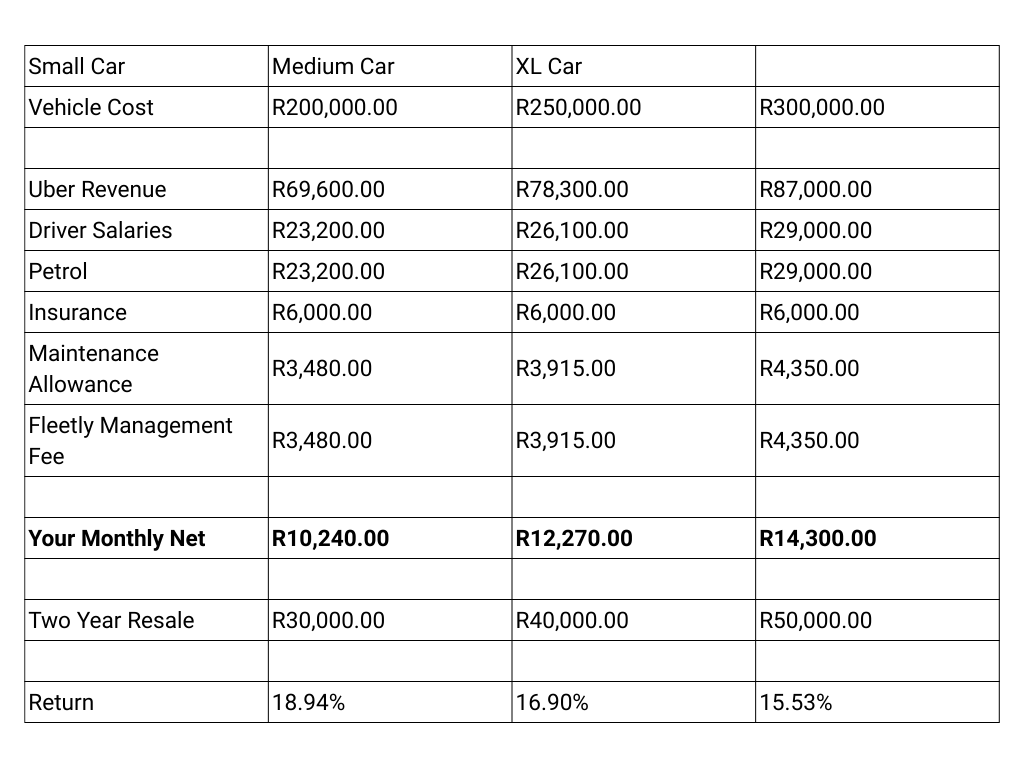
Fleetly solves these issues by assigning four drivers to each car: two full-time drivers who work on weekdays and two part-time drivers who work on weekends. “With us, the cars earn between R60 00 and R90 000 per month. Owners receive a net income between R 9000 and R 17 000,” he adds.

The table below shows earning estimates at full capacity.
*Please note that this is only indicative and may fluctuate in the market.

How Fleetly Works

Getting started is simple. Car owners can visit Fleetly’s website and click on “Manage My Car” to book a meeting with Luyanda. During the meeting, they discuss whether the car qualifies and what earnings to expect.

After that, they handle registration, assign drivers, and take over full management. The whole process takes about 2 to 4 weeks.

Fleetly handles everything, including insurance, driver salaries, maintenance, petrol and more. “Owners just get a monthly statement and their payment,” he explains.

A Better Life for Drivers

Fleetly is not just about making car owners money, it’s also changing the lives of drivers. All drivers go through a strict selection process, including vetting, interviews, and probation periods. Only 3% of applicants make it.

The drivers receive contracts, steady pay, and job security. Many use this opportunity to support their families and start saving. “Some drivers were at their lowest point when we met them. God used this vehicle to fetch them,” Luyanda smiles.

Trust, Technology, and Impact

The success of Fleetly depends significantly on trust and proven results. “We are our first customers. We have done this ourselves before offering it to the market.” He points out that most new clients come through referrals.

Fleetly’s tech system is fully digital, combining tracking, accounting, and driver performance tools. But Luyanda warns against putting too much focus on technology. “Tech is the means, not the goal. We are a people-based business that uses tech.”

Fleetly has already created hundreds of jobs and aims to create 1 000 in five years. “At this rate, we might hit that goal in our first year,” he says.

The Future of Fleetly

Fleetly’s vision goals extend beyond South Africa. They hope to expand, help more drivers become owners, and create more jobs.

“We want each driver to eventually become an owner, and pay it forward by creating more jobs,” Luyanda concludes.

Any owner who is stressed about managing their e-hailing business should consider Fleetly to avoid the hassle. Earn a great income and contribute to the economy by creating jobs.

Categories
Business- Africa

As funding slows, African venture capital doubles down on sustainable solutions

Hiruy Amanuel, co-founder, Gullit VC

Partner Content

After years of rapid expansion, the continent’s startup ecosystem is now adapting to a more measured pace, with investors emphasising sustainable business models and long-term value creation.

According to the African Private Equity and Venture Capital Association (AVCA), total funding for African startups declined by 46% in 2023 compared to the previous year. This slowdown mirrors trends in other emerging markets, where rising interest rates and macroeconomic uncertainties have led to tighter capital allocation. However, the recalibration has also sparked a strategic shift, with investors increasingly prioritising operational efficiency, profitability, and market resilience over unchecked growth.

“Investors are becoming more discerning,” noted Dario Giuliani, Director of Briter Bridges, a research firm specialising in African innovation. “The focus has shifted toward startups that demonstrate clear pathways to profitability and address critical market needs.”

Sectors with Enduring Potential

Despite the funding dip, certain sectors continue to attract significant attention, particularly those addressing Africa’s persistent infrastructure gaps.

Transport, healthcare, and logistics have emerged as key areas of interest, driven by their potential to deliver both financial returns and tangible social impact.

For example, digital mobility platforms are upscaling transportation across the continent, while health-tech startups are expanding access to affordable care in underserved regions. In logistics, innovative solutions are streamlining cross-border trade, a critical driver of economic growth in Africa.

Maya Famodu, Founder of Ingressive Capital, a leading VC firm focused on early-stage African startups, emphasised the importance of sector-specific investments. “We’re seeing a lot of traction in sectors like logistics and healthcare because they solve real, everyday problems for Africans. These are the areas where innovation can have the most immediate and measurable impact.”

Gullit VC: Creating a Shift in the Evolving Ecosystem

Amid these changes, Gullit VC, co-founded by Hiruy Amanuel, is a notable participant in Africa’s evolving VC landscape. Amanuel, who brings experience from Silicon Valley, recognised the untapped potential of Africa’s tech ecosystem and established Gullit VC to support startups in high-impact sectors.

The firm’s investment strategy aligns with broader market trends, focusing on startups that combine technological innovation with sustainable revenue models. “We’re seeing significant momentum in sectors like transport, healthcare, and logistics because they address fundamental challenges,”

Amanuel explained. “The key is backing companies that not only solve real problems but also have clear scalability and profitability potential.”

Spotlight on High-Impact Investments

Gullit VC’s portfolio reflects its sectoral focus, with investments in startups that are driving meaningful change across the continent. For instance, BuuPass, a digital mobility platform, is simplifying travel logistics for millions of Africans by enabling seamless ticketing for buses, trains, and flights. The platform’s recent expansion into South Africa and Nigeria highlights the growing demand for integrated transport solutions.

In healthcare, Gullit VC-backed WellaHealth is making strides in Nigeria by offering affordable telemedicine services, chronic care packages, and financial protection. As Africa grapples with healthcare infrastructure gaps, solutions like WellaHealth are proving essential in improving access and outcomes.

Logistics startup Logidoo, another Gullit VC portfolio company, is tackling one of Africa’s most pressing challenges: cross-border trade. By aggregating over 3,000 logistics suppliers and completing more than 100,000 operations across eight countries, Logidoo is helping to streamline trade flows. Its recent $1.55 million seed round is expected to support further expansion, including the launch of franchise networks in five additional countries.

A New Era for African Venture Capital

While challenging, the current funding environment is fostering a more disciplined approach to investment in Africa’s startup ecosystem. Investors are increasingly seeking out startups that balance innovation with financial sustainability, signaling a maturation of the continent’s VC landscape. This shift is creating opportunities for strategic investors to support businesses that address critical regional challenges while delivering long-term value.

Investors like Amanuel are at the forefront of this trend, making strategic funding decisions and offering mentorship to startups tackling pressing issues. The companies within Gullit VC’s portfolio, for instance, collectively employ a significant number of African engineers and technical professionals, generating both direct and indirect economic impacts. These efforts not only drive job creation but also contribute to skill development and innovation across the continent.

As African startups navigate this new chapter, venture firms like Gullit VC are playing a pivotal role in shaping a more resilient and impactful ecosystem. By prioritising long-term value creation over short-term gains, they are helping to lay the groundwork for a more sustainable future for African innovation.

Categories
Business- Africa

SMEgo Tackles SME Funding Challenges with SME South Africa

SMEgo Partners with SME South Africa to Tackle SME Funding Challenges

SMEgo, a digital platform powered by Old Mutual, has teamed up with SME South Africa to take part in this year’s SME Funding Summit. This key event focuses on unlocking access to finance for small and medium enterprises (SMEs).

The partnership underscores a shared commitment to support and empower the SME sector, which continues to face a range of hurdles. Access to funding remains one of the biggest challenges.

A Platform Built to Serve SMEs

SMEgo is part of Old Mutual’s broader SME strategy and is built to give entrepreneurs access to the tools and solutions they need to start, run, and grow their businesses. From funding to business insurance, cash flow tools, and financial tracking, all of this is available in one easy-to-use platform.

“First of all, this newly formed unit is a strategic step within Old Mutual because SMEs are the backbone of the economy,” explains Thandeka Dludla, Business Manager of the SME unit at Old Mutual. “We are doing a lot to empower them, but funding is the biggest need in the SME space. Across all industries and markets, that challenge is consistent.”

That’s part of the reason why partnering with SME South Africa for the Funding Summit was such a key move. “It was important for us to be there, in the room, showing up for the businesses we aim to support,” she adds.

Real Solutions for Real Business Needs

What SMEgo brings to the table is a broad range of funding options to tackle funding challenges. There’s no one-size-fits-all approach to SME finance.

“We’re here to listen,” says Dludla. “We want to hear what other players are doing and what SMEs are facing. Because we know we have solutions, from purchase order funding to asset finance and merchant cash advances, that can really make a difference.”

SMEgo is designed around the real challenges businesses face, like cash flow gaps and access to working capital. That’s why they’ve created a Funding Concierge, which brings together different types of funders in one place. It means businesses don’t have to waste time trying to figure out who offers what. They can find the right match quickly and easily.

“Not everyone is looking for a standard business loan,” Dludla explains. “Let’s say you’ve done the work but now you’re waiting to get paid. With invoice discounting, you can unlock cash against that invoice, easing that cash flow pressure.”

Other funding options available through the platform include contract finance, trade finance, and both secured and unsecured loans.

Walking the Road to Funding Readiness

But SMEgo isn’t just about connecting SMEs to money. It’s also about helping them get ready for it.

“We know not every entrepreneur is at the same point in their journey,” says Dludla. “That’s why we built this platform to also guide businesses on the path to funding readiness.”

That includes understanding key financial concepts like cash flow, credit health, and trade history, because those are the kinds of things funders look at. SMEgo offers tools to help businesses track cash inflows and outflows, monitor their credit scores, and build up the financial track record needed to apply for funding with confidence, regardless of their previous funding challenges.

“Most of our funders are debt funders,” she adds. “That means businesses need to be in a position to repay. It’s our job to help them understand what that means and get them there.”

Broader Access, More Opportunities

Every funder has its own criteria, and in some cases, that may include industry exclusions or risk considerations. But SMEgo’s mission is to keep the door open for as many SMEs as possible by partnering with a wide range of funders.

“We wanted to make the circle bigger,” Dludla says. “Different sectors have different needs, and we want to make sure those needs are met.”

While there are some limitations, like high-risk industries that some funders may avoid, the goal remains the same. SMEgo aims to provide businesses with clear, guided access to the financial solutions they need to grow.

Smarter Matching Through Tech

What makes SMEgo stand out is its use of smart matching. By answering a few simple questions, SMEs can be matched with funding options that align with their specific needs and business profile, without needing to scroll through long lists or guess who might help.

“Instead of businesses having to look for funders, the platform looks for them,” Dludla says. “It’s about making access to funding simpler, smarter, and more supportive.”

Categories
Business- Africa

Is Trade Credit Insurance Worth it for Small Businesses?

Is Trade Credit Insurance Worth it for Small Businesses
Trade credit insurance is a necessity for small businesses. One of the common issues faced by SMEs is non-payment from customers. Small businesses often extend credit to their customers as a way to boost sales and maintain competitiveness. However, this practice also comes with the risk of non-payment, which can have a significant impact on a company’s cash flow and overall financial stability.

This is where trade credit insurance comes in. It is designed to protect businesses from bad debt losses. By mitigating the risk of unpaid invoices, this type of insurance provides a safety net that allows businesses to confidently offer credit terms.

What Exactly is Trade Credit Insurance?

Trade credit insurance, also known as business credit insurance, is a form of business coverage that protects a business from losses that occur when clients and customers are unable to pay. One of your key customers could go into an insolvent state, and without insurance your business might go into financial distress.

Why Should Small Businesses Care?

According to Allianz Trade, 1 in 4 businesses fail due to late or non-payments from customers. While larger corporations often have legal teams to handle delayed payments, small businesses don’t always have that luxury. One large unpaid invoice can threaten monthly salaries or rent. In South Africa, where SME failure rates are already high, cash flow is everything.

The several benefits to having trade credit insurance, including:

Cash flow stability: You get to predict income and manage your cash flow effectively, even when customers default.

Increased confidence: You can extend credit to more customers, including new ones, with less risk.

Access to finance: Business credit insurance helps you increase the chances of your business being viewed favourably for funding.

Improved customer relationships: Trade credit insurance can help you build stronger relationships as you gain more confidence in providing credit.

Competitive advantage: Offering credit terms to customers can give you a competitive edge in the marketplace.

Professional risk management: By transferring the risk of bad debts to an insurer, you’re able to be proactive in your risk management, which can be beneficial when seeking investment or partnerships.

How Does Trade Credit Insurance Work?

Business credit insurance safeguards businesses from financial losses due to unpaid invoices. When a customer fails to pay for goods or services rendered, the insurance policy covers a significant portion of the outstanding debt.

For instance, if you own a packaging company and delivered goods worth over R50 000 to a regular customer, but you don’t receive your funds this time around because the company has gone into liquidation, you can claim a portion of that amount from your insurer.

This protection helps maintain a business’s cash flow and financial stability, especially for small businesses that are more vulnerable to the negative impacts of unpaid invoices.

What Are the Disadvantages of Trade Credit Insurance?

Like any insurance, there are exclusions and fine print. The downside includes the following:

Cost of premiums: It can be expensive, especially for small businesses or those in high-risk industries.

Exclusions and limitations: Policies often exclude high-risk buyers, disputes, or pre-existing overdue invoices.

Delayed claims process: Payouts may take time due to investigation and documentation requirements, which can badly affect cash flow.

Loss of control over credit decisions: Insurers may limit your ability to trade with certain customers or impose credit limits you must follow, even if you believe the customer is trustworthy.

Risk of dependency: Businesses may become overly reliant on insurance and neglect their internal credit control processes.

Not always fully covered: Insurers might only cover a portion of the loss (e.g., 90%), leaving you with a share of the bad debt.

How Do You Get Trade Credit Insurance in South Africa?

To get insured, you must first consider whether there is a need for it, and do your due diligence in comparing between the various insurance providers. Follow these steps:

Assess your risk: Are you offering large amounts of credit to a few key clients? Are you worried about late payments?

Speak to a broker: Insurance brokers specialising in commercial policies can help you find a trade credit solution tailored to your business size and needs.

Compare providers: Leading companies like Credit Guarantee Insurance Corporation (CGIC), Sanlam, and Hollard offer trade credit insurance. Compare pricing, pay out terms, and what’s covered.

Understand the terms: Before you sign, make sure you understand exclusions, claim processes, and how long it takes to get paid out. Speak to a professional, other than the sales consultant who might focus on pushing you to get the insurance.

Read here for more on other types of insurance for your business.

Categories
Business- Africa

6 Reasons Why Shoppers Abandon Their Carts

6 Reasons Why Shoppers Abandon Their Carts (And How to Keep Them Shopping)

Do you have users visiting your store and even adding items to their carts, but for some reason, they abandon their carts?

This is not only frustrating for a business owner, but it also leaves you wanting to figure out why this happens and how to prevent it from happening. While cart abandonment is something you should expect, there are some solid reasons why it occurs and ways to reduce how frequently it occurs.

1. Security Concerns

Cybercrime is a major e-commerce concern. One of the biggest dealbreakers for online shoppers is feeling unsure about whether their personal and payment information is safe. If your website looks outdated, doesn’t have HTTPS, or is missing security trust badges, customers may hesitate before entering their card details.

In South Africa, where online fraud is a genuine concern, trust is everything. Shoppers are more likely to complete their purchase if they feel confident in your site’s safety.

So, going forward, what should you do? Firstly, you must choose the right e-commerce platform for your business, then ensure you add SSL encryption, display trust signals like PayFast, Yoco, or Visa/MasterCard verified logos, and keep your site design clean and professional to boost credibility.

2. They Aren’t Making a Purchase (Right Now)

Sometimes, your customer isn’t saying “no” they’re just saying “not now.” Many people use their carts like wishlists. They might be comparing prices, waiting for payday, or just browsing with the intention to return later.

This kind of abandonment is common. The good news is, there are ways to encourage them to come back and make a purchase. Things you can do include sending reminder e-mails or WhatsApp messages with the items they left behind, offering them a small time-sensitive discount, or introducing a “save for later” button.

3. Shipping Costs and Delivery Uncertainty

Unexpected shipping fees are one of the fastest ways to lose a sale. If a shopper adds items to their cart only to discover high delivery charges or unclear timelines on when to expect their order, they’re likely to abandon their cart.

C-commerce stores price their items higher to provide free shipping. State delivery times clearly based on region, and partner with trusted local couriers like The Courier Guy or Fastway to provide reliable, trackable service.

4. No Return Policy

Every shopper wants peace of mind in knowing the item they are buying is worth their money. If your return or refund policy is missing or vague, this can scare off cautious buyers. It can especially scare off first-time shoppers. If your website has a clear return policy, it reduces the risk of buying from you.

To lessen the amount of abandoned carts in your online store, add a “Returns & Refunds” link to your product pages and checkout. Make the terms easy to understand, fair, and customer-friendly.

5. Lack of Variety in Payment Options

South African shoppers don’t all use the same payment method. While some prefer cards, others rely on instant EFT, mobile money, or Buy Now Pay Later (BNPL) options like Payflex or Mobicred. Additionally, platforms like Google Pay enhance the shopping experience for e-commerce customers. If your checkout only supports one or two options, you’re turning away potential buyers.

Integrate multiple local payment gateways to accommodate more preferences. If you’re looking to offer credit in a way that protects you, offering Payflex or a similar BNPL service makes that possible.

6. A Sketchy Website

Building a reliable e-commerce website should be a no-brainer. Users may browse through your website and add items to their cart, but adding their personal banking information, and risking losing their money to a sketchy website is not something they’ll overlook. Your store might have amazing products, but if your website isn’t user-friendly, your customers will be discouraged from checking out.

Things like slow load times and difficult navigation on your website can be a major turn-off. It’s also crucial not to overlook mobile optimisation, especially since there’s a rise in mobile commerce (m-commerce).

Make it Easy for Your Customers to Say Yes

If you ensure that everything related to the customer experience on your website is sorted, that will make it easy for your customers to purchase from your website.

You must understand the specific needs and concerns of your customers. This includes understanding the need for various payment methods.

Ultimately, making it easy and enjoyable for your customers to shop is the key to boosting sales and growing your online business.

Categories
Business- Africa

What You Need to Start a Storage Business in South Africa

What You Need to Start a Storage Business in South Africa

Owning a self-storage business in South Africa can be highly profitable. Think about how many people live in small apartments, move between cities or countries, or run businesses that lack space for extra furniture, equipment, or files. There’s a constant need for secure, affordable storage solutions, and if you can meet that need, there’s money to be made.

But a profitable business doesn’t mean an easy one. Starting a successful storage business takes careful planning, capital investment, and the right systems. Here’s what you need to know before getting started.

You Need a Solid Business Plan

The most important place to begin is with a well-thought-out business plan. Don’t rush into building or buying storage units without understanding the market. Ask yourself:

  • Who will your customers be? (e.g., homeowners, small businesses, migrants)
  • Is there already a demand for storage in your area?
  • What size units will you offer, and how will you price them?
  • Will your facility be container-based, warehouse-style, or a mix?

Planning also helps you strategically scale your business in a manageable way. Instead of overcommitting upfront, it’s often better to start small and expand based on actual demand. A business plan not only keeps you focused but also increases your chances of securing funding.

Start-up Essentials for a Storage Business

Even if you start on a smaller scale, there is a range of costs and essentials you need to prepare for when you’re planning to start your storage business. The cost depends heavily on your location and scale. A small facility with 10–20 containers could cost several hundred thousand rands to get up and running. Here’s what you’ll likely need to invest in:

Land: You need a plot in a location that’s accessible but not too expensive. Look at industrial areas or land near transport routes.

Site preparation: Depending on the condition of the land, you may need to clear vegetation and flatten the area.

Storage containers or units: Whether you’re using shipping containers or building storage rooms, these are your core business assets.

Security systems: This is critical. You’re dealing with people’s valuables, so expect to install fencing, automated gates, CCTV, motion detectors, and hire security staff.

Admin and yard staff: A small team is needed to manage bookings, payments, customer service, and to look after the property.

Inventory tracking: Even if you don’t handle the contents directly, you’ll need to log who is renting each unit, for how long, and manage keys or access codes securely.

Payment systems and policies: What happens if someone doesn’t pay? You’ll need a clear, enforceable policy, possibly including an auction process for abandoned goods.

Legal support: A lawyer can help you draft rental agreements, advise on liability issues, and guide you through any necessary legal processes when tenants default.

Insurance: It’s important for your business to have warehouse or storage insurance to protect items in the storage facility.

How to Get Funding for a Storage Business?

Securing funding can be a challenge, but not impossible. You’ll need to show lenders or investors that your idea is viable. Here are a few tips:

Prove demand: Conduct surveys, research local competitors, and use stats to show there’s a gap in the market.

Have a strong business plan: Include financial projections, a breakdown of startup and running costs, marketing strategy, and a growth timeline.

Make your business “bankable”: Register your company, get your compliance in order, and build credibility with early customers if possible.

There are quite a few financing options for self-storage businesses, which are:

  • Traditional bank loans.
  • Construction loans for building permanent structures.
  • Asset finance (to purchase containers or equipment).
  • Private investors or partnerships.
  • What Are the Pros and Cons to Owning a Storage Business?

Pros

High demand: As people continue to move, downsize, or run space-limited businesses, the need for storage keeps growing.

Recurring income: Monthly rentals create a predictable cash flow.

Scalability: You can start with just a few units and grow gradually.

Low day-to-day involvement: Once set up, the business can largely run itself with the right staff and systems.

Cons

High upfront investment: The costs of land, containers, and security add up fast.

Regulatory challenges: Zoning laws and permits may affect where and how you operate.

Security liability: Any theft or damage could harm your reputation and lead to legal issues.

Slow ROI: Depending on your pricing and market uptake, it might take time before you see significant profit.