Categories
Nigeria

President Tinubu’s Three Years of Infrastructure Transformation – THISDAYLIVE

By Jobson Oseodion Ewalefoh

Every nation reaches a defining moment when reform moves beyond promise and becomes real, visible on the roads people travel, the hospitals they enter, and the infrastructure that powers their daily life. For Nigeria, that moment is no longer ahead. It is here.
Three years since President Bola Ahmed Tinubu, GCFR, assumed office on May 29, 2023, the evidence is no longer measured only in policies announced. It is measured in concessions signed, airports handed over, power plants commissioned, and investors arriving at our doorstep with capital in hand. This administration is no longer defined simply by the courage to make tough decisions, but by the visible results those decisions are delivering.
The road here was not easy, and President Tinubu never pretended it would be. According to the National Bureau of Statistics (NBS), he inherited an economy under severe strain, a fiscal deficit at 5.4% of GDP, net foreign reserves of $3.99 billion, and an investor community that had grown deeply skeptical of Nigeria’s promises. In those first decisive hours, he told Nigerians the truth about the cost of the journey ahead. The subsidy removal, the exchange rate unification, and the coordinated fiscal and monetary reforms that followed were acts of political courage rarely seen in any democracy. They also reflected strategic foresight, because no nation can attract the private capital needed to build a modern economy while continuing to subsidize a broken status quo.

A Nation the World Now Trusts
Three years on, the verdict of the world’s most respected financial institutions tells the story better than any government statement can.
Nigeria’s external reserves have climbed from a net $3.99 billion in 2023 to about $50 billion in May 2026. The fiscal deficit has been more than halved, from 5.4% to 3.0% of GDP. GDP grew at 4% in 2025, while the World Bank has projected a 4.2% growth rate for 2026. The Nigerian Exchange Group (NGX) posted a 48.12% gain in 2025. Foreign direct investment surged to $720 million in Q3 2025, up from $90 million one quarter prior.
Beyond these numbers, a cascade of independent global validations has reshaped how the world sees Nigeria.
In 2025, Fitch Ratings upgraded Nigeria’s long-term issuer default rating from B- to B, citing exchange rate liberalization and sustained fiscal reform. Moody’s also raised Nigeria’s sovereign outlook, pointing to policy consistency and a stronger external position. On May 15, 2026, S&P Global Ratings announced Nigeria’s first upgrade in fourteen years, lifting the country’s rating from B- to B with a stable outlook, supported by sustained structural reforms, stronger reserves, and growing domestic refining capacity.
In October 2025, Nigeria exited the Financial Action Task Force (FATF) grey list, signaling stronger financial governance and lower risk premiums. In April 2026, FTSE Russell restored Nigeria from “Unclassified” to Frontier Market status, reopening the country to global index funds and the capital flows that follow.
Nigeria also deepened engagement with major international financial institutions. In March 2025, the country became the 77th shareholder of the European Bank for Reconstruction and Development (EBRD). By early 2026, the EBRD had signed a $100 million trade finance facility with Access Bank Nigeria Plc, while its President, Odile Renaud-Basso, visited Nigeria to strengthen the country’s position as the institution’s hub for expansion in Sub-Saharan Africa. The International Finance Corporation (IFC) also advanced major financing commitments into Nigeria’s private sector to develop a pipeline of bankable PPP projects across transport, energy, ICT, and sanitation.
Each of these is an independent verdict rendered by institutions that do not respond to rhetoric. They respond to results. And the results are what this administration has delivered.
Nigeria’s macroeconomic reforms were never an end in themselves. They were necessary to unlock long-term infrastructure investment. Public private partnerships (PPPs) thrive on investor confidence, fiscal stability, transparent market signals, and policy consistency. No serious investor commits capital to airports, power plants, highways, or seaports in an uncertain economic environment. By restoring credibility and stability, these reforms repositioned Nigeria as a destination for long-term PPP investment and infrastructure financing.

The Signal: A Summit That Moved the World
In June 2025, President Tinubu convened the Nigeria PPP Summit, hosted by the Infrastructure Concession Regulatory Commission (ICRC) themed “Unlocking Nigeria’s Potential: The Role of Public Private Partnerships in Delivering the Renewed Hope Agenda.” Represented by Vice President Kashim Shettima GCON, the President brought the African Development Bank (AfDB), the IFC, Afreximbank, Africa50, UK-Nigeria Infrastructure Facility, International Development Island (IDI), Nigerian Economic Summit Group (NESG), African Export Import Bank (Afrixem), PAC Capital and leading private sector institutions to Abuja not as observers, but as partners ready to deploy capital.
His message was plain: “What matters to the average Nigerian is not promises, but, roads to their farms, access to clean water, modern hospitals, and quality schools. We must build. We must deliver. And we must do it together.”
For decades, infrastructure conversations in Nigeria often ended at conferences, communiqués, and announcements. What is changing now is execution. The difference Nigerians are beginning to see is that projects are no longer trapped between announcement and abandonment.
The President matched those words with action. In August 2025, the ICRC introduced new PPP guidelines under presidential directive, devolving powers of approval so ministries can clear projects worth up to twenty billion naira and agencies up to ten billion naira. The Commission also pledged to issue compliance certificates within days, while a model PPP agreement template developed with the Federal Ministry of Justice (FMoJ) is scheduled for release in June 2026. These are more than procedural changes. They represent a structural shift in how Nigeria works with the private sector, one designed to be more transparent, more efficient, and more effective in turning policy into delivery.

The Proof: Projects Delivered Across Every Sector
Between 2023 and today, the FEC approved over Seventeen PPP projects under President Tinubu’s leadership. Each represents private capital being mobilised for public infrastructure and national development.
Other older PPP projects are also now attracting needed private sector investment under this administration.
Aviation: Akanu Ibiam International Airport, Enugu, concession signed and airport handed over to a private operator in July 2025. Port Harcourt International Airport approved in November 2025. V-PASS contactless biometric verification system is currently being deployed across Nigerian airports. MMA2 dispute resolution, where President Tinubu resolved a twenty-year concession stalemate, reinforcing contract sanctity and restoring investor confidence in the aviation sector.
For years, Nigeria’s aviation concessions struggled under uncertainty and disputes. The current administration has instead used contract sanctity as a signal to investors that agreements will survive political transitions and remain protected under the law.
Energy: Farin Ruwa 20MW Hydropower Project, Nasarawa State has achieved commercial close, and implementation underway since October 2025. Ikere Gorge 6MW Hydropower Plant, Oyo State, was handed over to the concessionaire in January 2026. Katsina Ala 460MW Hydropower Plant, Benue State has achieved commercial close in May 2026. Onne Port 50MW and Apapa Port 36MW Independent Power Projects, both certified and advancing.
The significance of these projects lies not only in megawatts generated, but in the deliberate use of private capital to close longstanding infrastructure gaps that government funding alone cannot address.
Maritime: Ondo Multipurpose Deep and Bakassi Deep Seaports both approved in December 2025 to expand cargo capacity and reduce pressure on existing ports. Federal Coastal Fishery Terminal, Borokiri, Rivers State, approved in May 2025.
These projects are expected to reshape regional trade logistics, unlock industrial corridors, and position Nigeria more competitively within continental and global maritime commerce.
Health: MEDIPOOL is meant to centralise the procurement and distribution of medicines, vaccines, and consumables nationwide under a coordinated PPP framework.
Digital governance: Product Authentication and Tracking System commercial close achieved in March 2026 to combat counterfeiting and strengthen revenue assurance. Smart National Transport Data Bank approved under the Nigerian Institute of Transport Technology (NITT), creating a real-time digital intelligence backbone across road, rail, air, and marine transport.

The Road Ahead
Nigeria’s infrastructure deficit stands at an estimated $2.3 trillion. Closing it requires approximately $100 billion annually, far beyond what public spending alone can provide. That is precisely why President Tinubu has made PPP not just a policy, but a presidency-defining commitment. A new national PPP project pipeline, soon to be published by the ICRC, will give investors structured, real-time visibility into Nigeria’s most investment-ready opportunities across every sector and region.
Three years ago, President Tinubu promised not an easy path, but a rebuilt one. He promised to replicate across Nigeria what infrastructure development had achieved in Lagos. Project by project, concession by concession, reform by reform, that promise is steadily taking shape.
The Renewed Hope Agenda is no longer a vision document. It is a construction site stretching from Enugu’s airport to Rivers State’s fishery terminal, from Benue’s dam to Nasarawa’s highlands, from Aba’s factory floors to the ninety thousand kilometres of fibre cable being laid across Nigerian territory. Infrastructure that Nigerians can see, touch, and use.
At the PPP Summit, the President articulated an unambiguous message: the Nigerian people are not asking for pledges — they are asking for results. They seek reliable electricity in their homes, accessible roads to their farmlands, functional healthcare facilities, and schools that open their doors every day without fail. That is precisely the vision being pursued and translated into reality. And the international community, having thoroughly assessed the progress made, has resolved to be a partner on that journey
Every concession signed, every dam commissioned, and every infrastructure milestone achieved represents a firm investment in Nigeria’s shared future. The world is choosing Nigeria because it recognises a nation serious about reform and delivery. Yet realising this vision demands more than government effort alone — it calls for unity, collective resolve, and the commitment of every Nigerian behind President Bola Ahmed Tinubu’s agenda for a stronger, more prosperous nation. This is a moment that requires all hands on deck.

*Jobson Oseodion Ewalefoh, PhD is the Director General/CEO, Infrastructure Concession Regulatory Commission

Categories
Nigeria

30,000 armed Fulani militants driving Nigeria’s insecurity — US Report

Nasarawa attack

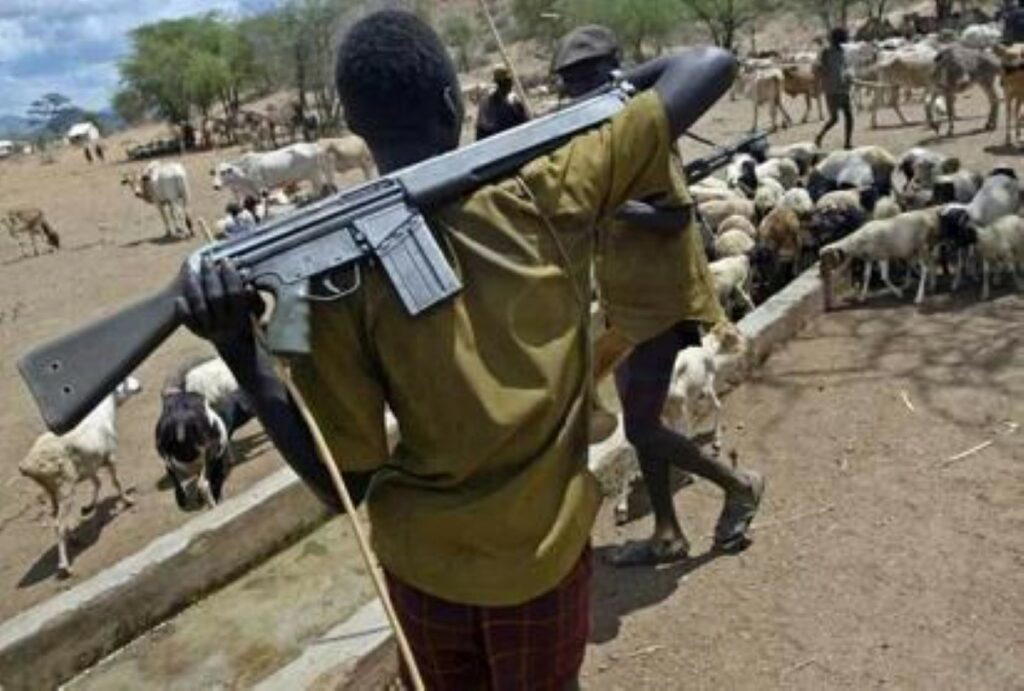
A report by the United States Commission on International Religious Freedom, USCIRF, has revealed that an estimated 30,000 armed Fulani militants are currently operating across Nigeria, worsening insecurity and religious freedom violations in several parts of the country.

The report, released in May 2026 and titled “Nonstate Violators of Religious Freedom in Nigeria: Fulani Militants,” described the armed groups as some of the deadliest non-state actors responsible for violent attacks across the Middle Belt and Southern Nigeria.

According to the commission, the militants operate in clusters ranging from 10 to 1,000 fighters, carrying out coordinated assaults that have led to thousands of deaths, mass displacement and heightened religious tensions.

USCIRF stated that attacks linked to Fulani militants accounted for the highest number of deaths among religious communities in Nigeria in the past year, surpassing casualties attributed to organised insurgent groups and criminal gangs.

The report noted that although many attacks targeted Christian communities, Muslim communities had also suffered killings, kidnappings and raids.

It stated: “Violence by Fulani militants caused the highest number of deaths among all religious communities in Nigeria over the last year compared to attacks by organised insurgent groups and criminal gangs.”

The commission explained that while the groups lacked a central leadership structure, some factions occasionally collaborated with bandit networks and extremist organisations.

“These actors operate in a variety of contexts and with a multiplicity of likely aims and motivations,” the report said.

“While many Fulani militant groups wage independent attacks, others periodically coordinate with a wide range of actors, from conventional bandit gangs seeking financial enrichment to recognised terrorist organisations that espouse violent interpretations of Islam.”

USCIRF further disclosed that the militants often attack vulnerable rural communities at night, using motorcycles, automatic weapons and machetes to instill fear and force residents off their lands.

“They often wield machetes and descend on vulnerable communities during the night, eliciting terror as a way to force victims to quickly leave and to achieve greater control of desired land,” the report added.

According to the commission, attacks by Fulani militants and other armed groups have displaced at least 1.3 million people across the Middle Belt, with many victims now living in overcrowded camps lacking adequate security and sanitation.

The report highlighted several major attacks recorded in 2025 and early 2026, including killings in Benue and Plateau states.

It cited a June 2025 attack in Benue State in which at least 200 persons, including internally displaced persons taking shelter in a Catholic mission, were reportedly killed.

USCIRF also referenced the Yelwata massacre in Benue State, where more than 200 Christians, mostly women and children, were allegedly killed, while over 3,000 others were displaced.

The commission stated that some attacks were deliberately carried out during Christian religious celebrations to maximise psychological impact.

“Militant actors have often carried out operations during Christian holidays such as Christmas or Easter to further maximise the psychological impact,” the report noted.

It further disclosed that in February 2026, suspected Fulani militants killed at least 32 persons in Niger State and attacked Holy Trinity Parish in the Kafanchan Diocese of Kaduna State, killing three persons and abducting 11 others, including the parish priest, Father Nathaniel Asuwaye.

The report also documented attacks on Muslim worshippers.

According to USCIRF, armed men abducted an imam and seven worshippers from a mosque in Plateau State in February 2026 and later demanded a ransom of N16 million.

The commission said Palm Sunday and Easter attacks in April 2026 also left dozens dead across Plateau, Kaduna and Benue states.

“On Easter Sunday, Fulani militants reportedly killed five worshippers at two churches in Kaduna State while abducting 31 others,” the report stated.

USCIRF noted that conflicting narratives surrounding the violence had complicated efforts to establish the exact motives behind the attacks.

While some analysts attributed the violence to environmental pressures, land disputes and economic competition, others viewed the attacks as part of a broader campaign targeting non-Muslim communities.

“In fact, multiple and overlapping factors, including religion in many cases, likely spur Fulani militants to attack communities or individuals,” the commission observed.

The report also criticised the response of federal and state authorities, alleging that security agencies were often slow in responding to attacks.

“Victims have long reported that security forces are consistently slow to respond to attacks on their communities,” USCIRF stated.

It added that some Christian advocacy groups accused security operatives of showing bias toward Muslim communities during investigations and security operations.

The commission, however, noted that efforts were being made to address the crisis.

It disclosed that governors from 11 states launched an initiative in June 2025 to establish ranches for herders as part of measures to reduce clashes over grazing routes and farmlands.

At the federal level, the report linked renewed government actions to the October 2025 decision by the United States government under President Donald Trump to designate Nigeria as a Country of Particular Concern over religious freedom violations.

According to the report, President Bola Tinubu subsequently classified kidnappers and violent armed groups, including Fulani militants, as terrorists in December 2025.

USCIRF further stated that Nigerian security agencies rescued 309 kidnapped victims in January 2026 during operations in Kogi and Kwara states, while 129 suspected Fulani militants were arrested and 55 others killed.

The report also drew attention to the Miyetti Allah Cattle Breeders Association of Nigeria, which has faced criticism from some Christian leaders over alleged failure to curb militant activities and land invasions.

However, the association denied any involvement in criminality.

“We do not support, condone, harbour, finance or protect any form of criminality, extremism or violence,” the association said, according to the report.

USCIRF disclosed that the US Congress introduced the Nigeria Religious Freedom and Accountability Act of 2026 in February, proposing sanctions against the association over alleged involvement in severe religious freedom violations.

Despite ongoing security operations and peace-building initiatives, the commission warned that insecurity remained widespread across central Nigeria.

“As a result, central Nigeria remains entrenched in an intense, daily and seemingly perpetual crisis of insecurity,” the report concluded.

It added that the violence was likely to persist until both federal and state governments created conditions capable of guaranteeing the safe practice of religious freedom across affected communities.

The post 30,000 armed Fulani militants driving Nigeria’s insecurity — US Report appeared first on Vanguard News.

Categories
Nigeria

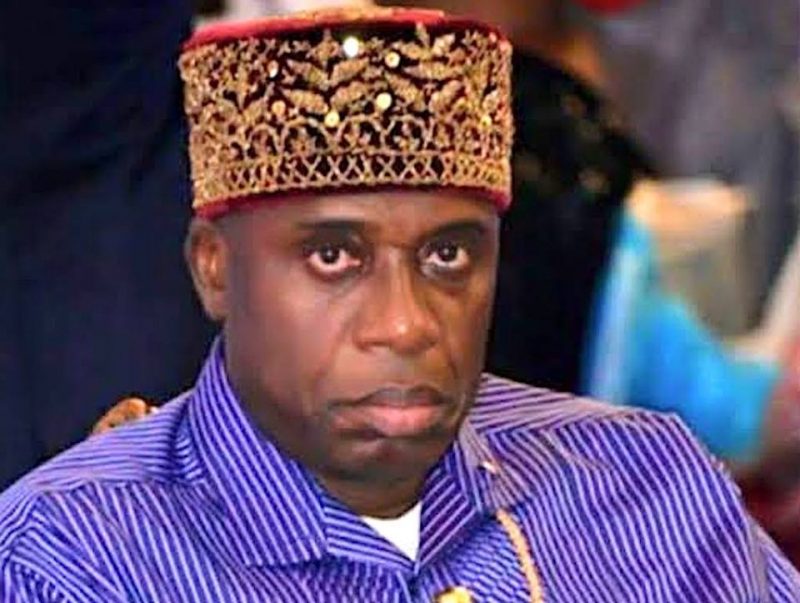
2027: ‘You can’t condemn rigging and write results’, Amaechi tells ADC

Amaechi

By Luminous Jannamike

ABUJA — Former Minister of Transportation and presidential aspirant on the platform of the African Democratic Congress, Chibuike Rotimi Amaechi, on Tuesday rejected the outcome of the party’s presidential primary, accusing the leadership of disenfranchising members and manipulating the process.

The rejection opens a fresh crisis within the ADC at a critical moment for the opposition party, which has been presenting itself as a credible alternative to the ruling All Progressives Congress ahead of the 2027 presidential election.

In a statement posted on X, Amaechi said he was rejecting what he described as ‘concocted results’ following reports of widespread voter disenfranchisement during the primary across the country.

Amaechi said, “I had initially stated that I will only accept the outcome of the Primaries if the process was free, fair, and transparent, and I stand by my word.

“I will not accept results from a process that does not reflect the values that the ADC had pledged to uphold, to rescue Nigerians from the impunity and gross mismanagement that our country is currently facing in the hands of the ruling party.”

The former Rivers State governor alleged that nearly 80 per cent of party members were denied the opportunity to vote during the exercise.

“There’s no way that about eighty percent of members of the party were not allowed to vote, and you expect me to accept such results. Then what makes us different from the others?” he asked.

Amaechi said the ADC was created to give ordinary Nigerians a voice and offer a genuine alternative to the kind of politics it once condemned.

Criticising the party leadership, Amaechi said: “A party that criticizes the ruling APC and INEC for vote buying, rigging and writing of results, cannot be engaged in vote buying, writing of results, and other electoral malpractices that leads to the disenfranchisement of voters who are party members. This is not acceptable!”

The remarks are expected to deepen tensions within the ADC and intensify scrutiny of the party’s presidential primary process as opposition parties prepare for the 2027 general election.

The post 2027: ‘You can’t condemn rigging and write results’, Amaechi tells ADC appeared first on Vanguard News.

Categories
Nigeria

Ogun  Warns AIG against Interference in Land Grabbing Prosecution – THISDAYLIVE

James Sowole in Abeokuta

The Ogun State Government has warned a senior police officer attached to the Force Intelligence Department, Abuja, Assistant Inspector General of Police, Enyinnaya Adiogu, to immediately stop what it described as a parallel investigation into an ongoing land grabbing case involving the World Mission Agency (WMA), owners of Living Faith Church Worldwide in Sango-Ota.

In a letter dated May 23, the Ogun State Attorney General and Commissioner for Justice, Oluwasina Ogungbade, warned the officer against investigating allegations of criminal conspiracy, threat to life, and illegal possession of firearms reportedly lodged against the mission by one Ibrahim Gbenga Ibuoye.

The government said Ibuoye is currently facing prosecution before a Magistrates’ Court in Abeokuta over allegations bordering on forceful entry into another person’s land, forceful takeover of land, and the use of threats and violence in connection with the disputed property.

According to Ogungbade, the matter is already before a competent court, making any parallel police investigation improper and capable of undermining judicial proceedings.

“It is settled law that when a case is pending in court, no person must take any steps calculated to or capable of usurping the jurisdiction of the court,” the Attorney General stated.

He questioned why a defendant already standing trial since 2025 would suddenly turn himself into a complainant against those involved in the pending criminal matter.

The commissioner accused Ibuoye of disregarding the rule of law by approaching the Force Headquarters and presenting himself as a complainant after allegedly trespassing on land belonging to WMA — land which the government said is backed by valid ownership documents and approvals issued by the Ogun State Government.

Providing background to the dispute, Ogungbade explained that WMA reportedly acquired the land around 2001 from a family recognised as the rightful owner by the Ogun State High Court. The property was subsequently fenced by the organisation.

He alleged, however, that Ibuoye and another suspect unlawfully demolished the fence, forcefully occupied over 100 acres of the land, and carried out illegal sand mining activities that severely degraded the property.

The Ogun State Government consequently directed the police officer to terminate any ongoing parallel investigation relating to the dispute, withdraw all invitations extended to officials of WMA, and comply with existing directives from the Inspector General of Police against duplication of case files.

The state government also acknowledged the efforts of successive Inspectors General of Police in curbing abuse of police processes and discouraging parallel investigations in matters already before competent courts. It specifically commended the immediate past police leadership of Kayode Egbetokun and the current Inspector General of Police, Olatunji Disu, for their commitment to professionalism and efforts aimed at putting a stop to the kind of conduct complained about in the letter.

The government further warned that failure to comply with the directive could result in legal action against the officer.

Categories
Nigeria

Ebola outbreak will get worse as cases rise in DRC, Uganda – WHO

WHO worries over high rate of COVID-19 infections as 3m die globally

By Chioma Obinna

The World Health Organisation, WHO, on Monday raised fresh alarm over the rapidly spreading Bundibugyo Ebola outbreak in the Democratic Republic of Congo, DRC, and neighbouring Uganda, warning that the epidemic is outpacing response efforts and could worsen in the coming weeks.

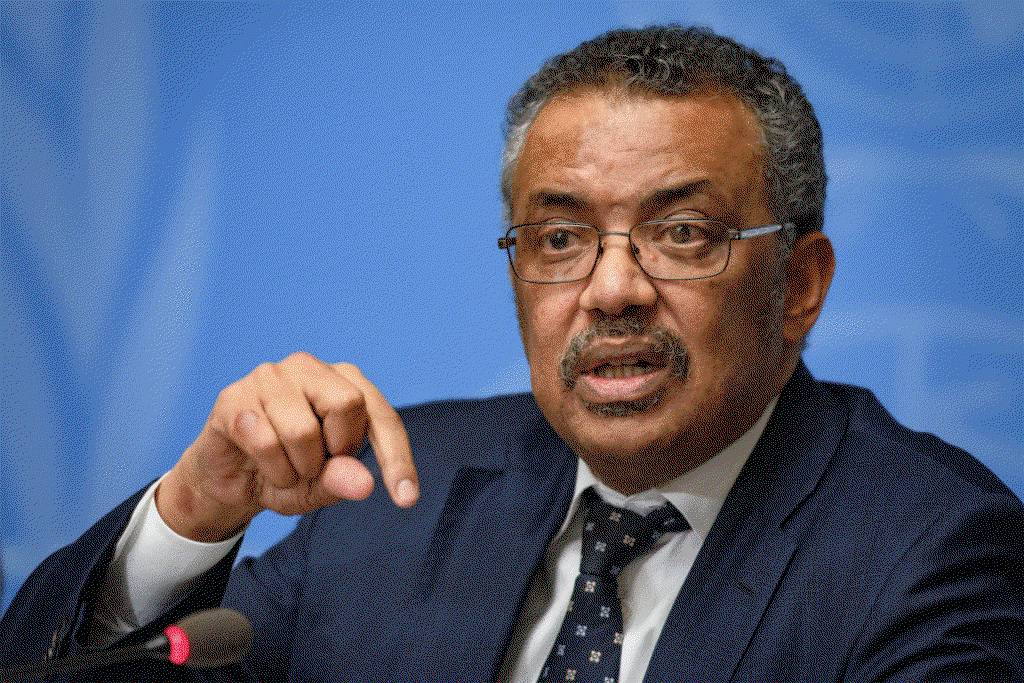
Speaking at a virtual ministerial briefing convened by the Africa Centres for Disease Control and Prevention, WHO Director-General Tedros Ghebreyesus described the outbreak as extremely serious and difficult, revealing that more than 900 suspected cases and 220 suspected deaths have already been recorded in DRC.

“So far, 101 cases have been confirmed in DRC, with 10 confirmed deaths. But we know the epidemic in DRC is much larger. In the early hours of Sunday, May 17, I declared the Ebola outbreak in DRC a Public Health Emergency of International Concern after consulting the Ministers of Health of both DRC and Uganda, and following Africa CDC’s notification,” Tedros said.

He disclosed that WHO had upgraded the national risk assessment in DRC from “high” to “very high,” while maintaining regional risk at “high.”

Countries bordering DRC, he warned, are particularly vulnerable and must take immediate preventive action.

“In Uganda, there are five confirmed cases and one death,” he said, commending President Yoweri Museveni for cancelling this year’s Martyrs’ Day celebrations, an annual religious event that attracts nearly two million people.

“I appreciate the leadership of President Museveni in cancelling the Martyrs’ Day commemoration to prevent further spread of the virus,” he added.

Tedros noted that insecurity and public distrust in eastern DRC are worsening the crisis.

“The delay in detecting the outbreak means that we are now playing catch-up with a very fast-moving epidemic. We are urgently scaling up operations, but at the moment, the epidemic is outpacing us.”

According to him, intensified fighting in the provinces of Ituri and North Kivu has displaced more than 100,000 people in recent months, complicating surveillance and response operations.

“There is also significant distrust of outside authorities among the local population. In the past week, there have been two security incidents at health facilities,” he stated.

“Building trust in affected communities is critical to a successful response and is one of our highest priorities.”

The WHO chief further disclosed that there are currently no approved vaccines or therapeutics specifically for the Bundibugyo strain of Ebola, which has only caused two previous outbreaks — in Uganda in 2007 and DRC in 2012.

“Last week, WHO convened leaders of several partner organisations to review the pipeline of vaccines, therapeutics and diagnostics,” he said.

“WHO has recommended prioritising two monoclonal antibodies to advance in clinical trials. We are also recommending evaluation of the antiviral obeldesivir in a clinical trial as post-exposure prophylaxis for high-risk contacts.”

He added that the clinical trial is being jointly developed with Africa CDC and the Collaborative Open Research Consortium on Filoviruses.

Tedros said WHO had already released $3.9 million from its Contingency Fund for Emergencies to support response efforts and announced plans to travel to DRC alongside Chikwe Ihekweazu.

He stressed that unity among African nations and international partners would determine how quickly the outbreak could be contained.

“We are facing an extremely serious and difficult outbreak. It will get worse before it gets better. But we know this virus, and we know how to stop it. We have stopped every previous Ebola outbreak, and we will stop this one too.

“The question is just how quickly we can do it, and how many more lives will be lost before we do,” he said.

The post Ebola outbreak will get worse as cases rise in DRC, Uganda – WHO appeared first on Vanguard News.

Categories
Nigeria

Kwara PDP Guber Candidate Pledges to Turn Around State’s Economy for Prosperity – THISDAYLIVE

Hammed Shittu in Ilorin

The governorship candidate of Peoples Democratic Party(PDP) in Kwara state, Engineer Sulaiman Bolakale Kawu, yesterday pledged to turn around the state’s economy for the economic prosperity of the rural populace.

Kawu made the pledge in Ilorin on Sunday after the stakeholders of the party affirmed his candidature of the party for the 2027 election during the PDP primaries held in Ilorin.

He said, “We are coming back to restore hope, revive infrastructure, improve education, support our farmers, empower our youths and women, strengthen healthcare delivery, create economic opportunities, and return Kwara State to the path of security, growth, dignity and economic prosperity.

“The struggle ahead is greater than what we have passed through. The task before us is enormous.

“Our people desire a government that listens, a government that cares, and a government that works for everybody irrespective of political affiliation, religion or ethnicity.

“Together, with unity, determination, and the support of the people, we shall overcome”.

He thanked every leader, especially the former Senate President, Dr. Abubakar Bukola Saraki, stakeholders, elders, youths woma and loyal members of the Peoples Democratic Party across the sixteen local governments of Kwara State for the confidence and trust reposed in him.

Kawu said, “This victory is not mine alone. It is a collective victory. It is a victory for every aspirant who, despite personal ambition and aspiration, invested resources, energy, time, and political capital in mobilising our people and strengthening our party across the state.

“Your sacrifices, consultations, maturity, and commitment to the survival and unity of our great party brought us to this defining moment. History will remember your patriotism, sportsmanship, and loyalty to the PDP family.

“Most importantly, this is a victory for the resilient people of Kwara State, Kwarans who have remained hopeful, patient, loyal, and committed to the dream of a better and more prosperous state. Your faith in the possibility of a greater Kwara has kept this movement alive”.

He also used the occasion to thank other aspirants, delegates, stakeholders, party faithful, INEC observers from Abuja, members of the press, and the entire people of the State.

Categories
Nigeria

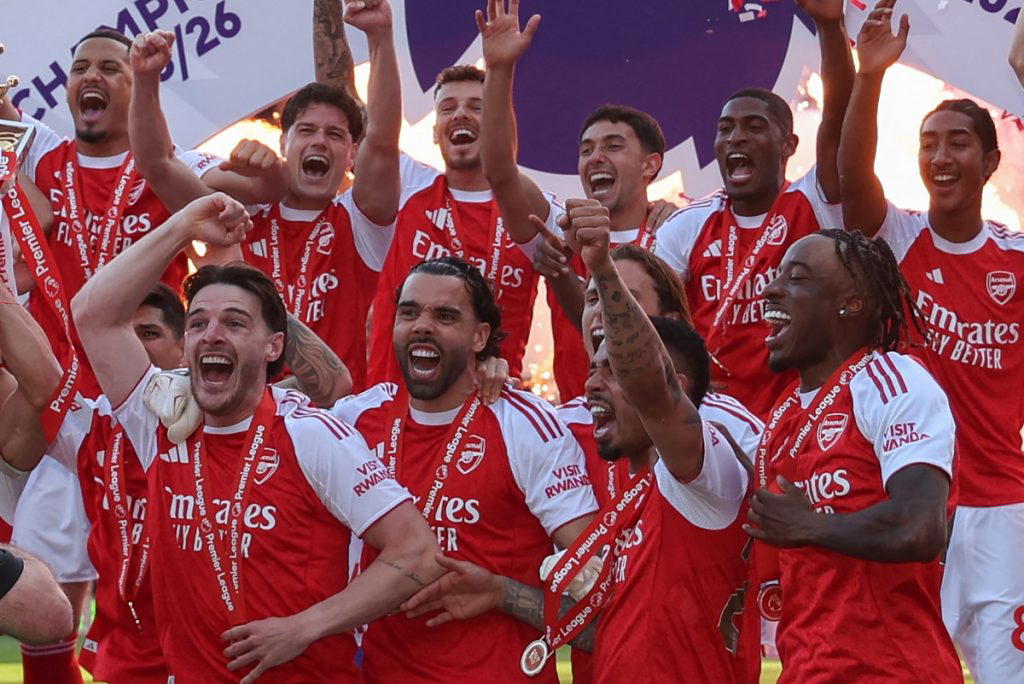
Photos: Arsenal lift Premier League trophy after 22 years

Photos: Arsenal lift Premier League trophy after 22 years

Arsenal lifted the Premier League trophy after celebrating their first game as champions with a 2-1 win against Crystal Palace on Sunday.

Mikel Arteta’s side clinched their first English title for 22 years on Tuesday when second-placed Manchester City drew at Bournemouth.

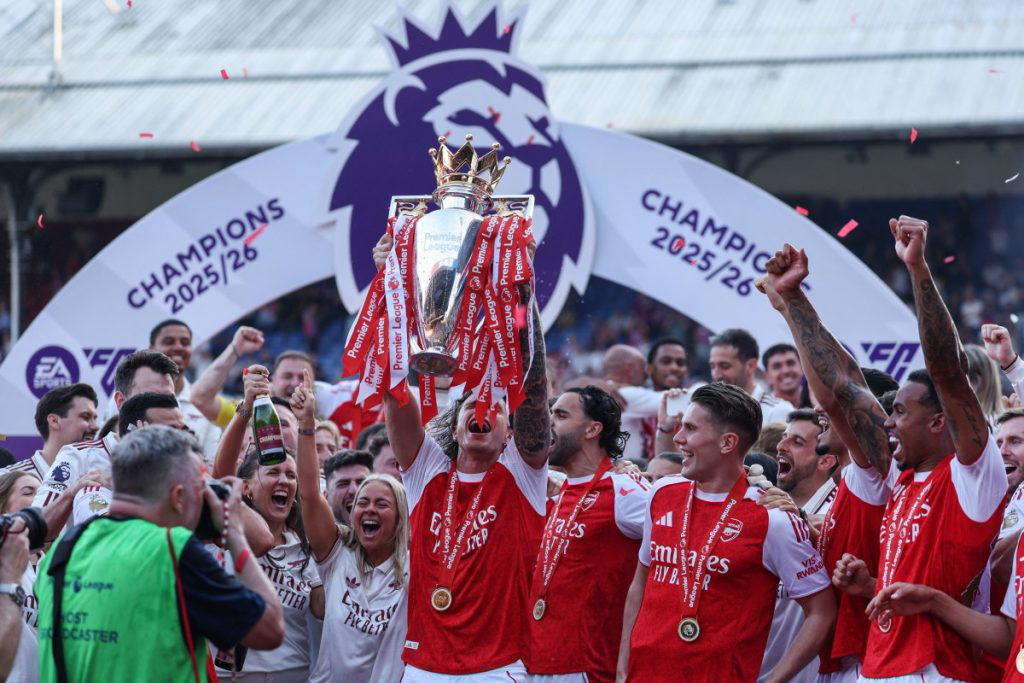
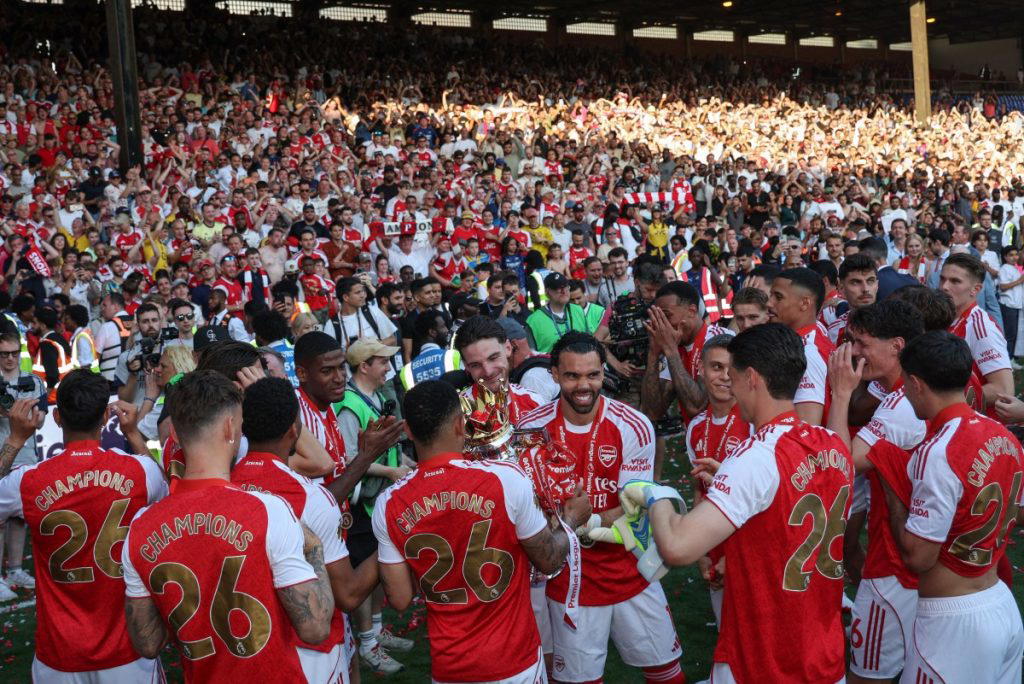
Arsenal’s Italian defender #33 Riccardo Calafiori lifts the Premier League trophy at a presentation ceremony on the pitch after the English Premier League football match between Crystal Palace and Arsenal at Selhurst Park in south London on May 24, 2026. Arsenal are English league champions for the first time since 2004, winning the league by seven points. (Photo by Adrian Dennis / AFP) / RESTRICTED TO EDITORIAL USE. No use with unauthorized audio, video, data, fixture lists, club/league logos or ‘live’ services. Online in-match use limited to 120 images. An additional 40 images may be used in extra time. No video emulation. Social media in-match use limited to 120 images. An additional 40 images may be used in extra time. No use in betting publications, games or single club/league/player publications. /

In action for the first time since the celebrations of their long-awaited triumph, the Gunners took the lead through Gabriel Jesus late in the first half at Selhurst Park.

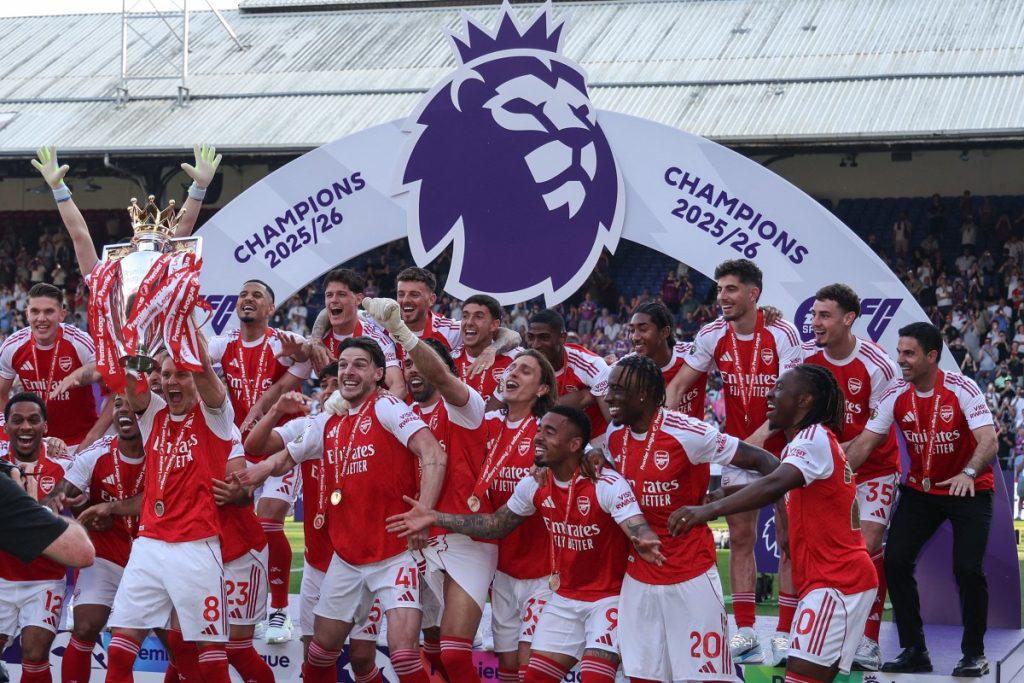
Arsenal’s players celebrate at the Premier League trophy presentation ceremony on the pitch after the English Premier League football match between Crystal Palace and Arsenal at Selhurst Park in south London on May 24, 2026. Arsenal are English league champions for the first time since 2004, winning the league by seven points. (Photo by Adrian Dennis / AFP) / RESTRICTED TO EDITORIAL USE. No use with unauthorized audio, video, data, fixture lists, club/league logos or ‘live’ services. Online in-match use limited to 120 images. An additional 40 images may be used in extra time. No video emulation. Social media in-match use limited to 120 images. An additional 40 images may be used in extra time. No use in betting publications, games or single club/league/player publications. /

Noni Madueke scored Arsenal’s second goal after the interval to ensure the champions ended the league campaign with 26 wins from 38 games.

Since losing at City on April 19 in a game that appeared to have tilted the balance of power in their rivals’ favour, Arsenal have reeled off five successive league victories to finish seven points above Pep Guardiola’s team.

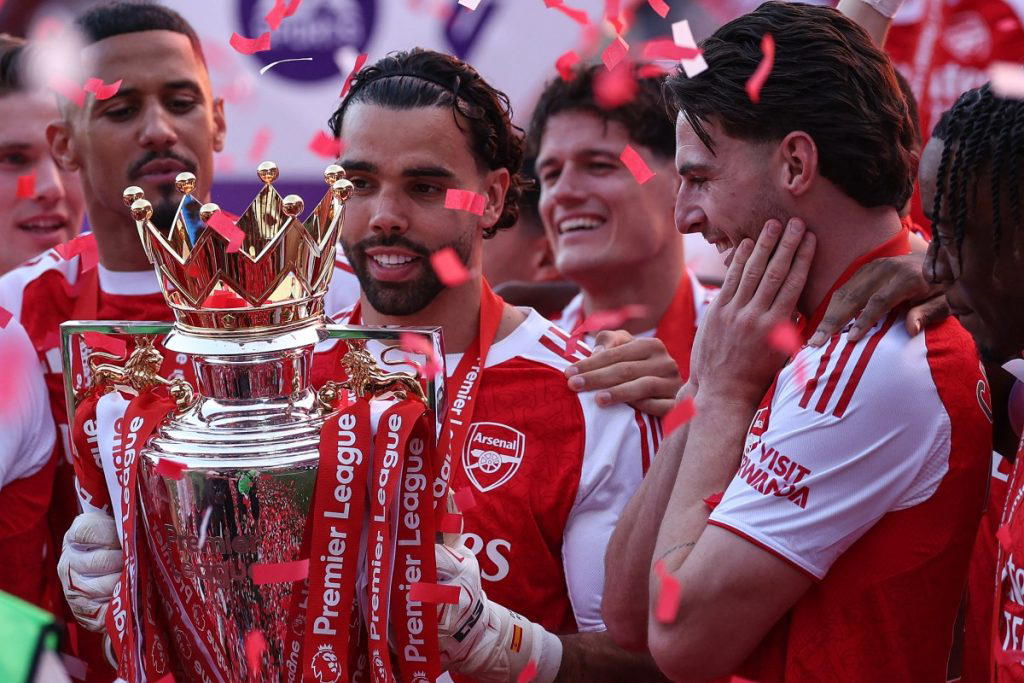
Arsenal’s Spanish goalkeeper #01 David Raya holds the Premier League trophy at the presentation ceremony on the pitch after the English Premier League football match between Crystal Palace and Arsenal at Selhurst Park in south London on May 24, 2026. Arsenal are English league champions for the first time since 2004, winning the league by seven points. (Photo by Adrian Dennis / AFP) / RESTRICTED TO EDITORIAL USE. No use with unauthorized audio, video, data, fixture lists, club/league logos or ‘live’ services. Online in-match use limited to 120 images. An additional 40 images may be used in extra time. No video emulation. Social media in-match use limited to 120 images. An additional 40 images may be used in extra time. No use in betting publications, games or single club/league/player publications. /

Once the match was over, the main event could take place as Arsenal captain Martin Odegaard got his hands on the trophy after medals were presented to Arteta and his squad.

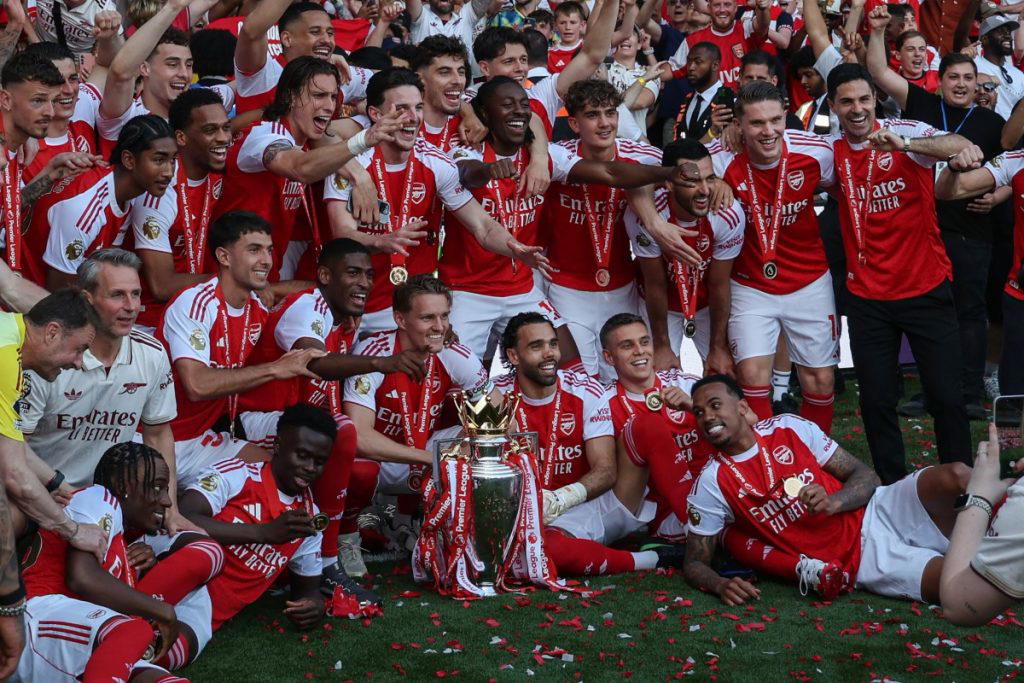
Arsenal players pose with the trophy after the Premier League trophy presentation ceremony on the pitch after the English Premier League football match between Crystal Palace and Arsenal at Selhurst Park in south London on May 24, 2026. Arsenal are English league champions for the first time since 2004, winning the league by seven points. (Photo by Adrian Dennis / AFP) / RESTRICTED TO EDITORIAL USE. No use with unauthorized audio, video, data, fixture lists, club/league logos or ‘live’ services. Online in-match use limited to 120 images. An additional 40 images may be used in extra time. No video emulation. Social media in-match use limited to 120 images. An additional 40 images may be used in extra time. No use in betting publications, games or single club/league/player publications. /

Red confetti and fireworks exploded into the air as he hoisted the silverware, while Arsenal’s stars sprayed champagne in front of thousands of Gunners fans in the Arthur Wait Stand.

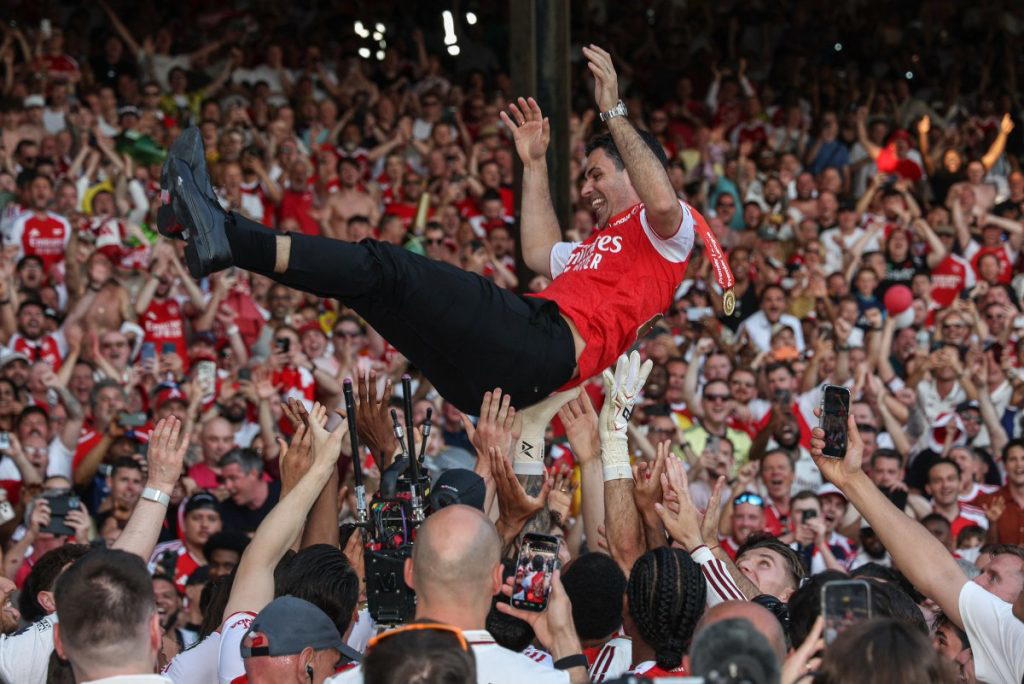
Arteta was tossed into the air by his players, while Arsenal’s United States-based owner Stan Kroenke and his son Josh had carried the trophy onto the pitch for the presentation ceremony.

Those ecstatic supporters kept the party going, singing songs of praise for the champions, waving inflatable replicas of the trophy and joining the players in a rendition of club anthem ‘North London forever’.

Arsenal’s players stand with the Premier League trophy after the presentation ceremony on the pitch after the English Premier League football match between Crystal Palace and Arsenal at Selhurst Park in south London on May 24, 2026. Arsenal are English league champions for the first time since 2004, winning the league by seven points. (Photo by Adrian Dennis / AFP) / RESTRICTED TO EDITORIAL USE. No use with unauthorized audio, video, data, fixture lists, club/league logos or ‘live’ services. Online in-match use limited to 120 images. An additional 40 images may be used in extra time. No video emulation. Social media in-match use limited to 120 images. An additional 40 images may be used in extra time. No use in betting publications, games or single club/league/player publications. /

Raising the trophy away from the Emirates Stadium couldn’t detract from the glorious moment for Arteta and his players, who will display the silverware to many more of their adoring fans at a parade in north London on May 31.

Now Arteta’s men will turn their attention to their bid to win the Champions League for the first time in the final against Paris Saint-Germain on May 30.

Winning the title was good enough but bringing home the Champions League as well would make this Arsenal’s greatest season.

– Guard of honour –

Arteta made a host of changes ahead of the final in Budapest, leaving Bukayo Saka, Declan Rice, Gabriel Magalhaes, Eberechi Eze, David Raya and Viktor Gyokeres on the bench.

Arsenal’s Spanish manager Mikel Arteta is thrown into the air by his players as they all celebrate after the Premier League trophy presentation ceremony on the pitch after the English Premier League football match between Crystal Palace and Arsenal at Selhurst Park in south London on May 24, 2026. Arsenal are English league champions for the first time since 2004, winning the league by seven points. (Photo by Adrian Dennis / AFP) / RESTRICTED TO EDITORIAL USE. No use with unauthorized audio, video, data, fixture lists, club/league logos or ‘live’ services. Online in-match use limited to 120 images. An additional 40 images may be used in extra time. No video emulation. Social media in-match use limited to 120 images. An additional 40 images may be used in extra time. No use in betting publications, games or single club/league/player publications. /

Arsenal forward Max Dowman became the youngest ever player to start a Premier League match at 16 years and 144 days, surpassing the previous record set by Jose Baxter, aged 16 years and 198 days old, in 2008.

Palace boss Oliver Glasner also rested several of his key players prior to Wednesday’s UEFA Conference League final against Rayo Vallecano.

Arsenal were given a guard of honour by Palace’s players when they emerged onto the pitch before responding to Arteta’s demand that they play with “new standards” befitting their status as champions.

On a blazing hot afternoon in south London, Jesus hit the post in the fifth minute and shot straight at Palace keeper Dean Henderson from a good position soon afterwards.

Jesus broke the deadlock in the 42nd minute, converting the trickiest of his three chances.

Gabriel Martinelli slipped a deft pass towards Jesus and the striker drilled a low drive past Henderson at his near post.

Madueke bagged Arsenal’s second goal in the 48th minute and fittingly it came from a corner.

Arsenal’s set-piece prowess has been the calling card of their campaign and once again they crafted a perfect dead ball goal as Kai Havertz headed back to Madueke, who volleyed home from just inside the area.

Jean-Philippe Mateta reduced the deficit with an 89th minute header, but Arsenal’s celebrations were all that mattered.

The post Photos: Arsenal lift Premier League trophy after 22 years appeared first on Vanguard News.

Categories
Nigeria

CORRUPTION AND THE POWER SECTOR – THISDAYLIVE

The Mambilla hydroelectric power project is yet another monument to waste

Conceived in 1972 under the military administration of General Yakubu Gowon, the 3,050MW Mambilla Hydroelectric Project in Taraba State was earmarked as a veritable tool to tackle the country’s persistent power shortages and stimulate economic growth. But after more than five decades and almost a billion dollars expended on preparing feasibility studies, hiring consultants, and doing preliminary works, the project remains more of a paperwork. Plagued by corruption, mismanagement, legal disputes and other structural delays, the Mambilla hydroelectric power project has become another monument to waste for which Nigeria has become notorious.

A fortnight ago, a former Minister of Power, Saleh Mamman, was convicted of corruption, following which he was sentenced to a hefty 75 years in prison. Mamman was prosecuted by the Economic and Financial Crimes Commission (EFCC) on 12-count charges bordering on money laundering and diversion of funds released for the Mambilla and Zungeru hydroelectric power plant projects to the tune of N33.8 billion. Although Mamman went underground before and after his conviction by the Federal High Court in Abuja and refused to show up for the sentencing, he was eventually apprehended last week by the EFCC with the agency releasinghis mugshot in handcuff.

Incidentally, while the case was playing out in the court, Mamman had joined the Taraba State governorship race under the All Progressives Congress (APC) ahead of the 2027 general elections. That gubernatorial dream may remain a dream. Meanwhile, in one of very rare instances, Mamman was sacked in 2021 by the late President Muhammadu Buhari after barely two years in office. But his conviction has again sparked conversations on why the power sector has not worked, and what accounts for the $5.8bn Mambilla failed project.

Indeed, Mambilla highlights critical issues of transparency, accountability, and governance deficits in the country’s public sector. It is in the mould of the abandoned $460 million Abuja CCTV camera project for which a Chinese loan was obtained, and the moribund Ajaokuta Steel project that has become a painful drain pipe. A complex of four dams and two underground stations, the Mambilla hydro project has over several decades enjoyed serial funds allocations from successive administrations but still has zero megawatts on the national grid.

After years of dilly-dallying, the project was formally awarded in 2003 under the administration of former President Olusegun Obasanjo. But since then, Mambilla has been enmeshed in serial problems, passing from one contractor to another with all sorts of disputes. Incidentally, Sudan, at about the same time, and even though at war, awarded and built 1,250 MW hydropower project in record five years. The Mambilla Power project was awarded to a local contractor named Sunrise Power Transmission and Procurement Company on Build, Operate and Transfer (BOT), a company allegedly discovered later to be fronting for another foreign company.

However, apparently in a bid to undercut Sunrise that was not performing, the federal government decided to deal directly with Sinohydro to which fresh contracts for civil works were awarded. In response, Sunrise took Nigeria and Sinohydro Corporation Limited to the International Court of Arbitration (ICA) in Paris, France for contract breach. The process of settlement is still in progress, with millions of dollars to the bargain. So, Nigerians are in a long and perpetual wait for Mambilla to solve the agonising problem of darkness. Moreover, it is not even on the priority list of the current administration.

Given the monumental scandals that have emanated from this project, it is no surprise that anti-graft agencies have had to wade into some of the disputes. In January 2024, the EFCC arraigned former Minister of Power Olu Agunloye over the failed Hydropower project, accusing him of awarding contract to Sunrise Power without budgetary provision, presidential approval, or cash backing. A year later in 2025, the charges were amended to include forgery, gratification, and disobedience to lawful presidential directive. Agunloye has, of course, denied the allegations.

In a 2021 report, the World Bank had rated Nigeria as the poorest country in the world on power supply to citizens with 85 million people not connected to the grid and a loss of $26 billion annually. If anything, the situation in this critical sector has only worsened, with NISO now projecting a $29 billion loss going by its 2025 report.

 Lack of electricity has limited access to healthcare, education, and other opportunities for majority of Nigerians. Many small and medium scale businesses have been crippled due to the prohibitive cost of generating their own power. Even the big business ventures, particularly the manufacturing ones, are also feeling the biting effect of energy poverty with consequences stretching to every part of the economy. 

Despite the fact that we cannot grow our economy without sorting out this critical infrastructure, most of the people that have been saddled with the responsibility seem to care more about their pockets than the public good. It is therefore commendable that Mamman is being held accountable. But the Mambilla and power related corruption scandals are mere symbols of a culture of graft for which much of Nigeria’s public sector is known. What is shocking is that neither investigation, trial, nor conviction has deterred present and future corruption schemes. It is perhaps time to review the regime of punishment for public sector corruption in Nigeria.

Categories
Nigeria

Pajor, Paralluelo star as Barcelona thrash Lyon to win Women’s Champions League

Pajor, Paralluelo star as Barcelona thrash Lyon to win Women’s Champions League

Ewa Pajor and Salma Paralluelo scored twice each in the second half as Barcelona thrashed a stunned Lyon 4-0 in the Women’s Champions League final on Saturday to win the European title for the fourth time.

It took until the 55th minute for the deadlock to be broken by Pajor, but Barcelona ran away with the game after that at the Ullevaal Stadion in the Norwegian capital.

Polish striker Pajor put the pain of five previous final defeats behind her as she also scored her team’s second goal on 69 minutes, leaving Lyon with too much to do.

Pajor was on the losing side in four Champions League finals with previous club Wolfsburg before joining Barcelona in 2024 and playing in their 1-0 loss to Arsenal in Lisbon last season.

Spain World Cup winner Paralluelo then added two late goals as Lyon fell apart, exposing a gulf between the two outstanding club sides in women’s football over the last decade.

The victory, and manner of it, confirmed that Barcelona have overtaken Lyon as the dominant force in recent years, as they won their fourth title, all of which have come in the last six seasons — only Lyon, with eight, have won more overall.

Barcelona’s European triumph follows a clean sweep of the Spanish domestic honours, and the Catalans brought reigning Ballon d’Or Aitana Bonmati on as a second-half substitute here following her recent return from a broken leg.

This was a sixth straight Champions League final appearance for Barcelona, and their seventh in the last eight seasons.

They had already beaten Lyon 2-0 in the 2024 final, when Bonmati and Alexia Putellas scored their goals — the latter wore the captain’s armband here in what could turn out to be her farewell appearance with her contract now up.

This was the fourth time the clubs had met in the final, with Lyon coming out on top in 2019 during their run of five consecutive titles, and also winning in 2022 — but that is now the only time they have lifted the trophy in the last six editions.

Ada Hegerberg scored a hat-trick in the 2019 final and was also on target three years later, but the competition’s all-time leading scorer looked a shadow of her former self on this occasion, which was a homecoming for the Norwegian former Ballon d’Or winner.

– Emphatic –

Lyon must now try to lift themselves for a French title decider against Paris FC next weekend, after failing to go the extra step in Europe following their defeat of reigning champions Arsenal in the semi-finals.

The French side thought they had taken an early lead in the evening sunshine in front of a crowd of 24,258, with Lindsey Heaps converting the rebound after a Wendie Renard header had been saved by goalkeeper Cata Coll.

However, the effort was disallowed for offside following a VAR check.

Barcelona perhaps should have scored soon after as a mix-up between Renard and Lyon goalkeeper Christiane Endler allowed Pajor to try a lob from outside the area, but her attempt hit the side-netting.

Coll saved well from a Selma Bacha free-kick as the first half ended goalless, but Barcelona looked the more likely side and were rewarded with the opener 10 minutes after the restart.

Patri Guijarro was the creator with a driving run and pass to Pajor, who controlled, took another touch to steady herself, and fired in.

Coll tipped a Vicki Becho shot around the post as Lyon sought a leveller, but instead Barcelona increased their lead just past the midway point in the second half.

The French champions failed to clear the ball in their box and Paralluelo cut it back from the byline for Pajor to score.

Substitute Tabitha Chawinga’s inability to beat Coll when clean through summed up Lyon’s evening, and Paralluelo added a late brace to make it an emphatic victory.

Her magnificent rising strike from range in the 90th minute was the pick of the goals on the day, before she ran through to make it 4-0 in stoppage time.

The post Pajor, Paralluelo star as Barcelona thrash Lyon to win Women’s Champions League appeared first on Vanguard News.

Categories
Nigeria

City Boys as Dressed-Up Charlatans – THISDAYLIVE

By Okey Ikechukwu

Our people say that a toad which, facing an identity crisis, ventures into the air under the mistaken impression that it is a bird quickly falls back to the ground with a resounding thud; looking silly and ridiculous. A bat that mistakes itself for a bird and prances out during the day to join the frolicsome engagements of real birds will drop to the ground in helpless self-immolation; after a debilitating encounter with the full blast of daylight.

Our people also say that a cat is no a leopard, nor a different type of leopard. Yes, it has whiskers and belongs to the class of animals, like lions and tigers called the ‘cat family’. But it is a cat and nothing more. If its imagination plays a mean trick on it and, believing that it is a leopard, it marches off into the forest in that delusion, it will up as afternoon snack to the real owners of the forest.

So, think of Cubana Chief Priest who stepped forward to present himself as a potential representative of his people. He performed so lamentably in the party primaries that all he could mutter after he was worsted was “I regret trusting my community elders”. He later changed his story to a claim about having withdrawn earlier from the entire process. But the damage was done. The point made by the outcome stands.

He complained bitterly about how the money he gave out failed to deliver the ticket for him. He did not complain about any programmes, brilliant initiatives or new leadership templates his inability to clinch the ticket would now deny his people. He spared no thought for the impact of his profile and life choices on social morality and the young.

Today this Imo State Coordinator of the City Boys Movement, an impressive assembly of political n’ver-do-wells, has seen for himself what his people really think of him. This is a blessing, if he and Obinna his boss would summon the courage and humility to dwell on the experience. This political battering is his chance for a re-awakening. Let us hope that he does not miss this rare Divine Intervention and fail to wake up and learn how to use his social visibility and little wealth to influence his environment for the better.

“I’m a hustler”, he said after the political disaster that struck him. Hear him: “I don’t regret trying to contest for a position. My only regret was trusting the elders in the community. I know how much I gave them, but only 14 people voted for me in the primary”. What he failed ort ask himself is this: “Who the hell am I that anyone should vote for me?

He spoke of wanting to bring a cleaner and issue-based political participation driven by young Nigerians, when announced his political ambition earlier this year. But he never really got to meaningfully explain the issues he had in mind. The question now is this: “What has he learnt about the young people and even the elders he was talking about”? 

In particular, what does Obi Cubana, his Chief Priest and others in that thoroughly disreputable assembly of deluded individuals know about society in general the Igbo society and the core values of leadership in particular?

Our people say that “Onye aju na ebu anaghi aza ide ji uno” (the person who is swooning cannot be hailed as the pillar that holds the edifice). Our people also say: “Ugo na udene anaghi azo nri” (the eagle and the vulture do not meet at the same dining table). And it is common knowledge that no family or kindred sends out an offspring of doubtful value to represent it in the village square as “Onu na ekwulu Umunna” (the voice of the kindred).

Ndigbo have core values that make a clear distinction between the sublime and the ridiculous. What the City boys represent today is one of the most visible expressions of a new breed of “Igbo leaders by self-proclamation”, who would declare themselves “Obi of Lagos”, “Mayor-General of Ndigbo”, etc., because of some paltry wealth.

Can any of these characters say “He who brings kolanut brings life” at the beginning of an event and actually explain what it means? Knowing that Ndigboo do not bring a dead man back to life by bringing kolanut to him, can they then tell you how this statement makes sense? Do they know that the kolanut is not a snack, but a symbol of communion?

Ndigbo do not eat it without calling on The Giver of Life and the gods protection and guidance. This makes the presence of kolanut, first and foremost, an opportunity for prayers. And since prayers bring blessings and strengthen life, whoever brings it has brought an opportunity for the strengthening of life. Hence the prayer of the person blessing the kolanut: “He Who Lives above, the Giver of life, protect us”.

The kolanut ceremonies also emphasize the interdependence in every community and among all living things. That is why it is said: “May the river not dry up and may the fish not lack water to swim in. The river’s looks more beautiful because of the fish, while the life of the fish depends on the steady flow of the river. Ndigbo also pray thus while before eating the kolanut: “Elders shall live and the young shall live. Our harvest shall be rich and none shall pray for the misfortune of another, lest his farm be the only patch of earth without rain’, etc.

This prayer is the first event in every serious gathering of Ndigbo, showing that Ndigbo have always been an organized people, with a mature sense of community and social responsibility. What the Igbo traditional political system lacked in absolute monarchy is replaced by a republicanism that uses the council of elders, titled men, age-grade associations, etc., to arrive at community decisions endorsed by all.

The concept of “Igbo enwe eze”, which has been fueling the type of tomfoolery characterized by many rich young men simply means that no single feudal authority can visit tyranny on the people unchallenged. That is why it is said: “When the talisman begins to act so tough as to even try to intimidate its owner, then it is time for you to show it the wood from which it was carved”.

Igbo enwe eze does not mean disrespect for constituted authority. It simply means that the collective right of the people can always be invoked to remind anyone with tyrannical aspirations that a hero is always a people’s hero. That is also why Ndigbo say that “A masquerade that flogs its drummers and followers ceases to dance, because it walks alone”.

It is because the tradition Igbo concept of power and authority rest more on respect for the laws of the land that the true Igbo concept of success is always linked with respect for Omenani. The people, and the laws of the land, always determined the difference between right and wrong. That is also why Ndigbo say: “Asokalie eze anya ekpuchie nkata na iru wee gwalua ya okwu aru” (After long periods of deference to a bad ruler, you should cover your face with a basket and go tell him the truth to his face).

To walk up to misbehaving the community leader and tell him what he needs to hear, you must either be part of a select group sent to admonish the leader, or you are stepping forward as the messenger of the community – sent by the community. Once you are sent in this way, you no longer represent yourself; just as a man is presumed to have transcended to the spirit world once he is dressed up as a masquerade. The covering of the face upholds the dignity of the office of Eze and affirms that no one may insult the office in his capacity as a mere mortal. But this presumably mysterious being from the beyond, speaking for the gods and men (but using the voice of a man) may do so to any unworthy occupant of the position of leader.

It is against the background of the foregoing that Ndigbo make a distinction between heroes and charlatans. The concept of  That is why the concepts of ndi akalogeli, ofo ogeli, ndi ome k’ome etc. exist to contrast “ndi obata Osu’ with true genuine leaders and heroes.

The person who boldly display debauchery as leadership violates everything a kolanut ceremony recommends.  Such a charlatan may impress some ignorant and wayward people, or mislead those who are on the fringes of social and spiritual morality. The major trade mark of an Igbo charlatan is that most of what he does cannot lead to sustainable development, or a healthy communal, religious or Family life, if it is adopted by everyone.

He is a danger to social morality and the economic life of the people; because of his ‘Okpata otitaa’ approach to on life.  It is such charlatans who parrot proverbs like: “Ewu na eso onye bu igu”. This statement is true, but it applies only to goats and any other living thing that behaves like a goat. Such sayings were originally meant to warn people against thoughtless materialism and immorality as a philosophy of life. But today it is freely used to justify irresponsibility, unfaithfulness and every form of debauchery.

It was not the case that only the person who offers immediate material satisfaction deserved loyalty. Not in Igboland, where the cardinal communal philosophy says: “namadu abughi ewu”. The fact that this proverb like “The goat only follows the person carrying green leaved (food)” is now popular in shows that the dregs and never-do-wells are truly on the ascendant.  

Truth is: Ndigbo know the difference between heroes and charlatans. Because Ndigbo are represented and led, particularly in Abuja, by an emergent elite with wrong ideas about leadership and social responsibility, everyone is disconnected from real issues of group values and identity. That is also why there is hardly an ‘Igbo Position’ on any national issue today.

A curious high breed of questionable antecedents, who are committed to ensuring that the worst in the land stand forth as epitomizing the best, cannot be the Igbo destination. Let the fate of Cubana Chief Priest be an object lesson to many similarly led astray. The City boys should calmy sit down somewhere and recalibrate. They are really nobodies, masquerading as meaningful varies in a political chess game that does not need them at all