








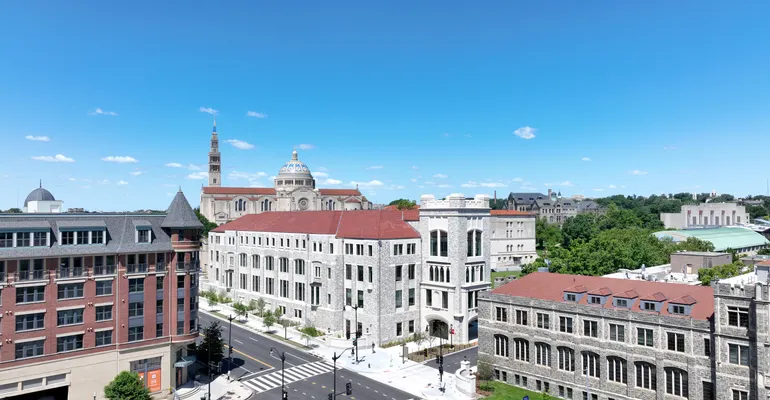
This May, Catholic University of America President Peter Kilpatrick notified his campus that the administration was laying off 66 staff members — about 7% of its workforce — along with other austerity measures, including lower salary increases and voluntary buyouts for faculty.
“The restructuring process we have completed today is significant,” Kilpatrick said at the time. “We did not take the easy path, but I am confident that we took the right one. With these essential changes complete, we stand on solid financial ground for the first time in years.
Following the job cuts, some students raised concerns to the university’s student newspaper, with one calling them “inhumane” and others expressing dismay over the university laying off the top leaders of its Center for Cultural Engagement.
It is by now an all-too-familiar story. Declining enrollment, falling tuition revenue and rising expenses combine to create a multimillion-dollar deficit that institution leaders must wrangle down — painfully.
In Catholic University’s case, its structural deficit stood at $30 million. In the five years between 2019 and 2024, the university’s operating expenses increased by 23.7% to $286 million while net tuition revenue fell by over 21.4% to $95.8 million.
That decline followed a drop in enrollment. Between 2018 and 2023, fall headcount decreased by 785 to 5,171 students at the religious university.
Kilpatrick stepped into the president’s role three years ago, in July 2022. Since then, he has had to navigate many of the same challenges other higher education leaders are facing: how to simultaneously shrink deficits, grow enrollment, make the most of institutional resources and downsize in a way that doesn’t degrade morale or dampen the soul of a university.
Higher Ed Dive sat down with Kilpatrick to discuss how his administration decided when and how to cut, and what comes next after the layoffs and deficits.
Editor’s note: This interview has been edited for clarity and brevity.
HIGHER ED DIVE: When you stepped into your role as university president, what was your sense of the university’s financial situation? Did you expect to have to make cuts while you were president?
PETER KILPATRICK: I knew from the publicly available financial statements and 990s that the university had some financial issues. I told the headhunter at that time, “Look, if I’m going to come and interview for the position and maybe be chosen as president of the university, I’m going to need complete transparency in terms of what your financial position is.”
We were just coming out of the pandemic — 2020, 2021, 2022 were tough enrollment years for many universities. Declining enrollments were not a surprise. I knew what I was stepping into. But I also knew that the university had a AAA Moody’s rating. I knew they had significant financial reserves, about $400 million.
I knew that I had a little bit of runway, and I thought we would be able to grow graduate enrollment. In my first year, we grew graduate enrollment significantly, largely through international enrollment.
Peter Kilpatrick, president of Catholic University of America.
Permission granted by Catholic University of America
But as you may know, there have been some challenges with tightening immigration policy. It became clear about a year ago that we were simply not going to be able to grow our way out of the hole that we had.
I knew what I was getting myself into, I just didn’t know what the magnitude of cuts was going to be.
If we can go to the moment when you realized you can’t grow your way out of the deficit, was it a clear numerical picture or did you have to make a call?
The federal government helps you with these financial ratios that are essentially telling you how healthy your university is. In essence, your liquid financial reserves in proportion to your long-term debt tells you a lot.
I had the good fortune to accredit a big Catholic university earlier this spring, and they have a pretty healthy ratio of liquid financial reserves to long-term debt. Ours was not as healthy because we had to reissue some bonds.
Now, we were very fortunate that we had donors who provided us with monies for a volunteer separation program for our faculty and generous severances for our staff.
Can you put us in those conversations with donors? I would imagine most donors want to feel like they’re helping the university grow. They want to fund scholarships and research and buildings. How do you ask a donor, “Can you help us compassionately shrink our workforce?”
It was the way we structured what we called the bridge fund. This was the idea of Scott Rembold, my executive vice president for university advancement. A small portion of the bridge fund would be for separation and severance packages, while a much larger proportion of that would be for growth — new academic programs, marketing and advertising, scholarships that would enable us to give more merit and financial aid, funds to help us build out online programming so that we could move more of our graduate programming online and even some of our undergraduate programming online.
The donors were willing — particularly our long-term donors who are very committed to us.
We considered monetizing some of our assets, and that’s what colleges that are in a real hole have to do. We decided, “I don’t want to sell my west campus where my solar array is, because that is a $60 million asset. I don’t want to sell that. I don’t want to sell my Monroe Street development, because that’s a money-generator and it’s an important buffer for the southern border of the university.”
Those are long-term assets. If you look at our balance sheet, we’re well over $1 billion in real assets.
Which helps your credit rating, which helps your cost of borrowing, which helps the rest of your finances?
What’s remarkable is Standard and Poor’s did not downgrade our bond rating, even though we had to reissue new bonds and had several years of a budget out of balance. They knew what we had on the balance sheet, and they knew all the steps we were taking to right-size the budget.
Credit agencies are not dumb. When they give you a BBB rating or a BBB- rating, there’s a reason for it. We were able to avoid that through this philanthropy of our insider donors.
How do you decide the depth of the reductions and where to do it? Is there a limit to just how surgical you can be? Everyone on campus is doing a job, filling a role.
This was a long conversation on my leadership team. We adopted a few principles to guide our reductions.
One principle was parts of the university that are directly revenue generating would be as protected as they could be. That would be advancement that does our fundraising, enrollment that does our recruiting, and the academy that teaches our core business.
It’s not that we took all of our cuts from the other divisions; it’s that we weighted the revenue-generating divisions, and to the degree that we could, we tried to protect them. Another principle we used was, wherever there’s redundancy in the workforce, wherever there’s multiple people doing the same or similar job, we’re going to look there first for cuts.
There’s been a lot of attention devoted by the managing consultants to how you calculate the margin in an academic program. It’s complicated, because no one academic unit owns the tuition and fees that are generated by a particular student. So you have to figure out a way to weight that so that you can do an honest and a graceful evaluation of the margin programs are generating. We looked hard at that, and some of our units were consolidated.
For example, very few people now are majoring in modern languages, or ancient languages for that matter, so we did a lot of combining departments and divisions in that regard.
What other sort of operational savings have you found?
We’ve been using technology much more effectively. For example, a software tool called Slate has built-in AI for customer resource management. We had people that were doing some of the work that Slate will do for you automatically.
Similarly, we had a fairly significant staff of professional academic advisors. A lot of what they do, honestly, can be done by AI. If you feed your course catalog into a large language model and then you test drive it to make sure that it’s accurate, you can have students query the AI agent to work on their course schedules in a way that’s actually hard for a person to do without spending a lot of time on it.
We’ve also looked at shared services. We belong to a consortium of Washington-area universities, and we’re looking at getting better insurance rates by virtue of the scale of negotiating power.
We’re partnering with another university with a mission that’s very similar to Catholic University’s. That enables us to explore shared back-office services so that we both save money. Now, there’s a limit to that if you want the autonomy of being a university.
You do have to combine all those expense reductions with growth. And we believe the only way to grow is to be different from every other university.
We’re a unique university. We’re the only papally chartered university in the country, so we’ve tried to lean into our uniqueness to find new ways to grow revenue.
Our master’s in evangelization, which is online, is a brand new program that we’re launching this fall. That’s one example of something that really no other university in America can do.
Do you think most college presidents really have a grasp on their own financial situation? You can know all your internal numbers, but what if you’re not measuring the right things or combining them in the right ways?
I was at the University of Notre Dame in northern Indiana [as professor and dean of the engineering school] for 10 1/2 years. That is not good preparation for being a university president. They have so much money they don’t know what to do with it — you learn virtually nothing about how to run a university in a resource-constrained environment.
After I left Notre Dame, I moved to Chicago to be the provost at Illinois Institute of Technology, which was a resource-constrained environment. I learned a ton about deferred maintenance, bonds, discount rates, cash flow — all the stuff that’s really important for a university president if you’re going to do your job. When I came here, I thought I was ready to lead.
But every university does their budget a little differently. It literally took a year, a year and a half, for me to get my arms around it. When I came in the door, my job was to assess — to meet all the trustees, to meet all the players on campus, to assess the health of the university in every conceivable way.
I would argue that not many university presidents have a good feel for “When should I start cutting? When should I not?” Now that I’ve been here three years, I feel like I’m in a better position. And we will never run an out-of-balance budget again. Never.
Do you feel like your faculty and staff are well-versed on the finances of the university?
We’ve been very transparent with our faculty and staff. Very transparent. We tell them exactly what we’re doing, why we’re doing it, what our finances are, why we’re cutting and where we’re cutting.
A lot of universities are making cuts to their campuses. We often hear faculty say that the administration bungled somehow, dropped the ball, and now they’re having to compensate with layoffs.
My predecessor had a strategy for growing the university, and I don’t fault him one iota. He invested in enrollment growth and marketing communications and new programming at the expense of some financial reserves. You can really only do that for so long. He didn’t know in 2017 that the pandemic was going to shut everything down in 2020 and 2021.
As long as you have faculty and staff who are committed to the mission of the university, and as long as you communicate with them transparently and effectively, you really minimize that anger or that frustration.
I feel like we did the very best that we could, and we did it with Catholic values, with compassion and kindness. Now we have an obligation to grow. We have an obligation to be healthy. I’ve told the faculty and staff my No. 1 priority when we get healthy budgets is to start really growing their compensation. Because they’re the future of the university.









Discussion about this post