









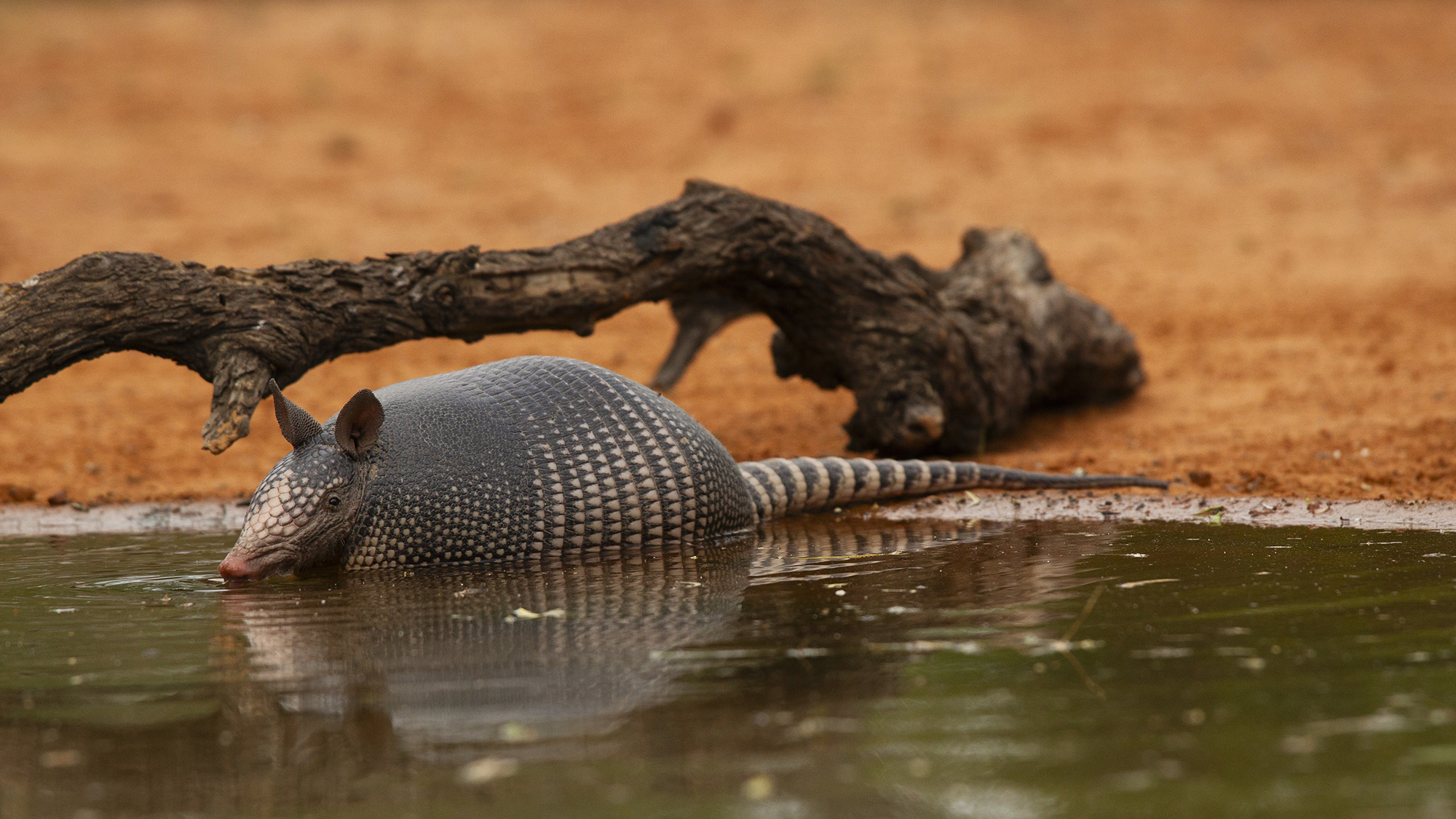
Armadillos are relatively recent arrivals in the United States. The scaly species crossed the Rio Grande from Mexico northward into Texas sometime in the mid-1800s. It’s not certain how, exactly, the animals made it to the U.S. and established themselves. Armadillos can swim, but the Rio Grande is a big river that poses a formidable barrier for a small armadillo.
[ Related: A new armadillo species was hiding in plain sight ]
One theory goes that the construction of human infrastructure like bridges, or increased river-travel aided armadillos across. Another is that colonization of Texas by white settlers made the habitat on the north side of the river more suitable for armadillos via fire suppression that fostered the growth of more scrubland and forest. Likely, multiple factors combined to allow the animals to establish roots in a new place without necessarily being transported by humans. A few decades later, humans directly brought armadillos to Florida for private zoos and circus exhibits, and escapees soon formed a separate, wild population.
From both points of arrival, armadillos have continued to spread northward and East. Eventually the two populations merged. Recently, they’ve made their way as far as southern Illinois and Virginia. Future projections indicate that, with climate change, the warm-loving species could keep going–up to New Jersey, Pennsylvania, and potentially beyond.
Martin Harvey
Armadillos are idiosyncratic, charismatic mammals. Texas has embraced the charming biological oddities as a regional, cultural symbol. At the same time, they are leprosy vectors and generalist predators that can stress out prey populations. They can also be garden and agricultural pests, damaging plants with their burrows and rooting behavior as they search for subterranean food. From yet another perspective, emerging research indicates armadillo burrows end up providing habitat and critical refuge for lots of other animals–64 different species of birds, mammals, reptiles, and amphibians use armadillo burrows, according to a 2022 study conducted in Arkansas. And in decades of study and observation, very little research (possibly none) has identified clear, ecosystem-level harms resulting from the presence of armadillos in the U.S.
So, are armadillos an invasive species? Depending on perspective, experience, and values–answers to that question vary widely. If you’re trying to keep golf courses unmarred by burrowing animals in the Southeast, you’d probably say yes. If you are a big fan of Texas Roadhouse, you might say no. Previously, the state of Florida said yes, though they’ve since changed the designation to naturalized. If you are the National Parks Service, you categorize them as “range-expanding,” not invasive. Even scientists studying the animals disagree on the correct terminology to use.
Conflict and questions
When it comes to armadillos, “It’s hard for me to believe that they aren’t having some substantial impact on something, but no one has done the research to show it,” says Daniel Simberloff, a professor and ecologist studying introduced species at the University of Tennessee. “There’s little doubt that many invasions do have impacts,” he adds.
Yet for now, armadillos are just one relatively innocuous example of an increasingly common biological conundrum: How should we evaluate and respond to animals that move themselves into new places? Often, these moves occur because of some human-mediated environmental change. In the case of the armadillos, infrastructure and fire suppression. But still, the animals have followed the path of a shifting world to where it led. Should we stop them? If so, under what circumstances? How far is too far for a range-expanding animal and for a human intervention?
The way conservation and wildlife management agencies approach that dilemma can result in major decisions and major controversy. Things can get thorny, particularly when one species is pitted against another. In one of the most recent, pressing, and high-stakes examples, the U.S. Fish and Wildlife Service has opted to kill nearly half a million barred owls in the Pacific Northwest over the next 30 years, as outlined in a final plan released in June.
Owl vs. owl vs. wildlife managers
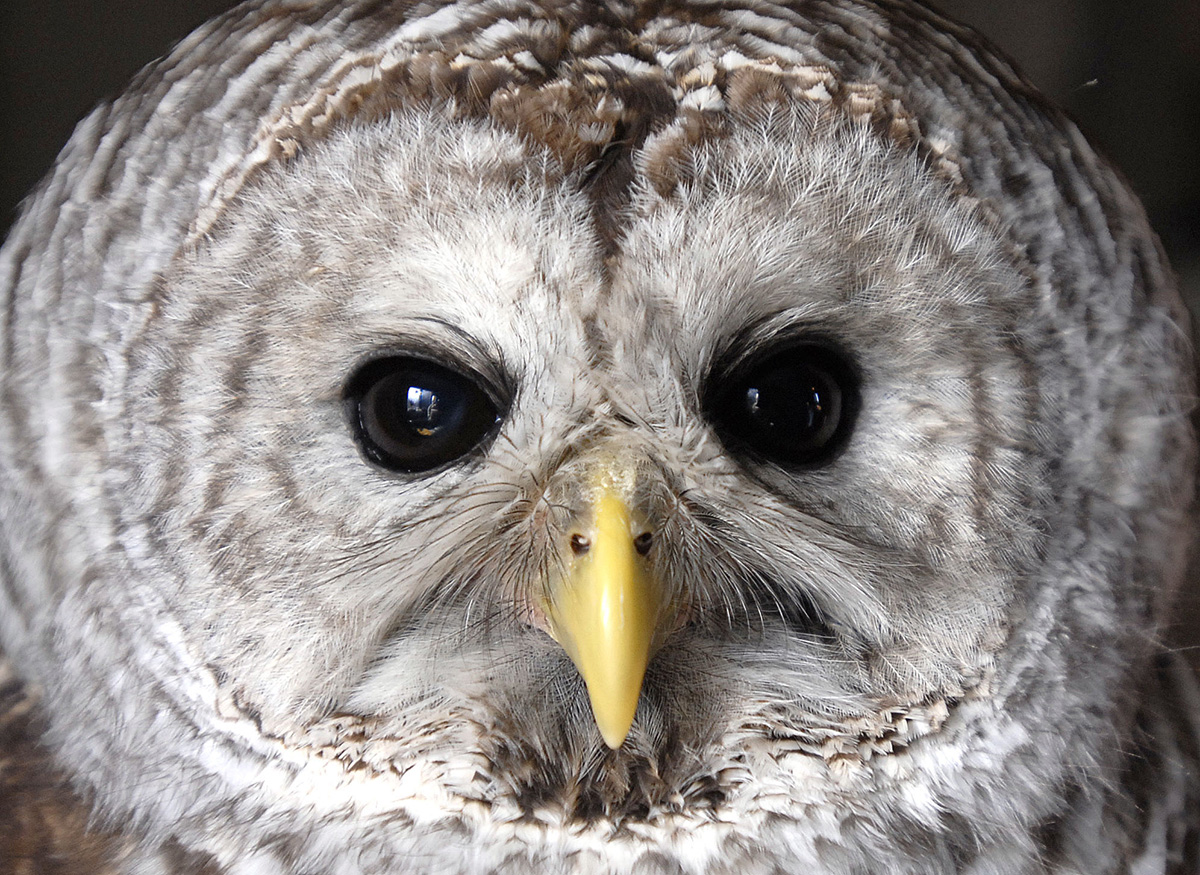
Similarly to the armadillos, barred owls expanded their range via their own movements. 150 years ago, the nocturnal bird species was confined to the eastern half of the country. Now, it ranges continuously from the edge of the Great Plains north through Canada to British Columbia and south into Washington, Oregon, Idaho, Montana, and northern California. By some accounts, barred owls spread via human-induced forestation in previously unforested areas. By others, the birds found their own way through natural Canadian boreal forest. Again, it may have been some combination of both. Yet in the case of the barred owls’ westward journey, a clear conflict has emerged.
Barred owls–through resource competition, aggression, hybridization, and even sometimes direct predation–are contributing to big declines for the northern spotted owl. This smaller and more specialized bird carries a strong cultural cachet in the Pacific Northwest. Spotted owls are dependent on old growth forest for habitat, and thus their conservation has been a rallying point and a symbol for the anti-logging movement in the region for decades.
Habitat loss and fragmentation, worsening wildfires, and climate change are all major threats to the spotted owl. But according to FWS analysis, barred owls pose the single biggest threat, and eliminating them carries the most potential benefit to spotted owls. One federal pilot experiment which ran from 2013 to 2021, and was controversial from its inception, found that culling barred owls locally reduced spotted owl annual declines from 12.1 to 0.2 percent–still not thriving population stats, but a significantly slower loss. Shooting barred owls en masse could provide enough relief for conservation managers to preserve and restore habitat, and ultimately bring spotted owl numbers back into the black–or at least that is the hope. But opponents, from animal rights and welfare advocates to conservationists skeptical about the cost and investment to save a single species, aren’t on board.
Unfortunately, the problem doesn’t end with barred owls. Many more tough decisions are likely on the horizon because we’re in a moment of extreme environmental flux. Climate change is the largest, human-caused ecological shift in Earth’s history. As a result, species are adjusting their ranges en masse, moving into new territories and retreating from others. Thousands of animal and plant range shifts have been documented in studies, and many of these aren’t occurring as predicted.
[Related: Nature wasn’t healing: What really happened with wildlife during pandemic lockdowns ]
Climate chaos
“We’re seeing a lot of species changing their distribution or changing their preferences or their habitat–and often a combination of both,” says Nathalie Pettorelli, a conservation biologist and professor at the Zoological society of London in England. Sometimes that change is rapid, on the order of a few years or a decade, she adds. Taken from one perspective, all these shifts are a positive sign of wildlife and ecological resilience, heralding the possibility of a biodiverse future under climate change. Some have argued we should reframe these newcomers not as “invasives,” but as “neonatives,” from which a new baseline may develop. And in many cases, where this reorganization does little damage to biodiversity as species shuffle around to find their new habitat, that’s easy. But in others, not so much.
“Chaos is the norm now,” says Brett Sheffers, an associate professor of wildlife ecology and conservation at the University of Florida. In one example, tropical urchins corals are migrating into historically cooler, more southerly waters off the coast of Australia, Scheffers notes. It’s great news for those concerned about the mass coral die-offs unfolding farther north in the imperiled Great Barrier Reef, but bad news for kelp forests. Kelp is also rapidly declining in its current habitat under climate change, and it’s losing more ground due to displacement by tropical corals and hungry urchins. “Managers in the north might be saying ‘protect those corals,’ while managers in the south say ‘get rid of them. That’s conflict right there,’” says Scheffers. Such tensions are inevitable moving forward, and in a 2019 paper, Scheffers argued we need to pre-empt them through intergovernmental treaties, coordination, and increased flexibility in wildlife management.
Yet it can be hard enough to settle on terms nationally, let actions alone internationally. The legal definition of an invasive species in the U.S. is “an alien species whose introduction does or is likely to cause economic or environmental harm or harm to human health,” per an executive order signed by President Bill Clinton in 1999. Most people would agree on how to assess economic or human health impact, says Mark Davis, a professor of biology emeritus at Macalester College in Minnesota. “It’s the impact on the environment where there’s often a lot of disagreement,” he adds. “For some people, just having a non-native species in an area amounts to harm. Or if a non-native species is causing a decline of a native species, but not an extinction, they would also view that as harm…. Once you declare something as harm, then you’re obligated to do something about it.”
Re-assessing conservation
In Davis’ view, a species’ impact should also be weighed against the effects of any potential human intervention, and species should be evaluated on their ecosystem-wide effects, not solely for their origins nor effects on a single other species. He, for instance, is against trying to protect northern spotted owls by killing hundreds of thousands of barred owls. “It’s terrible. I think that’s just not appropriate,” he says. Instead, he advocates for the concept of compassionate conservation, which holds that all wildlife have intrinsic value.
Simberloff sees it differently. “The barred owl case is one where people are trying really, really hard to manage an invasion,” he says. “I don’t think anyone thinks they’re going to eradicate them, but there are reasons to think they can keep the population at a much lower level,” and if the goal is spotted owl conservation, that’s worthwhile.
Evaluating harm is one challenge. Assessing “alien”-ness is another. Establishing what is and isn’t native is a question of drawing boundaries in time and space, says Scheffers. You have to pick a historical baseline and also a location limitation, which isn’t always simple. He offers the example of wild horses, which originally evolved in North America and were present up until about 5,000-6,000 years ago. Then, they died out on the landmass. Horses were reintroduced to North America by European colonists in the 15th century, and where they end up feral and roaming wild, “they have really harsh effects on the [present day] native ecosystems,” Scheffers notes. Many consider them destructive invasives, while some consider them symbols of the West. The Bureau of Land Management rounds up horses regularly, to keep the populations in check, but allows and protects a certain number of the animals on public lands. Then there’s the question of spatial cut-offs. “Natural heritage is scale-dependent,” he adds. Should policymakers consider it on the scale of a state, a region, a continent? Different responses would mean different choices and outcomes for range-expanders like the barred owls and armadillos.
Change is a constant. Throughout Earth’s history, organisms have migrated and relocated in response to environmental shifts. As we witness that process in real time, in response to our own actions, humans, too, will have to decide how to adapt and what we most care about. Do we want to vie for ecosystems that match historical records from 200 years ago, even when that may not be possible in many places? Should we welcome newcomers, or even plan and facilitate their arrival? The primary question is “how do you manage change in a system of values,” says Pettorelli. There isn’t any single correct answer.










Discussion about this post