
[ad_1]
Prosecutors obtained a search warrant for former President Trump’s Florida estate after receiving evidence from multiple sources that there was “likely” an effort to conceal classified documents in defiance of a grand jury subpoena to turn them over, according to the Justice Department in a response to Trump’s request for a special master to review the documents.
After Trump’s legal team handed over some classified documents in June as required by subpoena, the Justice Department “developed evidence that government records were likely concealed and removed from the storage room and that efforts were likely taken to obstruct the government’s investigation,” the filing states.
The Justice Department also argued in its response released Tuesday that Trump did not exert the executive privilege he is now trying to claim over classified and other materials recovered from his Mar-a-Lago home in Palm Beach, Fla., this month.
Appointing a third-party special master would slow down the government’s investigation and the intelligence community’s efforts to determine “the national security risk that improper storage of these highly sensitive materials may have caused and from identifying measures to rectify or mitigate any damage that improper storage caused,” the department said in the 36-page response.
The judge has told Trump’s legal team to respond by 8 p.m. ET Wednesday. A hearing on the matter is scheduled for 1 p.m. ET Thursday.
FBI investigators are probing potential crimes, including violations of the Espionage Act, related to highly classified national security documents stored at Trump’s Palm Beach residence. On Aug. 8, FBI agents removed 11 sets of classified documents — including some marked top secret and meant to be available only in special government facilities — and 20 boxes of materials from Trump’s Mar-a-Lago estate.
The National Archives asked the Justice Department to determine whether charges were warranted when the agency found highly classified information in 15 boxes of presidential records recovered from Mar-a-Lago in January 2022.
The Justice Department obtained a grand jury subpoena to secure any classified or sensitive materials in May. When three FBI agents and a Justice Department lawyer were called to Mar-a-Lago to retrieve documents in early June, they were given a sworn affidavit that a diligent search had been conducted and “any and all responsive documents accompany this certification.”
Department officials were told all materials taken from the White House were stored in a single room and were allowed to view it, but Trump’s legal team “explicitly prohibited government personnel from opening or looking inside any of the boxes” found there, the filing states.
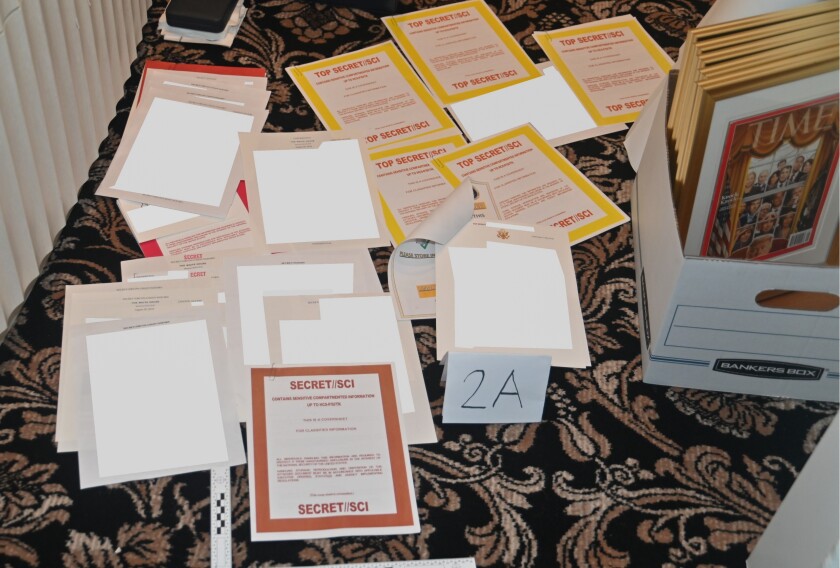
This image contained in a court filing by the Justice Department and redacted in part by the FBI shows documents seized during the Aug. 8 search of former President Trump’s home in Florida.
(Associated Press)
The response states that the search found 13 boxes or containers with information marked classified, totaling more than 100 individual documents with classification markings. A redacted photo included with the motion shows a pile of documents labeled “secret” and “top secret” next to a box of framed Time magazine covers.
“In some instances, even the FBI counterintelligence personnel and DOJ attorneys conducting the review required additional clearances before they were permitted to review certain documents,” the filing states.
Agents found three classified documents in desks in Trump’s office. In addition, the response notes that Trump’s passports were seized because they were in the same drawer as one of the classified documents. The search warrant instructed agents to take all items stored with classified information. The Justice Department has since returned the passports.
Seventy-six recovered documents were found in the storage room that Trump’s legal team said had been searched.
“That the FBI, in a matter of hours, recovered twice as many documents with classification markings as the ‘diligent search’ that the former president’s counsel and other representatives had weeks to perform calls into serious question the representations made in the June 3 certification and casts doubt on the extent of cooperation in this matter,” the filing states.
In response to a lawsuit from news companies this month, the Justice Department voluntarily unsealed the warrant and an itemized list of the items taken in the search, though the entries do not include details on the subjects of the documents. The Justice Department was also ordered in that case to release a redacted version of the affidavit used to lay out the probable cause that evidence of a crime might be found during the search.
Trump’s legal team argued in its initial filing that the warrant, list of items seized and redacted affidavit provide insufficient information about why the search was conducted. The lawyers said a special master is necessary to ensure the Justice Department returns any private or privileged documents seized during the search.
Along with Tuesday’s filing, the Justice Department filed under seal a more detailed list of the materials taken during the nine-hour search and an update on its review of the materials. It said in its filing that “the government is prepared, given the extraordinary circumstances, to unseal the more detailed receipt and provide it immediately to plaintiff.”
The Justice Department said Monday that its internal filter team has identified a “limited set of materials” taken in the search that may include material covered by attorney-client privilege. The response didn’t address Trump’s claims that some of the documents are covered by executive privilege.
[ad_2]
Source link