









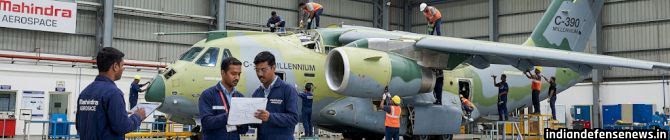
Embraer Seeks to Transform India into a Manufacturing Hub for C-390 Millennium Aircraft
Brazilian aerospace giant Embraer is not just eyeing India as a customer for its C-390 Millennium military transport aircraft; the company aims to establish the nation as a crucial manufacturing and export center for the broader Asian market. This strategic initiative reflects Embraer’s vision that Asia could generate approximately 40-45% of global demand in this aircraft category, equating to an expected need for around 500 aircraft over the next two decades.
Strategic Industrial Partnership with Mahindra Group
Embraer’s Defence & Security chief executive, Bosco da Costa Junior, emphasized that the company views India as a vital industrial partner rather than merely a purchaser of its initial order. His remarks illustrate Embraer’s intention to exploit an Indian production base for future exports across the region. However, it is important to note that the projected demand for 500 aircraft remains Embraer’s market estimate rather than a guaranteed order pipeline.
Focus on Indian Air Force’s Medium Transport Aircraft Program
The immediate focus for Embraer is the Indian Air Force’s Medium Transport Aircraft program, which plans to acquire 60 aircraft in a deal valued at around ₹1 lakh crore. Embraer, in partnership with Mahindra Group, is contending for this contract by presenting the C-390 Millennium along with proposals for extensive local manufacturing and supply-chain development.
Bid Requirements and Local Production Plans
According to reported specifications, the successful bidder must deliver the first 12 aircraft in fly-away condition, while the remaining 48 are to be assembled in India. The contract stipulates that locally manufactured aircraft should incorporate at least 40% indigenous content, with a completion timeline of 11 years for the entire contract. Interested parties must submit their bids by January 13.
Overview of Manufacturing Infrastructure in Nagpur
In the event that the C-390 is chosen, Embraer and Mahindra have pinpointed Nagpur as the optimal location for establishing a final assembly line. Their plans encompass aircraft assembly, integration of systems, development of manufacturing engineering, and the creation of a domestic supplier network. Additionally, they have proposed potential maintenance, repair, and overhaul capabilities. However, these plans are contingent on securing the Indian order, and no production line has been officially confirmed as of yet.
C-390 Millennium: A Versatile Military Transport Solution
The C-390 Millennium is engineered as a twin-engine jet transport aircraft capable of executing a diverse array of missions, including cargo transport, troop movement, aerial delivery operations, medical evacuation, search and rescue, firefighting, and humanitarian assistance. Embraer claims that the aircraft can accommodate a maximum payload of 26 tons and operate from makeshift or unpaved runways, attributes that enhance its appeal as a contemporary multi-role platform.
Evaluation Criteria for Indian Air Force
India’s assessment of the C-390 will take into account factors beyond mere capability. Operating suitability, acquisition costs, lifecycle expenses, delivery timelines, and overall performance in meeting the Indian Air Force’s requirements are key elements that will influence the final decision.
International Presence and Competition Dynamics
The C-390 has steadily attracted an international clientele, with Sweden ordering four aircraft under a framework agreement for further options, and the Netherlands and Austria collectively requesting nine units. Operational deployments already include Brazil, Portugal, and Hungary, showcasing Embraer’s growing export credentials and expanding global operator base.
Stiff Competition from Lockheed Martin’s C-130J Super Hercules
Despite Embraer’s ambitions, it faces tough competition, particularly from Lockheed Martin’s C-130J Super Hercules, which is being offered in partnership with TATA Advanced Systems. The Indian Air Force currently operates 12 C-130Js, which have proven effective in missions supporting forward deployments in Ladakh. This existing operational experience, coupled with Lockheed Martin and TATA’s established industrial footprint in India, positions their bid as a formidable rival.
Strategic Implications for India’s Aerospace Sector
The competition transcends the mere acquisition of transport aircraft; it serves as a crucial test for India on whether significant military aviation purchases can enhance defense capabilities while also fostering domestic aerospace manufacturing.
Potential for Future Regional Expansion
For Embraer and Mahindra, winning this contract would not only pave the way for the proposed Nagpur facility but also bolster their ambitions to capture additional sales across Asia. While the projected demand for 500 aircraft presents a compelling commercial case, the success of this initiative ultimately hinges on securing the Indian Air Force contract.
Agencies








Discussion about this post