
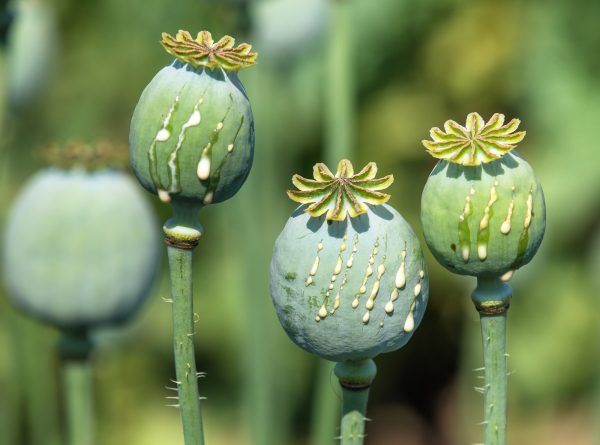
Following a ban on poppy cultivation in Afghanistan imposed by the de facto authorities, the Taliban, in April 2022, opium production plunged by an estimated 95 percent by 2023 from 6,200 tons in 2022 to 333 tons in 2023. Poppy fields were reduced from 233,000 hectares to 10,800 hectares.
However, three years since the Taliban’s ban, the United Nations Office on Drugs and Crime (UNODC), announced last week that the price of opium from Afghanistan has gone up tenfold – from $75 to $750 per kilogram. The price increase is not surprising. A classic economic model tells us that when demand is inelastic, supply-side reduction tends to make the commodity pricier. Hence, in the case of opium, many argue that a crackdown on the demand side would be more effective than one on the supply side alone.
A Paradoxical Problem: A Win in the Drug War, a Punishment for the Poor
However, the bigger fear that presents itself with a commodity becoming dearer is the collapse of the measure responsible for the shortage – in this case, the poppy cultivation ban. Amid the ban, small holdings farmers, including women, who were involved in the production of opium for the sake of their livelihood are suffering great distress in Afghanistan, while high-level traders and exporters in organized crime groups are making a killing, as per the UNODC’s admission.
The drastic reduction in poppy cultivation for opium in Afghanistan has had significant consequences for farmers and vulnerable rural populations in Afghanistan, mostly in the southwestern provinces where poppy growing has largely been concentrated. For a country that was already in macroeconomic tatters due to massive political turmoil in 2021, even as it was grappling with the COVID-19 pandemic, the ban on poppy cultivation added a devastating microeconomic shock for individual farmers. A World Bank report released last year said that in a “historic reversal,” the GDP per capita fell in at least 75 countries in the last four years with people in Afghanistan subsisting on less than $4 a day.
The Opium Economy of Afghanistan
The opium poppy is drought-tolerant and a high-value commercial crop. With a devastated economy and society, opium poppy cultivation and production in Afghanistan became the only viable source of income for much of its population. In other words, in Afghanistan with its conditions of extreme poverty and insecurity, opium production became a source of human security. The opium economy secured the livelihood of 3.3 million people directly involved in poppy cultivation, accounting for nearly 15 percent of the total population of the country.
According to the UNODC Afghanistan Opium Survey 2019, opium harvesting provided the equivalent of up to 119,000 full-time jobs to local and migrant workers hired by farmers. Reported wages for those weeding opium poppy fields are comparable to other types of farm labor at roughly $4 a day. But lancing could bring in $6 a day.
Opium poppy cultivation and production is labor-intensive work. Even in the deeply conservative Afghanistan society, women could be involved in the labor inside family compounds without being exposed to men from outside, which is considered un-Islamic in Afghan society. The division of labor provided opportunities for Afghan women and offered some degree of financial independence, through access to cash and status through work. In the context of rural poverty and a chronic cycle of debt for rural families, the opportunity to grow a lucrative cash crop was seen as a blessing by many rural households, as per a write-up in The New Humanitarian titled “Afghan Women and Opium.”
In 2021, the opiate economy accounted for up to 14 percent of Afghanistan’s gross domestic product (GDP), making opium cultivation and trade a major economic source. Given that Afghanistan’s GDP further contracted in the following year, the opiate economy likely constituted a larger proportion of its total economy in 2022.
The Political Utilization of Opium: From the Taliban to the CIA
Opium has long been deeply entrenched in the political and power games in Afghanistan.
One of the first efforts toward the prohibition of poppy came in 1957 under the Muhammad Daud Khan government, when Afghanistan was not a big grower. However, it posed a challenge to the political stability of the state as Badakhshan rose in rebellion. Three decades later, mujahideen leaders like Gulbuddin Hekmatyar, Pir Sayad Ahmed Gaylani, and Ismat Muslim used drug money for anti-Soviet resistance. This was strategically fed into and expanded by U.S. covert operations via the CIA to counter the Soviets in Afghanistan.
Ironically, the Taliban’s success is also linked to their early occupation of valuable poppy cultivation areas in southern and eastern Afghanistan by the end of the 20th century, which enabled them to pay higher wages to their followers and their mercenaries. Most of the production was taking place in Helmand (about 49 percent) and Nangarhar (25 percent); however, in the northern parts under mujahideen control, Badakhshan also became a smaller center of poppy cultivation (3 percent).
The Taliban took over in 1996 and cracked down on opium production in 2001 with a complete ban that dropped the production to 185 metric tons by the end of their first regime, but while out of power for the next two decades, Taliban strongholds showed an increase in opium production. Drug money once again essentially fueled the Taliban’s fight against the U.S. and NATO forces, leading to its return to power in August 2021.
The Taliban’s inconsistent and opportunistic stance on opium is quite obvious, like it has been for those before them. Poppy fields were destroyed after the Taliban supreme leader Hibatullah Akhundzada decreed that it would be prohibited to grow them because addiction and businesses related to it are un-Islamic, yet the Taliban have exploited and used poppy money all along.
A flip-flop in policy sends conflicting signals to those who implement policies on the ground and those who are supposed to follow the law. This remains a significant issue in Afghanistan around poppy cultivation along with other problems, like the rise in the price of the commodity can force the desperate farmers to take risks or lucrative cultivation shifts to other areas as was seen when Thailand first decided to crack down on opium.
A lesson to learn from Thailand’s success in eliminating poppy cultivation and becoming “opium-free” is that, unlike Afghanistan and Iran, they did so over a period of time, starting in 1984 and being declared opium-free by UNODC in 2008. Thailand is heralded as a successful example of “alternative development” programming, where the loss of income due to substitute crops was made up by establishing a floor price and the government became the guaranteed buyer paying the difference in the amount to the farmer.
Where UNODC Can Step In
Most Afghan farmers have very small holdings and a severe water shortage in the region means they have relied on drought-resistant, cash crops like poppy that result in handsome financial returns. The policy of banning opium poppy cultivation was not coupled with any alternative livelihood measures for the farmers, proving to be devastating for the struggling population.
Meanwhile, even when alternative livelihood efforts have been made in the past they have been poorly designed and ineffective and rarely generated sustainable income for poppy-production-dependent populations, as highlighted by Vanda Felbab-Brown in “No Easy Exit: Drugs and Counternarcotics Policies in Afghanistan.” Therefore, the brunt of the eradication is most often borne by the poorest and socially marginalized while generating extensive political capital for the Taliban.
This time, too, it seems the Taliban may have been angling for political legitimacy through measures that create the appearance of cracking down on illegal activities. The UNODC could use this desire to negotiate an alternative livelihood plan for the farmers. Felbab-Brown also suggested enacting a microcredit system, which continues to be lacking throughout much of Afghanistan. This, coupled with the establishment of local Afghan seedbanks, seed markets, rural enterprises, and value-added chains, will address the structural market deficiencies.
This moment could also be a foot in the door for the world to negotiate a better deal for the women and girls in Afghanistan. The current imperative is to transition from mere crop substitution to a more comprehensive strategy for sustainable livelihoods. This entails a balanced blend of on-farm support and off-farm employment opportunities, benefiting both men and women.
The Taliban need to be made to understand that the longevity of the opium ban hinges on a multifaceted approach. To achieve this, the Taliban must reconsider their stance on education and work for girls and women. Historically, opium-poppy cultivation involved women, serving as a safety net for families when male breadwinners faced adversity. Now, vocational training should be accessible to both genders, while targeted education can enhance women’s employability. By fostering multiple earning members within families, Afghanistan’s GDP and per capita GDP could be lifted. Moreover, women re-entering the labor force could pave the way for renewed foreign aid, offering hope to a struggling nation.
The Taliban’s real motives aside, seen purely in terms of an anti-drug war, it is also a moment for the UNODC to be able to assist with a clear knowledge of what the Taliban may truly be after, as explained above. The sharp reduction of opium from Afghanistan in 2023 needs to be sustained on a long-term basis by supporting farmers, as well as women, to transition away from poppy cultivation. This will mean not just a win for the fight against opium but also ensure a life of dignity for the Afghans, away from crippling poverty.


Discussion about this post