








Political Tensions Rise Following Accusations Against Stephen Miller
Recent statements by prominent leftist figures have escalated political tensions, culminating in serious allegations against Stephen Miller, the newly appointed chief of staff to former President Trump. Representative Hakeem Jeffries and MSNBC’s Jonathan Capehart have both made statements implying Miller’s involvement in severe misconduct.
Jeffries’ Stark Accusations
Representative Hakeem Jeffries, who is poised to become the next Speaker of the House, made particularly incendiary claims on the social media platform X. He stated:
“Stephen Miller is a dangerous xenophobe and reckless extremist who has American blood on his hands. His presence in government should be eradicated like a malignant tumor.”
While Jeffries attempted to clarify that his call for eradication was limited to Miller’s governmental role, the use of such strong language raises concerns. The phrase “American blood on his hands,” combined with the metaphor of being “eradicated like a malignant tumor,” suggests a level of rhetoric that transcends conventional political discourse.
Reactions From Media and Political Circles
If a conservative figure had employed similar language targeting Jeffries or another Democrat, it is likely that the media would react vocally, interpreting it as an incitement to violence. This disparity in reaction highlights the polarized nature of contemporary political commentary.
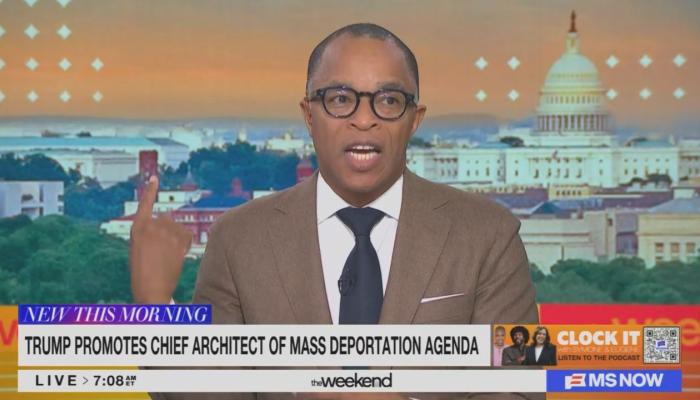
On a recent episode of MS NOW’s The Weekend, Jonathan Capehart echoed Jeffries’ sentiments, expressing his concerns about Miller’s impending role. He remarked:
“Now that Stephen Miller will have the top job on Monday, it would seem to me that this administration is about to — it was crazy before, it’s going to be even crazier now. We’ve got this guy who’s behind the ICE raids, behind the killings of Renee Good and Alex Pretti in Minneapolis.”
Potential Implications of Statements
If taken at face value, the assertions made by Jeffries and Capehart—that Miller has “blood on his hands,” was “behind the killings,” and should be “eradicated”—could suggest that they may be inadvertently inciting violence themselves. Such rhetoric paints Miller as a villain reminiscent of organized crime figures rather than a public servant.
Further Developments
During the same broadcast, Rep. Robert Garcia, the incoming chair of the House Oversight Committee, made a statement warning Miller to “lawyer up” in light of these accusations. Garcia characterized his remarks as a call for accountability.
This situation underscores the increasingly charged atmosphere in American politics, where rhetoric often eclipses reasoned dialogue. The implications of such heated exchanges could resonate throughout political discourse in the coming months.








Discussion about this post