










Once focused on the US drug market, Mexican criminal groups have turned their sights on their own country, seeking to control territory they can exploit financially.
They’re embedding themselves in local governments to maximise that control. That has made Mexico’s elections increasingly violent. Hundreds of local candidates in the June 2 vote have dropped out of the race because of threats. At least 34 people running for office in this election have been killed, according to the consulting firm Integralia.
The criminal groups “have become de facto rulers” in some communities, said Sandra Ley, co-ordinator of the security program at Mexico Evalua, a research organisation.
Mexico’s cartels began to diversify into extortion, migrant smuggling and other illicit businesses more than a decade ago, as they splintered into smaller groups under pressure from security forces. Newer gangs needed fresh sources of income.
By now, they’ve penetrated entire industries.
About 70 per cent of lumber production in Mexico is illicit, the Environment Ministry says – with a significant amount in the hands of organised crime groups. At least 30 per cent of the fuel sold in Mexico is stolen or smuggled, estimates Onexpo, a national gas station group. One in every five cigarettes comes from the black market.
On Mexican farms, criminals “tax” everything from potatoes to the avocados bound for Americans’ guacamole. Extortion accounted for nearly one-quarter of the 6 per cent price increase in agricultural goods last year, according to José Ignacio Martínez, an economist at the National Autonomous University of Mexico.
Erika Flores sells tortillas, in Mexico City. Credit: Fred Ramos for The Washington Post
While solid data is scarce, revenue from the array of illicit activities could rival the estimated $18 billion Mexican cartels rake in every year from drug sales. In one area alone – stolen and contraband fuel – the government estimates it’s losing about $7.5 billion a year.
The expanding criminal grip on the economy is starting to have a spillover effect at the US border. Detentions of Mexicans at the US border – including asylum applicants – have tripled since 2019, reaching about 717,000 last year. People leave the country for many reasons, including better-paying jobs. But an increasing percentage of Mexican migrants say they are fleeing violence and extortion.
In a poll commissioned last fall by the US State Department, and not previously made public, 39 per cent of Mexicans surveyed said they’d be willing to migrate irregularly to the United States in the following months – a fourfold rise from early 2022.
Fear and outrage
On a recent morning, Antonio Vázquez nudged his ute through the choking traffic south of the city of Cuernavaca, headed for a secret location. A fellow tortilla vendor was in trouble.
Vázquez, 55, a brooding man with silver-streaked hair, leads the tortilla association in Morelos, a small state south of Mexico City. Lately, he’d become a minor celebrity, making TV news by denouncing the threat to the state’s tortillerias. About 30 shops in his state closed last year because of extortion.
His wife has been urging him to lower his profile. But Vázquez, who’d trained as a lawyer, can’t contain his outrage.
“Somebody has to speak out,” he said.
He turned onto a quiet street of pastel-coloured homes and pulled into a walled compound. Under a giant tree, he sat down with a man in his late 30s, heavy-set and sweating. The man, who asked not to be identified for security reasons, had refused to pay extortion. A gang retaliated by setting fire to his house.
“I have to find another way to survive,” the younger man was saying.
There was only one option, he said – moving to the United States. Vázquez said he would try to help him open a tortilla shop there.
But, the man complained, “I can’t get a visa.” He said he might have to cross illegally.
Vázquez listened quietly, taking swigs of cold soda and swatting at the flies floating in the hot, still air.
All he could offer was a sympathetic ear.
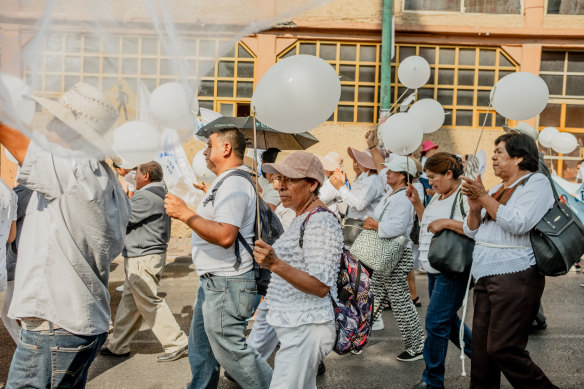
People participate in a pilgrimage to pray for peace in response to rising violence in Cuernavaca, Mexico.Credit: Fred Ramos for The Washington Post
More than two decades ago, Vázquez left his law firm to go into the family tortilla business, opening several shops in Cuernavaca. It seemed to be an ideal location. The city was a popular escape for well-heeled Mexico City residents, with its balmy weather, swimming pools, and riotous pink and orange bougainvillea spilling over stucco walls.
When the first gang turned up about three years ago, asking $15 a week to “protect the neighbourhood,” tortilla shops paid up. The criminal group quickly wiped out petty theft.
Five months later, in a burst of violence, a new gang took over, and protection fees began to rise.
Loading
“They lasted a year,” Vázquez recalled. “They were killed too.”
Now, gangs in the Cuernavaca area are hitting up tortilla makers for as much as $1350 a month.
Just the previous week, armed men in masks had barged into one of Vázquez’s shops and thrust a cellphone at him.
“Take it,” one said. “The boss is going to call you.”
Vázquez turned the phone over to the authorities. They asked him to convince his fellow tortilla vendors to provide all information possible: extortioners’ names, nicknames, their license plates, the model of their cars. Yet he was hesitant.
“Even I’m afraid.”
Competition for territory
Mexican analysts are still puzzling over what caused the new criminal economy to take off. But one of the seminal events occurred just a few kilometres north of Vázquez’s downtown tortilleria, in a leafy Cuernavaca neighbourhood known as Lomas de la Selva.
On the night of December 16, 2009, Mexican navy commandos stormed a luxury condo complex, and a firefight began. Four hours later, Arturo Beltrán Leyva lay dead in the doorway of a blood-spattered bathroom.
The Obama administration called it “a significant blow against drug cartels”. Beltrán Leyva, the “boss of bosses”, was the first of a string of drug lords who were slain or captured by Mexican security forces aided by US agents.
But the cartels didn’t collapse. They splintered. Today, Mexico has two cartels with a nationwide presence (Sinaloa and Jalisco), but also hundreds of smaller groups. In the past four years, the security firm Lantia Consultores has identified at least 87 regional armed groups and 586 gangs.
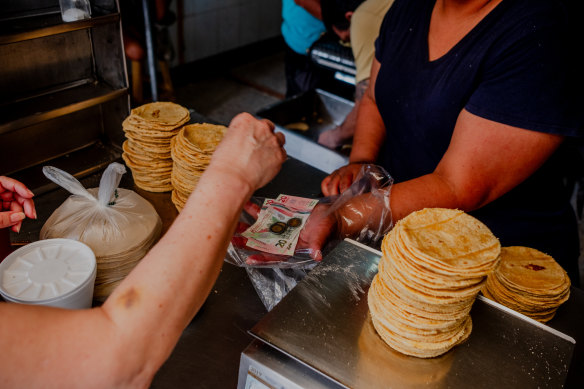
A woman buys tortillas at a tortilleria in Mexico City .Credit: Fred Ramos for The Washington Post
“Fragmentation means that there’s a lot more competition for territory,” said Eduardo Moncada, a political scientist at Barnard College who studies crime in Latin America. “And so these criminal groups are turning to extortion as one way to generate revenue, to be able to wage these wars.”
The trend is evident in other parts of Latin America, too. In Ecuador, reported cases of extortion rose almost 15-fold between 2021 and 2023, reaching 21,811, according to the Ecuadorian Observatory of Organised Crime. In Colombia, businesses ranging from rural coffee farms to multinational mining firms are forced to pay protection money. Gangs in Latin America have also expanded into migrant-smuggling and environmental crimes such as illegal logging and mining.
“These illicit activities are less profitable than drug trafficking, but they have become increasingly attractive because they generate relatively stable incomes at lower risk,” noted an International Crisis Group report issued last year.
The rise of the mini-cartels is evident in Cuautla, a sunbaked city of 150,000 people nestled amid sugar-cane fields 30 miles south-east of Cuernavaca. A downtown park features a towering statue of Emiliano Zapata, the insurgent who famously attacked the city during the Mexican Revolution.
These days, a different kind of battle is under way. Four crime groups vie for power, according to law enforcement officials. They’re the Mexico City-based Union Tepito, and three smaller groups – including Los Acapulcos – that split off from big drug-trafficking cartels.
The groups shake down nearly everyone in the city: butcher shops, nail salons, hamburger stands, even dental practices. At one point, they demanded a cut of proceeds from the annual festival honouring Saint Joseph – forcing the Catholic Church to cancel it.
“You can’t imagine the fear people are living with,” Ramón Castro, the Catholic bishop in Morelos, told worshippers at a recent Sunday Mass, after visiting Cuautla. Gangs were demanding that tortillerias hand over 50,000 pesos in protection money – about $4500, three times as much as in Cuernavaca. Trucks carrying sugar cane had to pay the same amount to enter the local mill.
“Fifty thousand!” exclaimed the bishop. The sugar employees “are going to wind up working for them”.
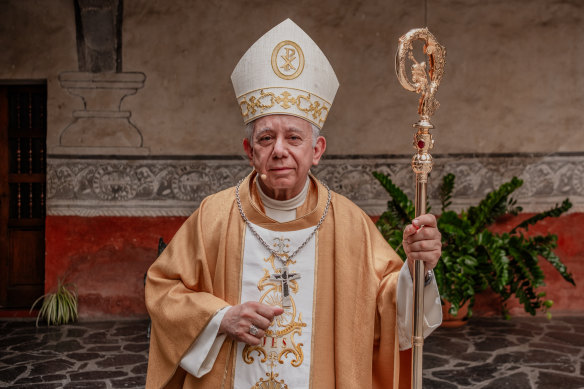
Bishop Ramon Castro at the Cuernavaca Cathedral.Credit: Fred Ramos for The Washington Post
The sermon made the front pages of national newspapers; it was rare for anyone to say such things publicly.
The following day, the co-ordinator of the truckers at Cuautla’s sugar mill was shot dead. Two weeks later, a prominent local butcher was killed, after complaining to local authorities about extortion.
Taking a cut
Tortillerias are especially vulnerable to extortion. They do brisk sales; the average Mexican eats 165 pounds of tortillas a year. Nearly all customers pay cash.
But the threat of crime doesn’t stop at the tiny tortilla shops. It overshadows nearly every step of the tortilla process.
The north-west state of Sinaloa is famed for the cartel once led by Joaquín “El Chapo” Guzmán. It’s also an agricultural powerhouse that produces the best white corn for tortillas.
Crime groups have infiltrated the public water system in Sinaloa, imposing their own people in offices that oversee irrigation, according to two agricultural leaders in the state who spoke on the condition of anonymity, citing security fears. Farmers allied with the cartel pay little or nothing for water, the leaders said. Other customers are assessed an extra “tax”.
“They realised what a good business this can be, especially given that the price of drugs has dropped,” said one of the agricultural leaders.
Mexico’s National Water Commission said the distribution of water for irrigation is handled by a local concession, not the government. Emilio González Gastélum, president of the state association that manages the concession, dismissed the allegations as “just rumours”. He said that water fees were set by a governing board in consultation with farmers.

A threshing machine cuts corn on a farm in Culiacan, Mexico.Credit: The Washington Post
Once corn is loaded onto trucks and trains, other organised crime groups take a cut. Gangs, many carrying semiautomatic rifles, have robbed nearly 70,000 trucks carrying manufactured goods and farm produce on Mexican highways in the past five years, according to Concamin, a national business chamber.
The big cartels see such robberies as another revenue stream, said Héctor Manuel Romero Sánchez, a transportation security consultant. They “are trying to raise funds to invest in their biggest businesses – which are trafficking migrants, weapons and, obviously, drugs.”
In some areas, crime groups are also taking over corn distribution. In Guerrero state, which adjoins Morelos, cartels strong-arm farmers into selling corn to them, and then force tortillerias to purchase it. The gangs even inspect the shops’ inventories to ensure they’re not buying elsewhere.
“If you have extra corn, they beat you,” said one tortilla employee in the historic silver-mining city of Taxco.
Rarely convicted
After taking office in 2018, López Obrador declared the “war on drugs” over. It had turned Mexico into a battleground, he said, without reducing the flow of narcotics. He scaled back co-operation with the US Drug Enforcement Administration and called for a renegotiation of the Merida Initiative, a decade-long plan under which the US government had provided more than $3 billion in security equipment and training.
“It hasn’t worked,” the president said.
López Obrador disbanded the federal police and cut funds for local cops, widely seen as corrupt. He fashioned a two-pronged strategy – relying on the military and a new, 130,000-strong national guard to keep the peace, while offering scholarships and job-training programs to deter young people from crime.
The Mexican president has defended his “hugs, not bullets” policy, noting the reduction in homicides and a decline in other major crimes such as kidnapping. In January, López Obrador announced that the percentage of Mexicans who said they felt “unsafe” in their city had dropped to its lowest level in a decade. “People feel like things are getting better,” he said. Still, 59 per cent of city dwellers reported feeling unsafe.
Security Minister Rosa Icela Rodríguez declined a request for an interview.
Sergio Aguayo, a political scientist, said the president had provided “no evidence those social programs are reducing the strength of organised crime”.
Luis de la Calle, an economist who has written about extortion, said slashing investment in local security forces had boomeranged. “When you have an absence of the state,” he said, “somebody fills it.”
Many analysts point to Mexico’s weak justice system and low spending on security as structural causes of the expansion of organised crime. Nationwide, only 1.3 per cent of crimes are reported and solved, according to the non-profit group Impunidad Cero. Few extortionists are ever convicted.
Uriel Carmona, the attorney general of Morelos, said in an interview that it’s hard for the justice system to function when citizens don’t trust authorities enough to provide information about extortion. And not only is there a lack of local police, he said; those on the job are paid miserably. “They’re tempted by corruption.”
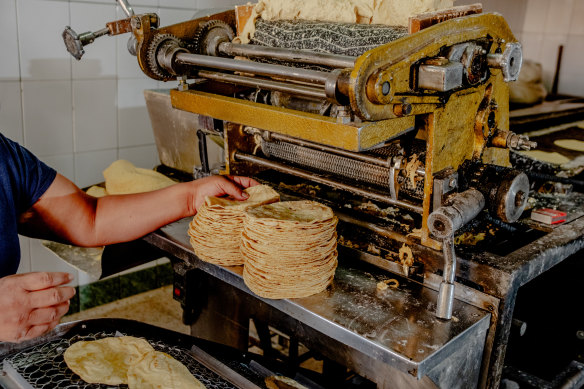
A woman makes tortillas in Mexico City.Credit: Fred Ramos for The Washington Post
When Carmona’s investigators arrested a group of alleged extortioners in Cuautla in April, they discovered that one was a former police officer. An investigation into the Acapulcos gang in 2022 produced evidence that it was being protected by members of the Cuautla police force, according to the attorney general’s office.
But the crime economy doesn’t only thrive because of dirty cops. In many cases, the gangs have political cover. “Drug traffickers are totally involved in the elections,” said Castro, the bishop.
In January 2022, the Sol de Mexico newspaper published a bombshell – photos of the Morelos governor, Cuauhtémoc Blanco, with the leaders of three crime groups. Blanco, a member of the ruling Morena party, told reporters he hadn’t known they were gangsters. “I take photos with everyone,” he said.
The case is under investigation.
On a recent visit to Morelos, López Obrador praised Blanco as a “great man”. His party has nominated the outgoing governor for a congressional seat.
Turning up at the US border
Local elections have become increasingly violent as crime groups try to win control of mayoral offices.
A research project called “Voting Amid Bullets” tallied 836 attacks against elected authorities, political candidates, government employees and party activists during the past six years. That’s nearly triple the number under president Felipe Calderón, whose six-year term ended in 2012.
The crime groups have forced tens of thousands of Mexicans to flee their communities in recent years, according to the UN refugee agency and non-profit groups.
Increasingly, the displaced are turning up at the US border.
The Kino Border Initiative, a migrant-services organisation in the Mexican city of Nogales, found that 88 per cent of the Mexican migrants it interviewed last year cited violence as their reason for leaving home. That compares with only 6 per cent eight years earlier.
Many migrants said they could no longer tolerate the extortion demands, said Pedro De Velasco, advocacy director at the organisation. “It becomes impossible to make the payments.”
Juan de Dios Navarrete understands why people migrate when extortioners strike. He owns the two tortilla shops attacked in Cuautla in November. The 15-year-old boy who was wounded by gunfire was his son, working the counter.
His panicked family urged Navarrete to leave the country.
But he had already done that. He spent two unhappy years in the Bronx back in the 1990s, working in a supermarket and at a restaurant, before coming home with an idea: to start a chain of tortillerias.
As he surveyed the damage to his downtown shop after the shooting, Navarrete became increasingly furious. He wasn’t going to run away, he decided. He was going to demonstrate.
He turned to a local journalist, who was doing a Facebook hit.
“We citizens have to make noise,” he said into the cellphone camera, waving his arms. “We have to come together.”
Loading
Who else could residents rely on? Not the police. Not the army.
“Let’s get together and clean up our city,” he said, stuttering in frustration. “Please support me.”
Navarrete waited for someone to join him. And waited.
Finally, he went home. After a few days, he reopened his shops. The customers returned, handing over their white cotton napkins.
Shielded by new steel bars, under the gaze of security cameras, his employees filled them with stacks of warm tortillas.
The Washington Post
Get a note directly from our foreign correspondents on what’s making headlines around the world. Sign up for the weekly What in the World newsletter here.









Discussion about this post