[ad_1]
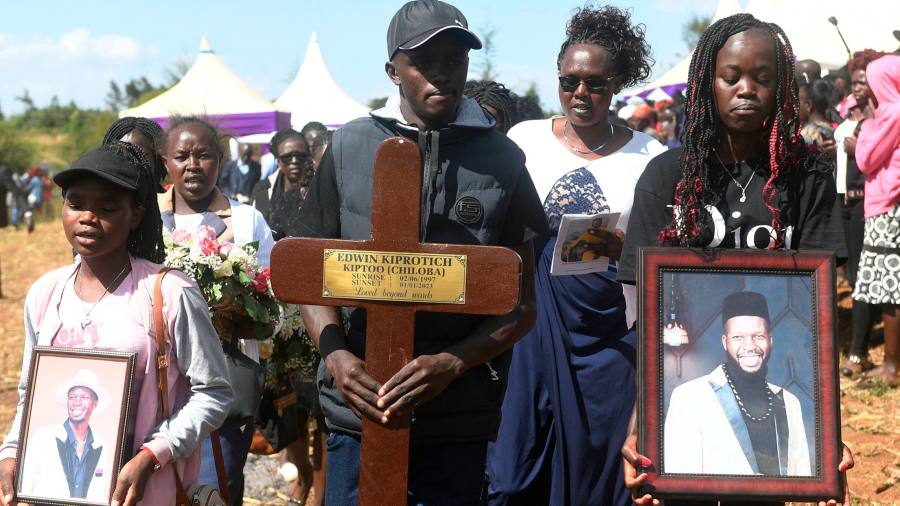
As hundreds of people paid their respects to Kenyan LGBT+ rights campaigner Edwin Chiloba at his funeral this week, members of the queer community were outraged by some politicians’ bigotry directed at them over his sexuality.
“This is so heartbreaking, such lack of humanity troubles me deeply,” said Lorna Dias, co-ordinator of GALCK+, a Kenyan gay, lesbian, bisexual and queer coalition.
The body of Chiloba, 25, was found dumped in a metal box near the western city of Eldoret early this month. Police said he had been choked to death and stuffed into the box. Human rights groups linked Chiloba’s killing to his sexuality and US government officials called for a “transparent” investigation.
The killing has exposed the constant struggle of LGBT+ people in a country where, as in much of Africa, homosexuality remains taboo and gay sex is punishable with prison.
“It is truly worrisome that we continue to witness escalation in violence targeting LGBT+ Kenyans,” the Kenya Human Rights Commission said in a statement. Kenyan police said that five suspects had been arrested in connection with the death, including one with whom Chiloba is believed to have had a personal relationship, officers said.

While several organisations, including Amnesty International, commended the Kenyan Directorate of Criminal Investigations “for the swift investigations into the brutal murder” of Chiloba, they called on authorities to “replicate this determination and enthusiasm and act to close other pending cases”.
In the past two years, the National Gay and Lesbian Human Rights Commission has recorded seven murders of LGBT+ people, three of them activists, in addition to Chiloba. According to a 2019 study by the Southern and East African Research Collective on Health, 59 per cent of respondents in Kenya who identified as trans or gender diverse said they had been physically assaulted in their lifetime.
“These incidents can be attributed to the absence of strong preventions, weak protection mechanisms for survivors, evasive prosecution of sexual and gender-based violence cases, and an uncoordinated and often reluctant response to sexual and gender-based violence from state and non-state actors,” the organisations stated.
Q-initiative, a gay and lesbian coalition in Eldoret, where Chiloba ran a fashion business, said: “We urge the government of Kenya, which has been indifferent as countless lives have been lost, to address the underlying issues that contribute to inequality and heinous crimes against LGBT+ Kenyans.”
The US government also commented on Chiloba’s case. “When violence stems from possible bias or stigma, it indirectly harms all members of the targeted community,” said Ned Price, state department spokesperson. “We urge and expect the Kenyans to conduct a thorough and transparent investigation.”
The outcry was far from universal, however, with a number of MPs using the case to vocally express their deep-rooted opposition to LGBT+ rights.
“What could be the reason why God created a man and from him he created a woman so that they can pair and fill the world. Now evil forces are trying to change God’s script,” said Mishi Mboko, an MP from the coastal city of Mombasa. “We aren’t advocating for the killing of LGBT+IA but we can’t entertain their agenda.”

Mohammed Ali, another MP, was equally trenchant. “On this one Democracy my foot! Jail them.”
Dias of GALCK+ described such attitudes as “absolute nonsense, but that’s what these so-called leaders are peddling and that’s what other people are buying”. She added: “And the trouble is, when they buy it, we get harmed.”
Hostility to homosexuality is not new in Kenya. The country’s film board has banned two movies since 2020 for their portrayals of gay and lesbian characters. In 2019, Kenya’s high court upheld a colonial-era law punishing gay sex as “against the order of nature” with up to 14 years in prison.
Although the law is rarely enforced, activists say discrimination is common, This creates “an environment for violence to thrive and go unpunished”, said Irungu Houghton, executive director at Amnesty International in Nairobi.
It is not just Kenya where LGBT+ people are targeted. According to a report by the International Lesbian, Gay, Bisexual, Trans and Intersex Association, as of 2020, homosexual relations were criminalised in 32 of Africa’s 54 countries. This is nearly half the countries worldwide where homosexuality is outlawed.

In Mauritania, Somalia and parts of Nigeria where sharia law is practised, homosexuality is punishable by death. Uganda and, more recently, Sudan abolished the death penalty for homosexual relations, but some offences can be punished with life imprisonment, similarly so in Tanzania.
There have, however, been some advances across Africa in recent times. Angola in 2021 became the last former Portuguese African colony to decriminalise homosexuality. Botswana’s appeal court the same year upheld a court decision to decriminalise consensual gay sex, saying these laws belong “in the museum or the archives”. South Africa has the most liberal laws, with same-sex marriage legal since 2006. A 2020 law also prevents marriage officers from refusing to conduct such ceremonies.
“We must actively disrupt the normalisation of prejudice and pain in all our spaces,” said Amnesty International’s Houghton. “Until we succeed, it doesn’t matter whether you are an infant, student or fashion designer, old or young, rich or poor, generations of prejudice will visit those around us with vengeance.”
[ad_2]
Source link