








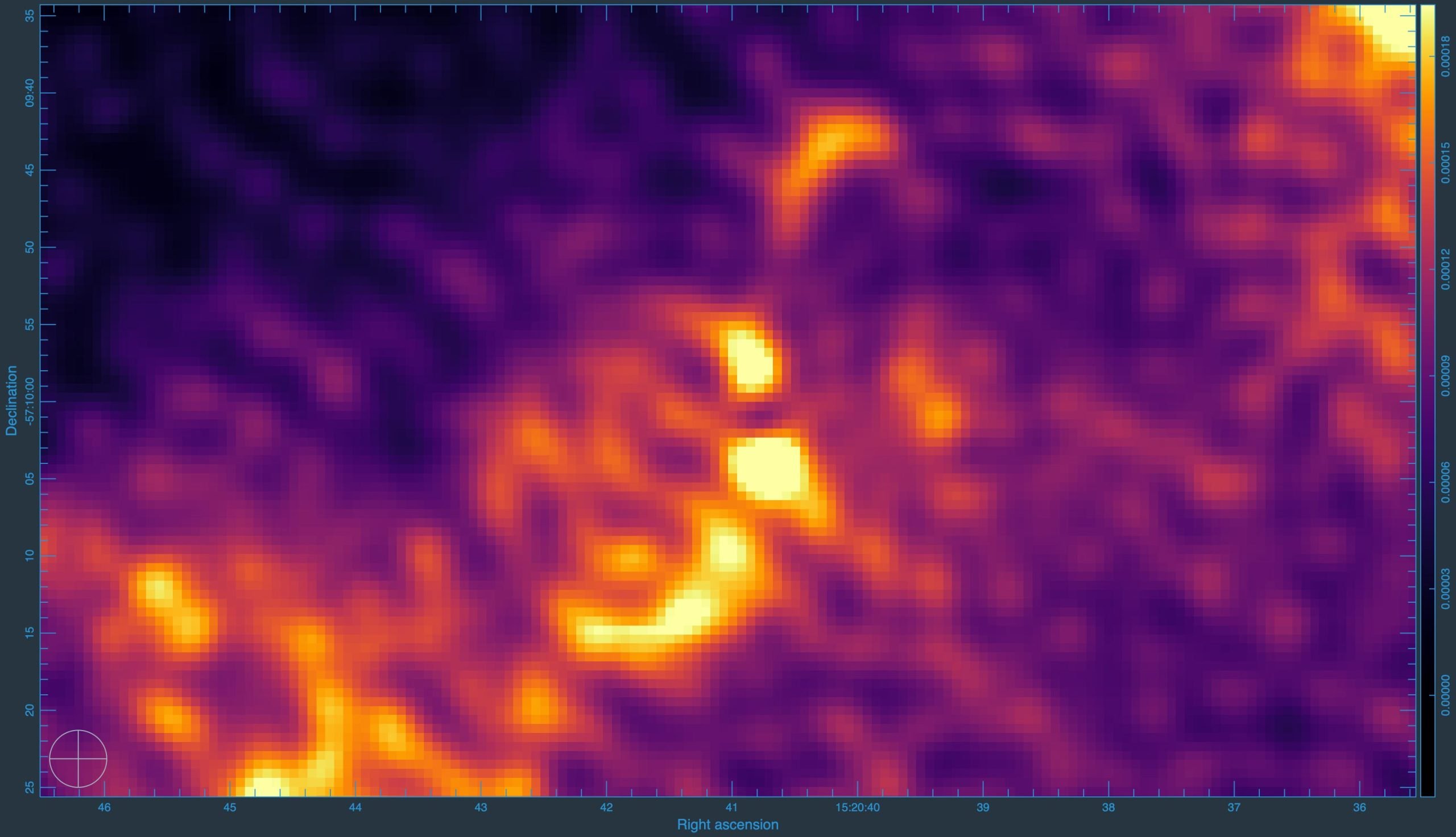
Radio image of the S-shaped precessing jet launched by the neutron star in Circinus X-1. Both Cir X-1 itself (center of the image) and a background source have been subtracted from the image to make the S-shape clearer. The jets are fast, narrow flows of material outwards from Cir X-1. The size of the jets against the sky is the same apparent size as a penny viewed from 100 meters away, but their real size is greater than five light-years. Credit: Fraser Cowie
For the first time, astronomers have captured an image of a
Animation of moving termination shocks from Circinus-1. These are regions where the jet violently rams into the surrounding material causing a shockwave travelling at a significant fraction of the speed of light. Credit: Fraser Cowie
Cosmic Phenomena in Circinus X-1
This particular object sits in the binary system Circinus X-1 more than 30,000 light-years from Earth and formed from the core of a massive supergiant star that collapsed around the same time Stonehenge was built.
It is so dense that a teaspoon of its material weighs as much as Mount Everest.
Binary systems have two stars that are bound together by gravity. In the case of Circinus X-1, one of these is a neutron star.
Both neutron stars and black holes are cosmological monsters that form when the biggest stars in the Universe die and collapse under their own gravity.
However, the latter are considerably more massive and can only be detected through their gravitational effects, while the former can be observed directly despite their denseness.
They are some of the most extreme objects in the Universe and have interiors almost entirely made of neutrons.
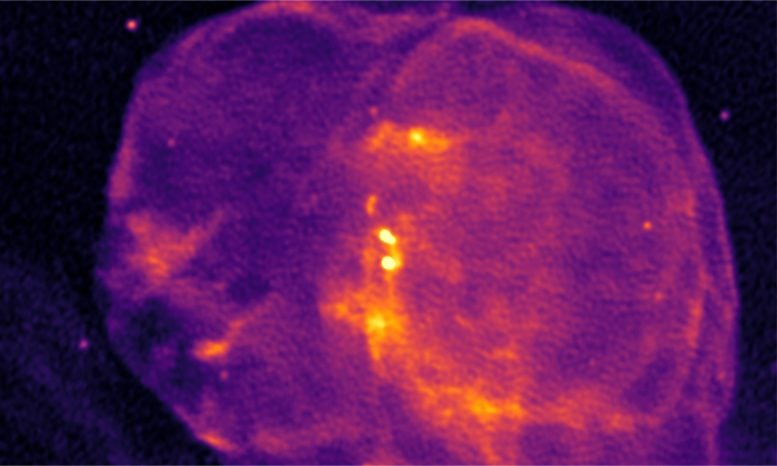
Radio image from the MeerKAT telescope showing Circinus X-1 in the center, within the spherical remnant of the supernova it was born in. The shockwaves caused by the jets are seen above and below Cir X-1, and the S-shape structure in the jets is somewhat obscured by a bright source in the background. Credit: Fraser Cowie
Observations With MeerKAT
The jet emanating from the neutron star was spotted by a team of astronomers at the










Discussion about this post