
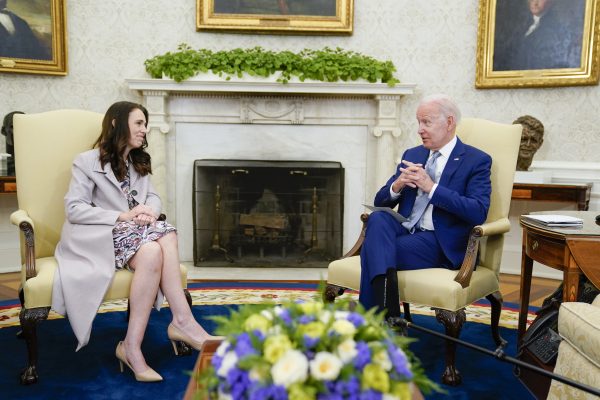
New Zealand Prime Minister Jacinda Ardern’s rock star status has been reinforced by her recent visit to the United States. During the trip, Ardern received an honorary doctorate from Harvard University, was a guest on the popular late-night Stephen Colbert show, and met with President Joe Biden in the Oval Office.
Besides raising Ardern’s visibility, the visit has also raised expectations that New Zealand may align itself with the United States against China. And why not? Both countries share a commitment to liberal democracy and a strategic interest in a stable Indo-Pacific region. In contrast, China is a Marxist-Leninist state that is increasingly intent on challenging the regional and global order that Wellington and Washington are committed to defending.
Two recent developments involving China have undermined New Zealand’s national interests and made it more open to aligning with the U.S. than at any time since its contentious departure from the ANZUS alliance in the 1980s. The first relates to China’s treatment of Australia, New Zealand’s sole treaty ally. Foreign Minister Nanaia Mahuta has called Australia “our closest foreign policy and security partnership,” while Ardern recently referred to Australia as New Zealand’s “most important partner.”
This helps us understand why the needle on Wellington’s political Richter scale went haywire after Beijing responded to then-Australian Prime Minister Scott Morrison’s April 2020 formal call for an independent World Health Organization inquiry into the origins of the COVID-19 pandemic with an array of economic sanctions. For good measure, Beijing’s ambassador to Canberra listed 14 grievances that it required Canberra to satisfactorily address before relations could be restored. This development has driven home to New Zealanders the less benign side of China’s rise in ways that no amount of speeches or visits by U.S. officials or leaders could ever do.
The second concerns China’s activism in New Zealand’s traditional sphere of influence, the Pacific Islands region. The signing of a five-year China-Solomon Islands cooperation agreement in April is a direct challenge to New Zealand’s security. The final agreement is not publicly available at this time, but a leaked draft states that “China may, according to its own needs and with the consent of the Solomon Islands, make ship visits to carry out logistics replenishment in, and have stopover and transition in the Solomon Islands.” Ardern noted that this was a “gravely concerning” development.
Ardern also pointedly asked why Solomon Islands has looked to China, an extraregional power, to meet its security concerns. After all, the October 2000 Biketawa Declaration that was agreed to by Solomon Islands and 17 other Pacific Islands Forum members (including New Zealand) already constitutes a framework for pursuing collective responses to security crises. The Declaration notes “the vulnerability of member countries to threats to their security, broadly defined” and emphasizes “the importance of cooperation among members in dealing with such threats when they arise.” The China-Solomon Islands security agreement contravenes the spirit, if not the letter, of the Declaration and required a response. On May 31, a very strong joint statement was released after Ardern’s meeting with Biden, stating an unequivocal shared concern with the China-Solomon Islands agreement.
That said, a combination of countervailing imperatives, including New Zealand’s deeply ingrained tradition of foreign policy independence and robust economic ties to China serve as a considerable constraint on major policy change. New Zealand will not take lightly a decision to join a coalition against China.
Foreign policy independence is the practical expression of contemporary nationalism in New Zealand. It has two interlinked sources: geography and anti-nuclear sentiment. New Zealand’s geography epitomizes a low threat environment, which makes relative independence both an appealing and achievable goal. The country is located deep in the southern hemisphere. Its neighbors are either a close ally with near identical values and interests (Australia) or relatively small island states.
And then there is New Zealand’s anti-nuclear sentiment, which manifested itself in public aversion to the docking of nuclear-powered and nuclear-armed U.S. naval vessels in the 1970s. This was buttressed by then-Prime Minister David Lange’s widely endorsed statement in a March 1985 debate at Oxford University that “nuclear weapons are morally indefensible.” The back story is important to understand the clash of interests that broke the New Zealand-U.S. leg of the ANZUS alliance.
In February 1985, a crisis broke out in the alliance when the Reagan administration stuck to longstanding U.S. policy of not revealing whether its naval vessels were armed with nuclear weapons while transiting New Zealand’s territorial waters. Faced with this uncertainty, Wellington refused to allow a U.S. naval vessel access to New Zealand ports. When the Lange administration refused to change course, the United States suspended its ANZUS security obligations to New Zealand in August 1986.
Wellington then passed the New Zealand Nuclear Free Zone, Disarmament, and Arms Control Act in 1987, banning both nuclear-powered and nuclear-armed vessels from its ports. Congress responded immediately with the Broomfield Act, downgrading New Zealand’s status as a formal ally. To be sure, both sides have since sought to improve ties, as shown by the signing of the 2010 Wellington Declaration and the 2012 Washington Declaration. In February 2013, then-Prime Minister John Key even stated in an interview that “the relationship between New Zealand and the United States has never been better.” Nevertheless, Secretary of State George Shultz’s 1986 statement at the time of the ANZUS break, that “we remain friends, but we are no longer allies,” holds true.
Hard economic interests, exemplified in the contemporary China-New Zealand relationship, reinforce the imperative not to align with Washington against Beijing. Since signing a free trade agreement in 2008, China has become New Zealand’s top trade partner, with total trade exceeding US$33 billion in 2020. In the first quarter of 2022, New Zealand government figures reveal that China is the destination for more than 25 percent of New Zealand’s exports and the source for just under 20 percent of imports. Economic interdependence has a political effect. Like many states in the Indo-Pacific, there is a deep reluctance in New Zealand to get on the wrong side of China.
There is a clear record here. As far as possible, the New Zealand government’s formal statements of disagreement on China-related issues are expressed in as non-provocative a manner as possible. When China’s treatment of its Uyghur population in Xinjiang was heavily criticized in a non-binding resolution in parliament in 2021, the Ardern administration rejected any formal designation that genocide was occurring.
Truth be told, New Zealand’s engagement with China has been challenged as Beijing’s internal political sensitivities and problems are increasingly being projected abroad. Events in Auckland in June and July 2019 exemplify the point.
In the run-up to planned protests for the 30th anniversary of the Tiananmen protests in China, Chinese Vice Consul General Xiao Yewen met with Auckland University of Technology Vice Chancellor Derek McCormack. According to emails obtained by Newsroom, a New Zealand media website, a request was made by the Chinese official to cancel the event, presumably because its symbolism represented a repudiation of the current regime in Beijing. Lady Luck intervened: The meeting was cancelled on a technicality, thanks to the Tiananmen anniversary occurring on a public holiday in New Zealand.
But problems kept coming for Wellington. In late July 2019, tensions between two groups of University of Auckland students over the political situation in Hong Kong culminated in a short verbal and physical altercation between two students. Remarkably, after the event, on August 1, 2019, the Chinese consulate in Auckland seemingly expressed its support for the group opposing the Hong Kong protests. Subsequently, on August 5, New Zealand officials met with Chinese embassy staff to reiterate the importance of freedom of expression in New Zealand and its universities.
The Auckland examples illustrate the difficulty that China has in adhering to its own principles of noninterference in the internal affairs of other states, and the pressure that New Zealand, like many of China’s trade partners, faces in reconciling economic engagement with liberal democratic principles. The root of the problem is the asymmetric power possessed by China and the accompanying vulnerability that is caused by smaller states’ disproportionate dependence on exporting to China.
To be sure, the winds of China-U.S. great power rivalry may become so severe that New Zealand eventually picks a side. But we are a long way from that point. As it stands, New Zealand’s tradition of foreign policy independence and robust economic ties to China create a strong imperative against joining a U.S. coalition to balance China anytime soon.

Discussion about this post