
By Vijay Prashad
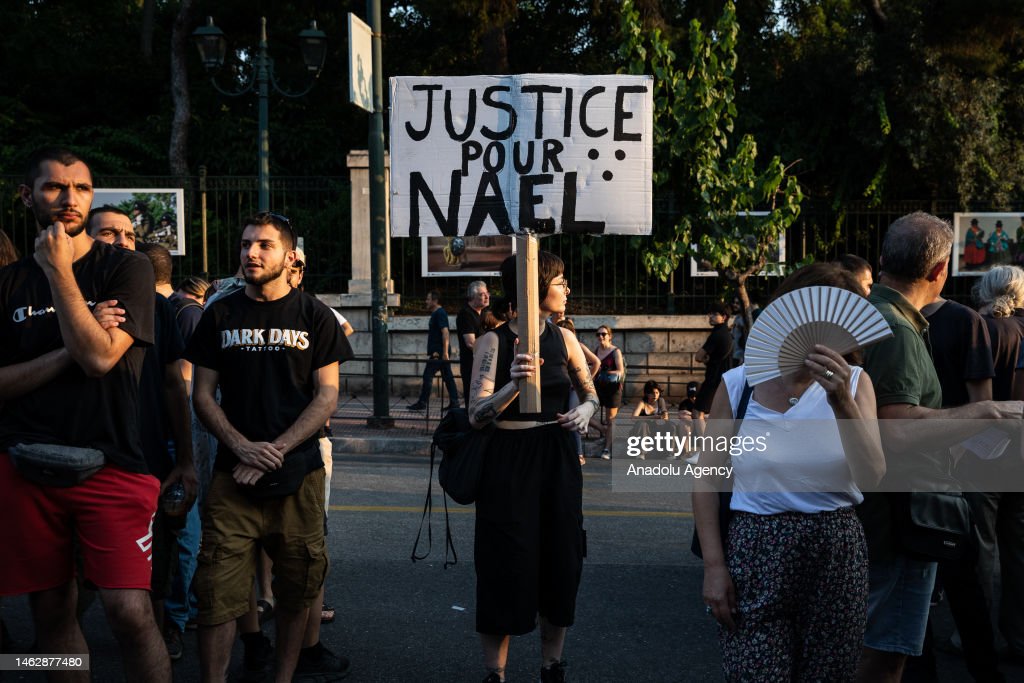
News Americas, PARIS, France, Thurs. July 6, 2023: On Saturday, July 1, 2023, a large crowd gathered inside and around the Ibn Badis Mosque in Nanterre, France, where a seventeen-year-old boy, Nahel M, was mourned and then later buried. Nahel M, of Algerian and Tunisian heritage, was shot dead by a police officer during a traffic stop. It was clear that the police officer had not acted in self-defense but had shot the young man in cold blood. A wave of outrage swept through the country, with protests and riots breaking out across France. French President Emmanuel Macron sent out security forces to stem the protests, which inflamed the protestors whose anger at the police is at very high levels. Antipathy toward the police was confirmed by the language of the police unions (Alliance Police Nationale and UNSA), who called the protestors “vermin” and “savage hordes” and said that “it’s no longer enough to call for calm; it must be imposed.” This is an act of war by the French police against the French population who come from France’s former colonies.
President Macron called the killing of Nahel M “inexplicable,” but this is hardly a credible response. Racism against people of Arab and African descent in France has become almost banal, something that takes place and no longer raises an eyebrow. When France’s Ministry of the Interior released the numbers of racist attacks and killings from 2021, the French National Consultative Commission on Human Rights (CNCDH) said that the situation was “alarming.” Sophie Elizéon, chief of the inter-ministerial delegation for the fight against racism, anti-Semitism, and anti-LGBT hate (DILCRAH) said, “What is being reported from the ground is the exacerbation of unabashed [behavior.]” The killing of Nahel M, in this context, was absolutely explicable—it was the result of a general social toxicity towards minorities and one that is given expression through the police force. No wonder the Office of the United Nations High Commissioner for Human Rights said, “This is a moment for the country to seriously address the deep issues of racism and discrimination in law enforcement.”
Deep Issues of Colonialism
France never really came to terms with its colonial heritage or its colonial mindset. French colonizers went to the Americas in the 16th century, and a hundred years later set up a number of plantations in the Caribbean that operated a slave-based economy. At the heart of the French colonial enterprise was the island of Hispaniola, half of which is today’s Haiti, and from where the French Empire derived an enormous volume of its considerable wealth. France’s attitude to its colonies and to their urge for freedom is encapsulated in the story of Haiti. When the Afro-descendent population of Haiti rose up in a major rebellion in 1791, France—bubbling with its own Revolution of 1789—nonetheless denied the Haitians of their freedom and fought till 1804 to deprive Haiti of its independence. Even after Haiti defeated the French planters, the French state—with the full backing of the United States—forced the Haitian government in 1825 to pay an enormous indemnity of 150 million French francs, which Haiti only paid off in 1947 to Citibank (which bought the debt after 1888).
The reticence of France to allow its own universal pretensions (Liberté, Egalité, Fraternité—the phrase from the revolution that was the center of the 1958 Constitution of the Third Republic) to be heard in the colonies ran from 1804 in Haiti to the wars against national liberation by the French from Algeria to Vietnam in the 1950s and 1960s. So ugly is that history that French students are not taught it in an unvarnished manner. If a French student is asked how many Algerians died due to the brutality of the French regime during the liberation war (1954-1962), they would be hard-pressed to come up with the real number, which is over a million; nor would those students know that when thirty thousand Algerians marched in Paris on October 17, 1961, the French police killed at least a hundred of them and threw their bodies into the River Seine, while arresting at least fourteen thousand people. This is an unacknowledged history, and an unacknowledged colonial history confounds the French public who are therefore unprepared for the colonial structures that assert themselves through the police force and through France’s continued colonial adventures.
Over the course of the past six months, the governments of Burkina Faso and Mali have ejected French troops. They have argued that the 2013 French intervention, purportedly against al-Qaeda, in fact intensified the instability in the region and that France actually consorted with secessionist groups against the national states. A growing feeling of anti-French and anti-Western sentiment runs from these countries in Africa’s Sahel northwards to Algeria and Morocco, where President Macron has been heckled during recent visits. Confidence is growing in the northern Africa region, where people are now quite clear that the French interventions are not for the sake of the African people but are for the narrow interests of France. For instance, the French continue to garrison the town of Arlit, Niger, not for reasons of Mission civilisatrice, but to power the French nuclear reactors; a third of all lightbulbs in France are powered by the uranium from Arlit. There is a general swell of anti-French feeling in the country’s former colonies, now inflamed by the murder of a boy of Tunisian and Algerian heritage.
Debt and the French Burden
Just a few days before the murder of Nahel M, President Macron hosted the Paris Summit for a New Global Financial Pact. The idea for this summit originated with Barbados’ Prime Minister Mia Mottley, who suggested that countries that were especially climate-vulnerable—mainly low-lying island states—needed to get easier access to financing to offset the dangers of rising sea waters. Mottley had argued that the cost of mitigation—building sea walls—and the costs of disasters as well as the high cost of borrowing for green energy, made it impossible for countries such as Barbados to protect themselves or to undertake the kind of transition necessary as climate disasters increased. “What is required of us,” Mottley said, “is absolute transformation, and not reform, of our institutions.”
Macron’s summit on the Financial Pact was as hollow as the promises to reform the French police or France’s colonial attitudes to the African states. Akinwumi Adesina, the head of the African Development Bank, said that “Africa alone loses $7 to $15 billion a year because of climate change, and that’s going to rise to… almost $50 billion a year by 2040. So, the world has to meet its commitment, the developed countries, of the $100 billion” pledge that they have made. Treaty obligations and promises made since at least 2009, Adesina said, have been broken. “I mean, it’s a very small amount of money compared to the scale of the problem, but by not meeting it, it has created a crisis of trust in the developing countries.”
Macron and the incoming World Bank president Ajay Banga gave speeches that sounded as if they could have been given over a decade ago. Same language, same tired promises. “Hope and optimism,” said Banga, to an audience that was not feeling hopeful or optimistic. At least Macron put some tangible suggestions on the table such as a global tax on shipping, on aviation, and on the wealthy to raise $5 billion for a loss and damage fund. It is unlikely that the corporate sector, which has influence in the International Maritime Organization (who will see about the shipping taxes), will allow increased taxation in this sector.
The UN Secretary-General Antonio Guterres pointed his finger at the residue of the colonial mindset and the neo-colonial structure when it comes to financing. The International Monetary Fund’s Special Drawing Rights (SDRs) are available to ameliorate the negative impact of the permanent debt crisis and to bring much-needed emergency finances to poorer countries. But even here, Guterres said, the European Union—with a total population of 447 million people—received $160 billion in SDRs, while the continent of Africa—with a total population of 1.2 billion people—received only $34 billion in SDRs. “A European citizen received on average almost 13 times more than an African citizen,” Guterres pointed out. “All this was done according to the rules. But let’s face it: these rules have become profoundly immoral.” He could have been speaking about the French police code.
EDITOR’S NOTE: This article was produced by Globetrotter. Vijay Prashad is an Indian historian, editor, and journalist. He is a writing fellow and chief correspondent at Globetrotter. He is an editor of LeftWord Books and the director of Tricontinental: Institute for Social Research. He is a senior non-resident fellow at Chongyang Institute for Financial Studies, Renmin University of China. He has written more than 20 books, including The Darker Nations and The Poorer Nations. His latest books are Struggle Makes Us Human: Learning from Movements for Socialism and (with Noam Chomsky) The Withdrawal: Iraq, Libya, Afghanistan, and the Fragility of U.S. Power.
Source: Globetrotter



Discussion about this post