








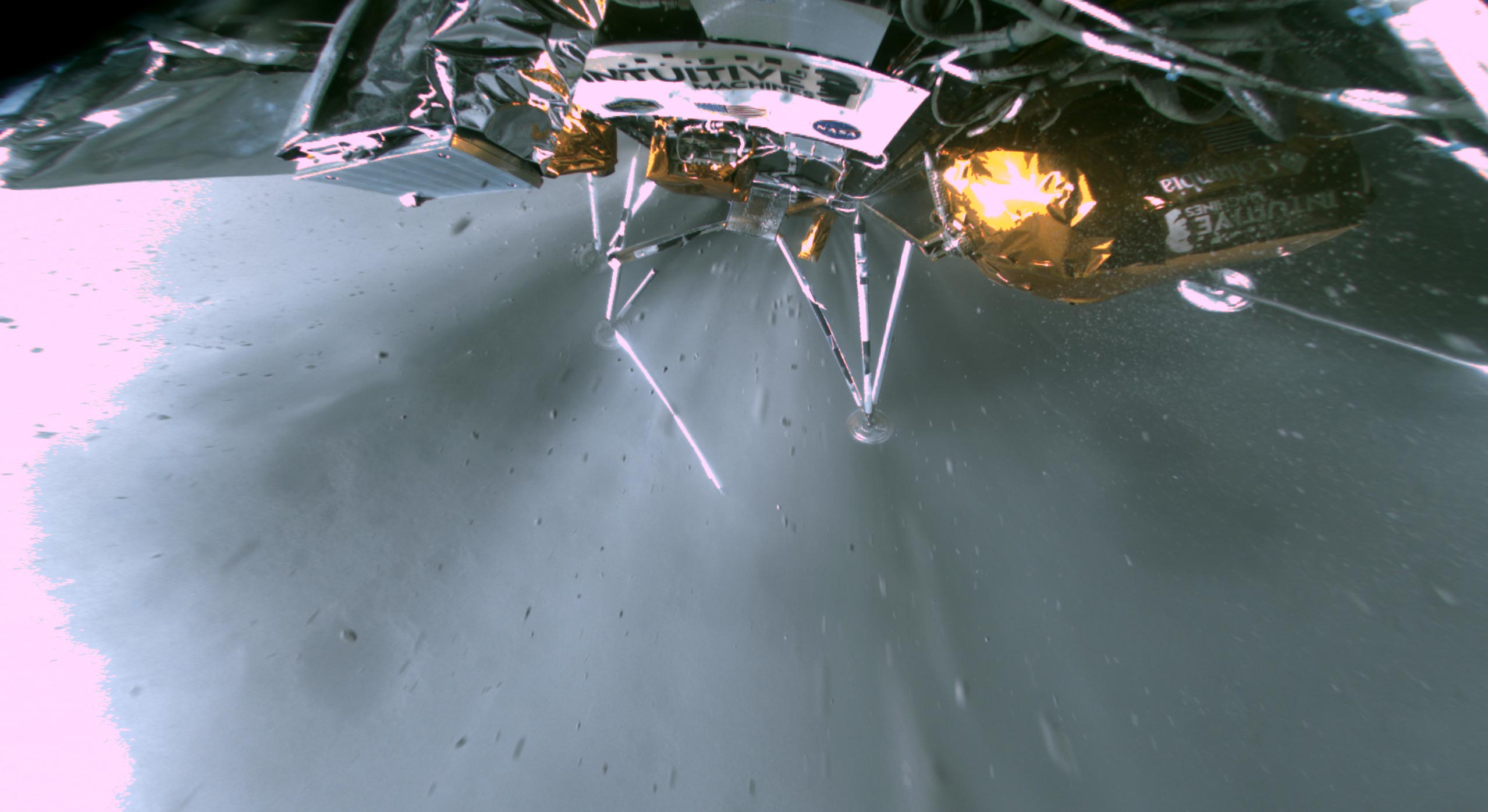
Touch down! A NOVA-C lander named Odysseus and built by the company Intuitive Machines lands on the surface of the moon. Credit: Intuitive Machines
Odysseus, a lunar lander, successfully touched down near the Moon’s South Pole on February 22, despite technical difficulties. The ROLSES experiment recorded Earth’s radio waves, potentially aiding in the search for extraterrestrial life. Future missions are planned to continue this research.
On February 22, a lunar lander named Odysseus touched down near the Moon’s South Pole and popped out four antennas to record radio waves around the surface. It was a moment University of Colorado Boulder astrophysicist Jack Burns hails as the “dawn of radio astronomy from the Moon.”
It was a major achievement for the tenacious lander, which was built by the Houston-based company Intuitive Machines and had to overcome a series of technical difficulties to make it to the lunar surface. Burns is co-investigator on the radio experiment that flew aboard Odysseus called Radio wave Observations at the Lunar Surface of the photo Electron Sheath (ROLSES).
Recently, at the 244th Meeting of the American Astronomical Society in Madison, Wisconsin, he gave an update on the ROLSES data, and shared what’s in store for future radio astronomy from the Moon.
Heroic Effort by Intuitive Machines
“It was heroic for Intuitive Machines to land under these conditions, and to deploy our antennas, take some data and get that data back to Earth,” said Burns, professor emeritus in the Department of Astrophysical and Planetary Sciences at CU Boulder.
Natchimuthuk Gopalswamy at 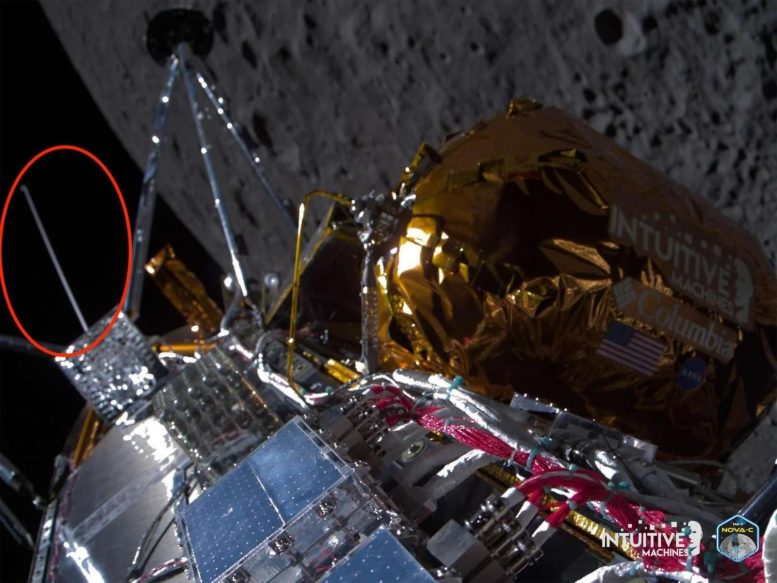
In this selfie of Odysseus, one of the ROLSES antennas sticks out into space on the far left. Credit: Intuitive Machines
Despite the challenges of the mission, ROLSES managed to view Earth in a unique way.
“We viewed Earth as an 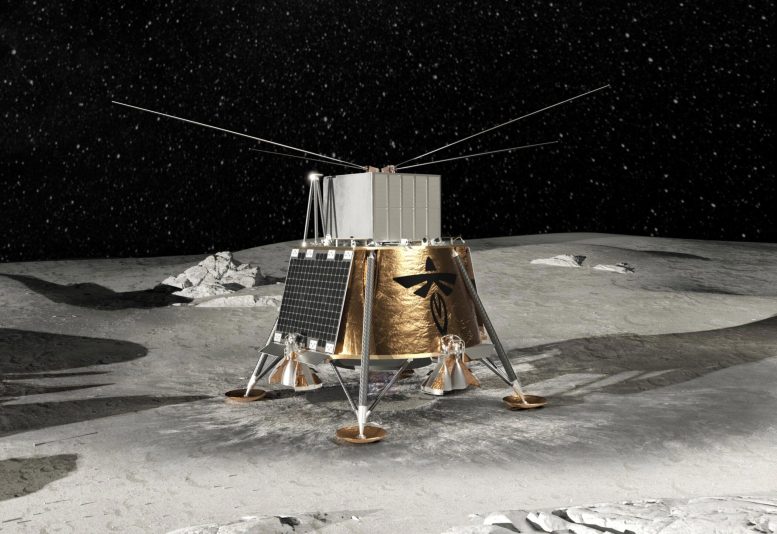
This artist’s rendering shows LuSEE-Night atop the Blue Ghost spacecraft scheduled to deliver the experiment to the far side of the moon. Credit: Firefly Aerospace
Greenlit for Future Missions
He and his colleagues are just getting started. NASA has already greenlit a second ROLSES experiment, which will fly on another CLPS lander, likely in 2026.
The astrophysicist is also part of a third CLPS experiment, known as the Lunar Surface Electromagnetics Experiment-Night (LuSEE-Night), scheduled to arrive at the Moon in 2026. The instrument will land on the far side of the Moon, a quiet spot that human radio emissions can’t reach. From there, it will gaze at radio emissions coming not from Earth but from the earliest days of the Universe before the first stars formed called the Dark Ages—shedding more light on how the cosmos evolved during this crucial junction in its history.
“Because NASA is going to send two or three landers to the Moon every year, we have a way to upgrade our instruments and learn from what goes wrong in a way we haven’t been able to do since the early days of the space program,” Burns said.








Discussion about this post