

Scientists at Scripps Research have identified a molecule secreted by roundworm intestines that communicates with the brain to reduce the rate of fat loss during periods of food scarcity.
In a scenario that many dieters can likely relate to, the less a Caenorhabditis elegans (C. elegans) worm eats, the slower it sheds fat. Researchers at Scripps Research have now uncovered the reason: a small molecule produced in the worms’ intestines during fasting travels to the brain, where it blocks a signal responsible for burning fat during this period.
Although the exact molecule they identified in the worms has not yet been studied in humans, the new work helps scientists better understand the complex crosstalk between the gut and the brain. It also may shed light on why fasting—not eating for set periods of time—has benefits that are independent from the number of calories a person eats. The new study was published in identified FLP-7, a brain hormone that triggers fat burning in the roundworm’s gut. However, C. elegans do not have sensory nerves in their intestines, so scientists have struggled to pin down the reverse communication pathway: How does the gut signal the brain?
“We knew that altering the metabolic state of the gut could change the properties of neurons in the brain, but it was very mysterious how this actually happened,” says Srinivasan.
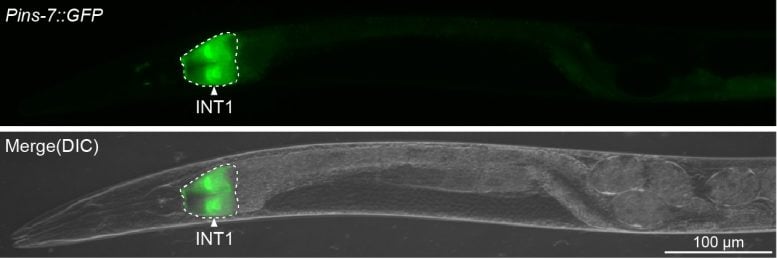
In the new work, Srinivasan and her colleagues removed more than 100 signaling molecules from C. elegans intestines, one at a time, and measured their impact on the brain’s production of FLP-7. They found one molecule that had a large effect on FLP-7: a form of DOI: 10.1038/s41467-024-51077-3
This work was supported by funding from the