
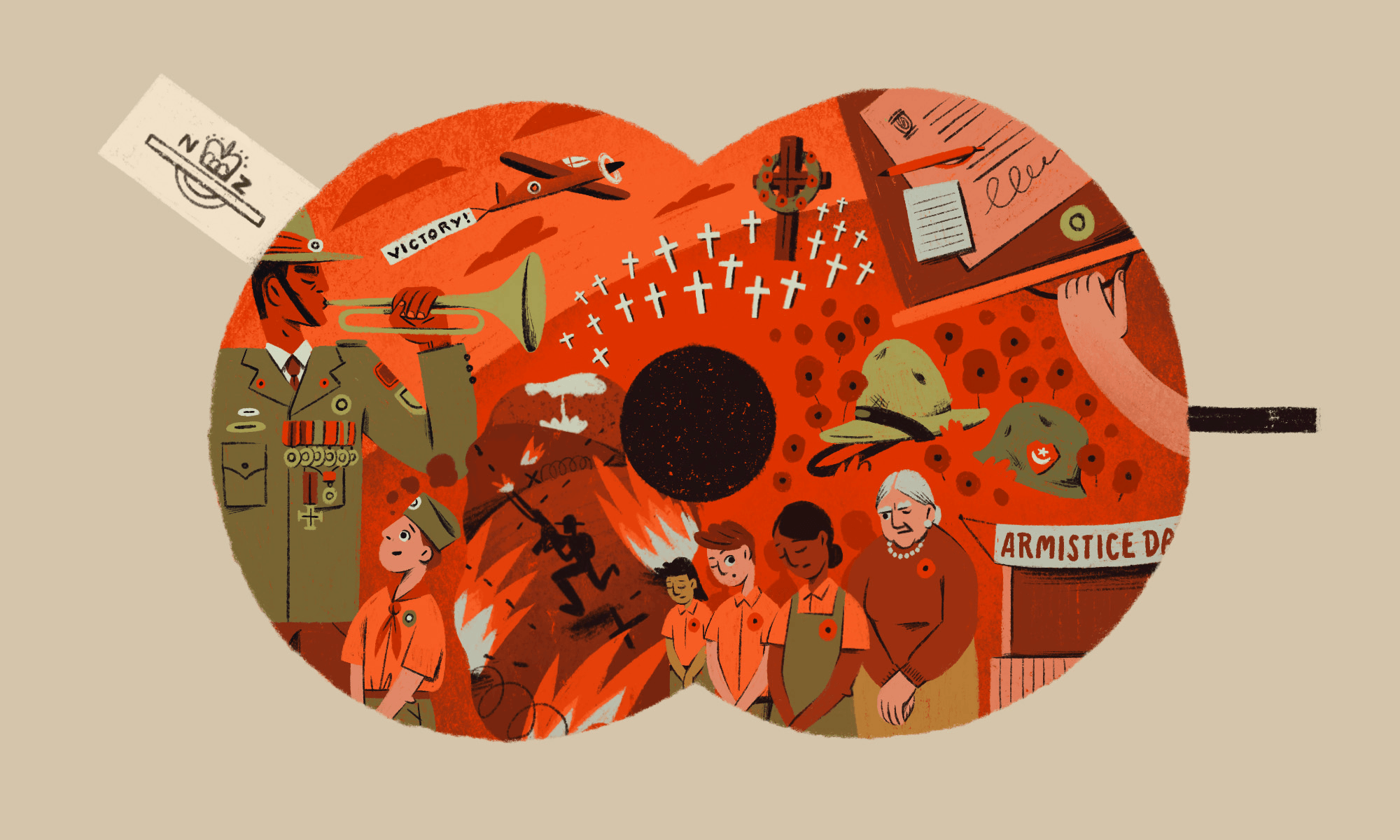
While Anzac Day has experienced a resurgence in recent years, our other day of remembrance has slowly faded from view.
The Sunday Essay is made possible thanks to the support of Creative New Zealand. Original illustrations by Hope McConnell.
First published in 2022.
The high school’s head girl and boy each made a short speech, outlining what the day meant to them. The RSA rep talked about “young men and women…laid down their lives….defence of liberty”. The principal asked the assembly to stand and observe two minutes’ silence. Some 800 teenagers rose, stood with bowed heads, while staff and dignitaries on stage did the same. Outside on the nearby road, traffic had pulled over and waited silently.
A particularly formal Anzac Day service? No. In any year up to the mid 1970s, at 11 am on November 11, such ceremonies took place all across New Zealand, to mark Armistice Day, the exact moment in 1918 when World War 1 officially ended.
I felt I had to specify that date and time, because Armistice Day has slipped so much from public awareness. The governor general still lays a wreath at Wellington’s Pukeahu National War Memorial. Ceremonies are held in some centres. But there’s little media coverage, and any report mentions “a few members of the public….a small number of spectators”.
Yet it began only two years after our first Anzac Day service. The two-minute silence started a year later, at King George V’s request. The name changed to Remembrance Day and then to Remembrance Sunday in 1946, when the ceremony’s date shifted to the weekend before Nov 11.
Soon after that, I stood for the first time with the rest of Napier Central School for those two silent minutes, uncomprehending at first, while our primer teachers frowned at us or put a finger to their lips if we looked like slipping into five-year-olds’ inattention.
My November 11 participation went on, through Napier Intermediate, Napier Boys’ High, Victoria University, into my first years of secondary teaching.
For over half a century, Armistice Day was an occasion marked by crowds and coverage. The scene of my opening paragraph was repeated at several secondary schools where I taught in the 1960s and 70s. And the teenagers did stand in total silence; a few girls even wept.
But the day was already dwindling. The 1946 “Sundayisation” contributed: people already had enough to do on their weekends. Things underwent a brief revival on November 11, 2004, when the Tomb of the Unknown Warrior was dedicated in Wellington. Two years later, also on November 11, Paul Dibble’s remarkable NZ War Memorial was dedicated at Hyde Park Corner in London, with major media coverage. Otherwise, Armistice Day has continued its slide into obscurity.
While it’s shrunk, our other national time of remembrance – I’m talking about Anzac Day, of course – has surged again in public awareness.
I grew up with mixed feelings about April 25. It was a date when my dad’s woolstore workmate Clarrie, who’d spent three years of World War II in a conscientious objectors’ camp on the Rangipo Desert, found that people who’d begun speaking to him stopped again.
It was also an occasion when my father couldn’t march. Age and health meant he’d spent the war in the Home Guard, training with WWI rifles and learning how to stop enemy tanks by thrusting a crowbar into their tracks. He always spoke of it in tones of rueful comedy. But if Japan had invaded, he, with his dad’s army mates, was supposed to withdraw into the Kaimanawa Ranges and launch suicidal guerrilla strikes. Potentially, he was in as much danger as anyone fighting overseas.
Yet for many RSA branches in the 1950s, serving in the Home Guard didn’t entitle you to parade on Anzac Day. You didn’t qualify for the first of their three initials. I recall April 25 partly as a day on which my father went quiet; when my mother put her hand on his shoulder a lot.
I realised later that he must have felt abashed, illogically inferior. At the time, I just wished he had medals like my friends’ dads. I also yearned for the 25-pounder shells used as ashtrays, the framed photos of Bravo Company, the cushion covers of imitation black velvet with garish gold lettering reading Egypt 1942. All my father had was a certificate that stayed in the drawer where we kept envelopes and our Collins lined writing pad.
The lawyer from the big house next to our small house on Napier Hill had been a major in the Army Ordnance Corps – “and he still struts around like he expects you to salute him.” my mother observed tartly.
On those 1950s Anzac Days, held in Napier’s Clive Square around the cenotaph (symbolically if incongruously adjacent to the Plunket Rooms), he’d be prominent in the 11am parade. First would come WWI veterans, still sprightly in their early 60s. Behind them, taller-looking, came the 30-40-year-olds of WWII. And behind them, respectfully separate, half a dozen women: ex-nurses or drivers or clerks. Every chest and bust glittered with medals.
I’d already have been to the Dawn Service, held on Napier’s Bluff Hill, high above the sea. Boy Scouts (me!) were invited, and I revelled in the shadowy ranks, the sun crawling up over the rim of the Pacific, the bugle’s Last Post that sent me home brimming with determination to live a heroic life – and kill any Nazis I met.
But I also went with my parents to the 11am service. Everyone did; neighbours noticed and commented if you weren’t there.
(That’s unless you were my farming uncles, who both fought in the Western Desert, and who weren’t going to drive 15 miles along shingle roads to salute useless old buggers who’d spent the war comfortably at Brigade HQ, and anyway, they had cows to milk. My uncles were seen as peculiar, yet immune from reproach.)
At 11am, there were the same speeches and readings as five hours earlier; martial music from the Napier Silver Band; wreath-layings. Then the parade marched off, with Major Lawyer now in the front rank – “with his bum stuck out as usual,” sniped my mum, in what I later realised was another defence of my father.
They marched back to the RSA rooms, where rum and a meal were provided. Some stayed on. The same neighbours would note how X or Z didn’t arrive home till 4pm, “totally shickered”. Nobody begrudged X / Z the indulgence. Not aloud, anyway. And why shouldn’t the returnees have their day of reunion, their talk of shared ordeals which they hardly ever mentioned to their families? Why shouldn’t they feel significant for a while, as their lives began to dim into civilian anonymity?

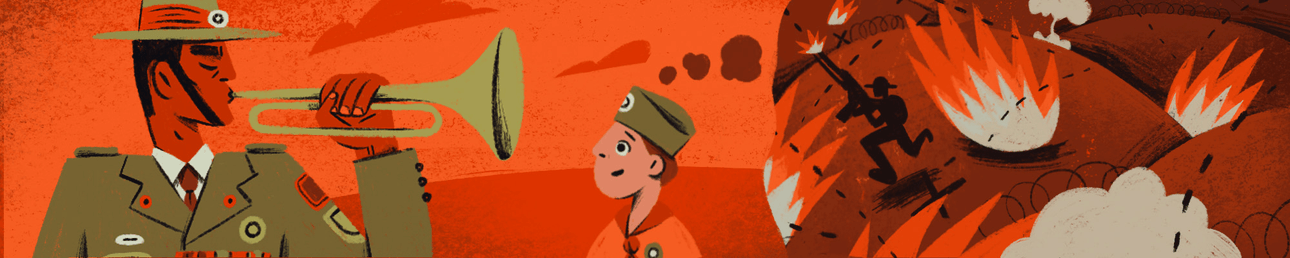
Armistice Day ceremonies in those decades were subdued by comparison. The speeches and wreath-laying were there, but the music was more muted, the marching less swaggering. The dead on all sides might be mentioned – uncertainly. There was little to stir a small boy’s martial zeal. And since then, the day has continued its slow fade.
It hasn’t happened elsewhere: Australia has turned November 11 into its National Remembrance Day, and in the UK, it’s an occasion for nationwide ceremonies.
Also in Australia, a decade back, a number of historians expressed disquiet at what they saw as the growing “militarisation” of Anzac Day, its inflation of historical fact into mythology.
I don’t feel that’s happened here during the resurgence of attendance on April 25. But I still have mixed feelings about Anzac Day commemorations. Any event involving uniforms, bands, parades is going to elevate the perceived glamour of war. And I do not warm to the idea of small boys wearing (great)grandad’s medals. I wonder what fantasies of blazing guns and dying baddies some of them are having, just as I did nearly 70 years back.
Am I lacking in national pride? I’m proud of some things our nation has done. I’m proud of numerous individuals past and present from the said nation. But “national pride” is a slippery, potentially manipulative term – just like “heroism” and “sacrifice”.
I have no objection to a day which acknowledges and laments the loss of lives and the associated sufferings that war brings. One of the most moving phrases I’ve heard came from a Turkish politician who mourned for “all the Tommies and Mehmets lying side by side”.
We’re constantly told that Anzac Day is an almost uniquely New Zealand event; that it marks the forging of a national identity. Maybe.
But I wonder, should we be focusing on an event that involved a few countries only, or on the November 11 one, which directly or by implication affected far more nations, which carried hopes of global peace and reconciliation? Should we be separatist or inclusive?
I’m all in favour of recording and understanding moments from our history. I can put up with the day’s sonorous cliches. I even approve of the formal rituals; Pākehā New Zealand is a culture with too few of those.
But I still feel all these admirable intentions, all the symbolism and commemoration would fit equally well into a November 11 occasion. At its baldest, I see a choice between a date marking peace and a date marking war. Now you may….. shoot down my arguments.


Discussion about this post