
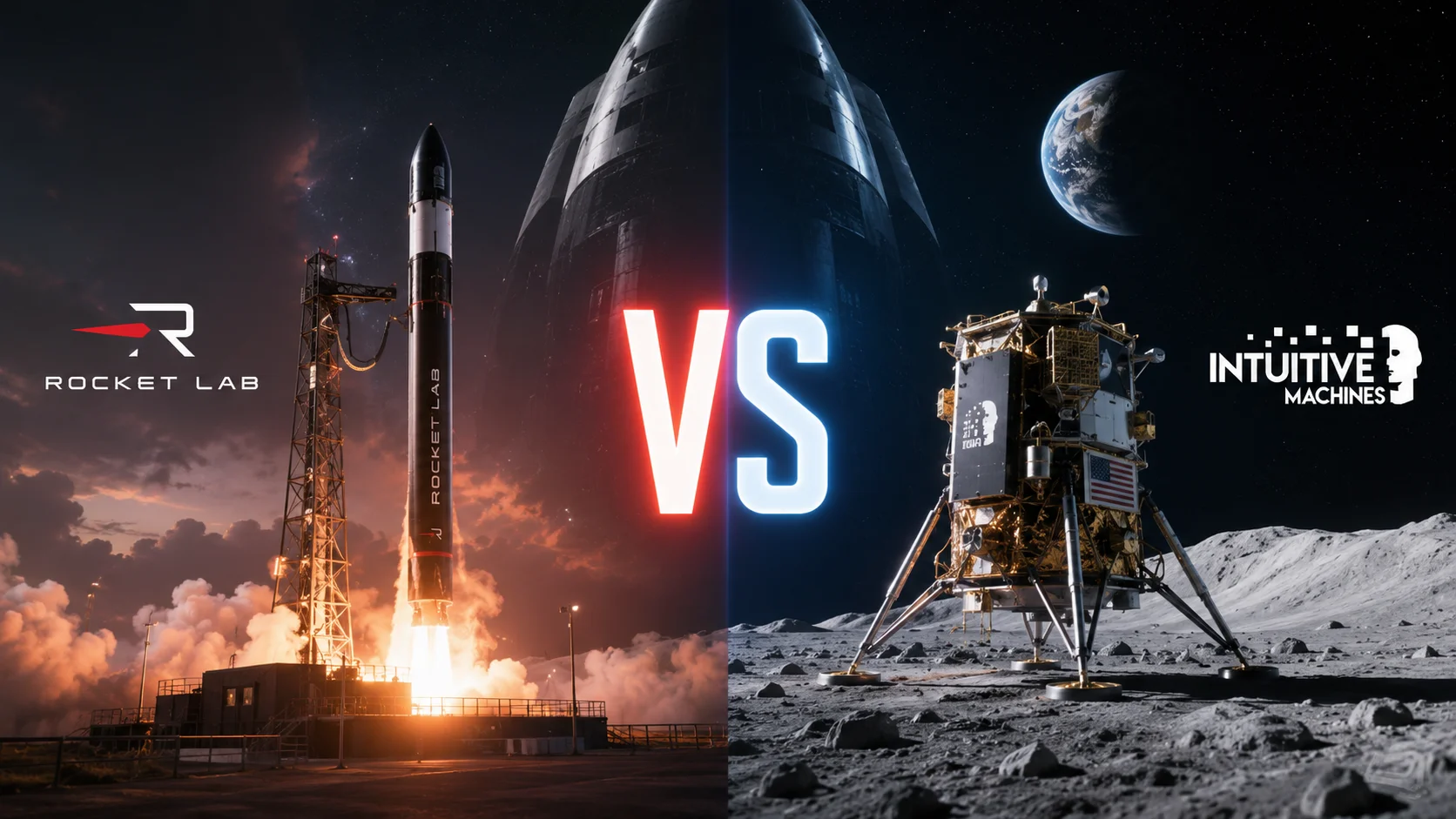
Rocket Lab and Intuitive Machines give investors two very different ways to invest in the commercial space boom. One offers diversification and financial strength. The other is a higher-risk bet on the Moon.
SpaceX has changed what investors expect from the commercial space industry. But there’s one major obstacle for everyday investors who want exposure to Elon Musk’s space empire: SpaceX isn’t publicly traded.
That leaves investors searching for the next best thing.
Two companies stand out: Rocket Lab and Intuitive Machines.
Both can be viewed as publicly traded alternatives to SpaceX, but that comparison only goes so far. Rocket Lab is building a diversified space business spanning launches, spacecraft, satellite components, and propulsion systems. Intuitive Machines is concentrating much of its opportunity around lunar missions and infrastructure.
That makes Rocket Lab vs. Intuitive Machines less about finding a smaller version of SpaceX and more about deciding which part of the future space economy you want to own.
For me, the choice comes down to one fundamental question:
Would you rather invest in a company with several ways to win, or make a concentrated bet that the Moon becomes the next major commercial frontier?
Rocket Lab vs. Intuitive Machines at a Glance
Rocket Lab and Intuitive Machines are both pursuing enormous opportunities, but their strategies are almost opposites.
Rocket Lab is attempting to participate across a large portion of the space value chain. It launches rockets, builds spacecraft, produces components, sells propulsion systems, and is developing Neutron to pursue larger missions.
Intuitive Machines has built its strategy around lunar activity. Its business includes lunar landing services, communications, navigation, and infrastructure supporting future missions to the Moon.
That difference shapes almost everything else about these two stocks.
Rocket Lab is the more diversified space investment. Intuitive Machines is the more concentrated lunar investment.
And concentration can work both ways.
If lunar spending grows rapidly, Intuitive Machines could have tremendous upside. If the space economy develops in unexpected directions, Rocket Lab has more businesses that could benefit.
Why Rocket Lab Is More Than a Rocket Company
Rocket Lab is still closely associated with Electron, its small-satellite launch vehicle.
But judging the business solely by launch activity misses what may be its most important advantage.
During the first quarter of 2026, Rocket Lab generated approximately $64 million from Launch Services. Space Systems brought in roughly $137 million, accounting for around two-thirds of total revenue.
That revenue mix reduces the company’s dependence on individual rocket launches.
Launch schedules can change because of:
- Weather
- Technical issues
- Customer readiness
- Mission-specific delays
Rocket Lab’s Space Systems operations give the company additional revenue streams while those launch risks play out.
That matters because a diversified business doesn’t need a single product to perform perfectly every quarter.
Rocket Lab can generate value from launches while also selling spacecraft, satellite components, propulsion systems, and mission hardware.
Its biggest advantage may be that Rocket Lab can participate in the space economy without needing to dominate any single corner of it.
Intuitive Machines Is Betting on a Lunar Economy
Intuitive Machines is making a much more focused bet.
Instead of spreading its opportunity across numerous parts of the commercial space market, the company is positioning itself around future activity on the Moon.
Its first-quarter 2026 revenue nearly tripled year over year to approximately $187 million, supported by the Lanteris acquisition and continued progress across lunar contracts.
Management’s full-year guidance called for revenue between $900 million and $1 billion.
That growth highlights why Intuitive Machines attracts so much attention.
If NASA and commercial customers steadily increase their presence on and around the Moon, companies providing transportation, communications, navigation, and infrastructure could become extremely valuable.
The risk is that Intuitive Machines depends more heavily on that specific future becoming reality.
Its revenue can be influenced by mission milestones, government funding, contract timing, and the continued expansion of lunar programs.
Rocket Lab doesn’t have the same degree of concentration.
Intuitive Machines could have more explosive upside, but more of the investment thesis depends on the lunar economy developing as expected.
Neutron Could Transform Rocket Lab
Rocket Lab’s next major test is Neutron.
The reusable medium-lift launch vehicle is designed to carry up to 13,000 kilograms into low Earth orbit.
If Rocket Lab can successfully bring Neutron into service, the company could pursue larger commercial missions and national security launches that aren’t suitable for Electron.
That could significantly expand its addressable market.
It could also strengthen Rocket Lab’s position as one of the most credible publicly traded alternatives to SpaceX.
But Neutron is also a major source of execution risk.
Developing a larger reusable rocket isn’t easy. Delays matter because investors aren’t valuing Rocket Lab exclusively on its current operations. Part of the bull case depends on Neutron becoming another significant growth platform.
That’s the tradeoff.
Neutron could substantially increase Rocket Lab’s opportunity, but the company still has to prove it can deliver.
Intuitive Machines Has Already Reached the Moon
Intuitive Machines faces a different technical challenge.
Its Nova-C landers have already reached the lunar surface.
That gives the company real-world experience in an area where only a tiny number of commercial organizations have operated.
But lunar missions also demonstrate how unforgiving this business can be.
The IM-2 Athena mission landed inside a crater and ended early after gathering limited data.
Reaching the Moon is an extraordinary technical achievement, but investors need something beyond individual achievements.
They need repeatability.
For Intuitive Machines to build a durable lunar services business, it must demonstrate the ability to execute difficult missions consistently enough for government and commercial customers to depend on it.
The execution comparison therefore looks like this:
- Rocket Lab must prove it can successfully transition to a larger class of rocket.
- Intuitive Machines must prove lunar operations can become repeatable and dependable.
Neither task is easy.
Rocket Lab Has the Stronger Backlog
Backlog is especially important when evaluating companies investing aggressively ahead of future growth.
Rocket Lab ended the first quarter of 2026 with approximately $2.2 billion in backlog.
During the same quarter, it secured 31 new Electron and HASTE launch contracts along with five dedicated Neutron launches. The company’s contracted work covers commercial customers, defense programs, and government missions.
Intuitive Machines reported approximately $1.1 billion in backlog after adding significant lunar contracts and completing the Lanteris acquisition.
That’s still a substantial amount of contracted work.
The bigger difference is where that work is concentrated.
Much of Intuitive Machines’ business remains linked to NASA’s Artemis roadmap and lunar infrastructure programs.
That creates policy risk.
Government priorities and funding can change. Rocket Lab also works with government customers, but its wider mix of markets and products gives it more ways to adapt.
Rocket Lab has both a larger and a more diversified backlog.
For a long-term investor, that’s an important combination.
Rocket Lab Also Has More Financial Flexibility
Space exploration requires enormous amounts of capital.
That makes cash especially important when comparing these companies.
Rocket Lab had approximately $1.38 billion in cash and current marketable securities at the time, as reflected in the original analysis.
Intuitive Machines held approximately $231.6 million in cash while continuing to consume capital as it expanded.
A larger cash position doesn’t eliminate execution risk, but it provides more room when things go wrong.
Rocket Lab can potentially absorb development delays, continue funding Neutron, and invest in new opportunities without depending as heavily on outside financing.
Intuitive Machines has less room for error.
If major programs are delayed or capital spending remains elevated, shareholders face a more obvious risk of future dilution.
For me, Rocket Lab’s balance sheet materially strengthens its five-year investment case.
Wall Street Sees Bigger Potential Upside in Intuitive Machines
Interestingly, analyst targets favor the riskier stock when measured purely by potential upside.
Among the 17 analysts referenced in the original analysis, Rocket Lab had a consensus Strong Buy rating. Its mean and high price targets suggested approximately 79% to 135% upside.
Intuitive Machines carried a Moderate Buy rating among 11 analysts, while its mean and high targets suggested roughly 218% to 480% upside.
Those targets shouldn’t determine whether you buy either stock.
They do, however, illustrate the difference between the two opportunities.
Rocket Lab has the stronger operating foundation.
Intuitive Machines has the more speculative upside.
Higher potential returns are being paired with greater uncertainty.
Rocket Lab vs. Intuitive Machines: Which Stock Would I Buy?
If I could own only one of these companies for the next five years, I’d choose Rocket Lab.
The company has several advantages:
- A more diversified revenue model
- A roughly $2.2 billion backlog
- Exposure to commercial, defense, and government customers
- A stronger cash position
- An established small-launch business
- A significant potential growth catalyst in Neutron
- Several different ways to benefit from expansion of the space economy
Intuitive Machines still has an exciting opportunity.
If lunar exploration becomes a sustained commercial market, its early position could eventually prove extremely valuable.
But investors have to accept more concentration.
The company needs lunar investment to continue, difficult missions to succeed, and commercial demand beyond low Earth orbit to develop.
That’s why I see Rocket Lab as the stronger five-year investment and Intuitive Machines as the more speculative moonshot. This is the same core distinction reflected in the original analysis.
The Best SpaceX Alternative Doesn’t Need to Replace SpaceX
Investors often talk about finding the “next SpaceX.”
I don’t think either company needs to become that.
SpaceX can remain the dominant player while Rocket Lab and Intuitive Machines build highly valuable businesses alongside it.
Rocket Lab could become essential to customers wanting dedicated launches, satellite systems, spacecraft hardware, or an alternative supplier.
Intuitive Machines could become essential to organizations that need access to the Moon and the infrastructure around it.
There should be room for more than one winner if the commercial space industry continues expanding.
The difference is how much needs to go right.
Rocket Lab can potentially win through Electron, Space Systems, or Neutron.
Intuitive Machines is making a larger bet on the Moon.
For investors who want the more balanced approach, Rocket Lab looks like the better SpaceX alternative today.
For investors willing to accept significantly more uncertainty in exchange for potentially much greater upside, Intuitive Machines remains one of the more intriguing moonshots in the public market.
Rocket Lab vs. Intuitive Machines FAQ
Is Rocket Lab a competitor to SpaceX?
Rocket Lab competes in parts of the commercial launch and space infrastructure market, although it doesn’t need to replicate SpaceX’s entire business. Electron, Space Systems, and potentially Neutron give Rocket Lab several ways to participate in the growing space economy.
What does Intuitive Machines do?
Intuitive Machines focuses heavily on lunar services and infrastructure, including lunar landers, communications, and navigation capabilities.
Which company has the larger backlog?
Based on the figures used in this analysis, Rocket Lab reported approximately $2.2 billion in backlog, compared with approximately $1.1 billion for Intuitive Machines.
Which is riskier, Rocket Lab or Intuitive Machines?
I consider Intuitive Machines the more speculative investment because its opportunities are more concentrated in lunar development and government-backed programs. Rocket Lab operates across a broader mix of products and markets.
Which space stock would I choose for five years?
Between the two, I’d choose Rocket Lab. Its stronger balance sheet, larger backlog, diversified revenue base, and multiple growth platforms give it more ways to succeed if the space economy develops differently than expected.


Discussion about this post