
Scientists at the Princeton Plasma Physics Laboratory are pioneering the use of liquid lithium in spherical tokamaks to enhance fusion performance.
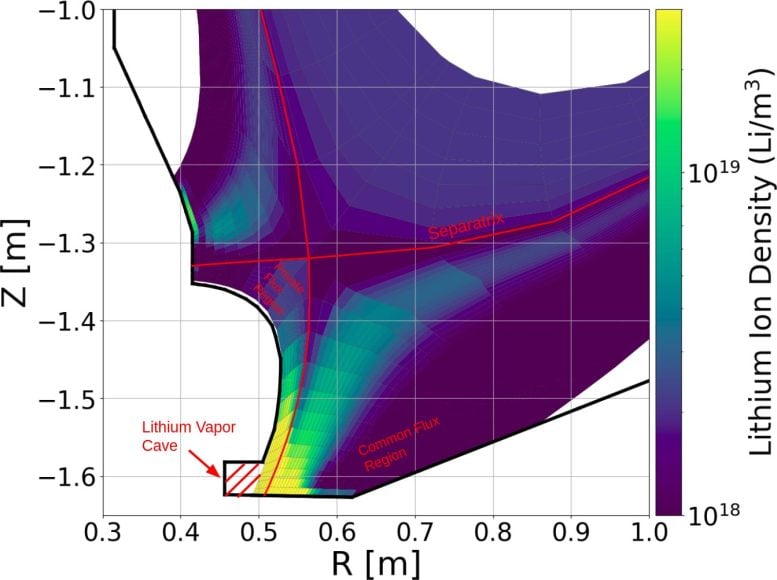
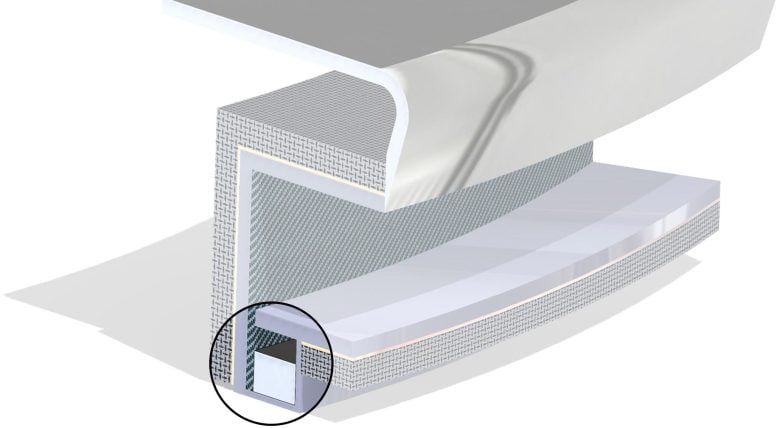
Recent computer simulations suggest the optimal placement of lithium vapor to protect the tokamak’s interior from intense “ “The lithium evaporator really does not work unless it is placed in the private flux region,” said Eric Emdee, an associate research physicist at PPPL and lead author of the new paper. When the lithium is evaporated in the private flux region, the particles become positively charged ions in a region with a lot of excess heat, protecting the nearby walls. Once the lithium particles are ionized, they obey the same magnetic fields as the plasma, spreading and dissipating the heat so it strikes a larger area of the tokamak and reduces the risk of components melting. The private flux region is also the ideal target for the evaporated lithium because it is separate from the core plasma, which needs to stay hot. “You don’t want your core plasma to get dirty with lithium and cool, but you also want the lithium to do some heat mitigation before it leaves the cave,” he said. The researchers originally thought the lithium would be best housed in a “metal box” with an opening at the top. The plasma would flow into the gap so the lithium could dissipate the heat of the plasma before reaching the metal walls. Now, the researchers say a cave — geometrically just the inner half of a box — full of lithium vapor would be simpler than a box. The difference is more than just semantics: It impacts where the lithium travels and how effectively it dissipates heat. “For years, we thought we needed a full, four-sided box, but now we know we can make something much simpler,” said Emdee. Data from new simulations pointed them in a different direction when the research team realized they could contain the lithium just as well if they cut their box in half. “Now we call it the cave,” Emdee said. In the cave configuration, the device would have walls on the top, bottom and side closest to the center of the tokamak. This optimizes the path for the evaporating lithium, setting it on a better course for capturing the most heat from the private flux region while minimizing the complexity of the device. Yet another approach proposed by PPPL scientists in the new paper could achieve the same heat-quenching effect without drastically modifying the tokamak’s wall shape. In this approach, liquid lithium flows quickly under a porous, plasma-facing wall. This wall would be located where the excess heat impacts the tokamak the most: at the divertor. The porous wall allows the lithium to penetrate the surface directly facing the plasma heating, so liquid lithium is delivered exactly where it is needed most: at the area of the highest heat intensity. This capillary porous system is explained in an earlier paper published in the journal Physics of Plasmas. The lead author of that paper, PPPL Principal Engineering Analyst Andrei Khodak, said he prefers the idea of using a porous plasma-facing wall on its own, as tiles embedded in the tokamak. “The advantage of the porous plasma-facing wall is that you don’t need to change the shape of the confinement vessel. You can just change the tile,” Khodak said. Khodak was also a co-author on the new paper, along with former Lab Director Robert Goldston. Having lithium evaporation on the divertor surface leads to strong coupling between the plasma edge and the plasma-facing component in terms of heat and mass transfer because the heating from plasma will lead to lithium evaporation, which will, in turn, change the plasma heat flux to the liquid lithium plasma-facing component. A new model, described in a paper by the same authors in IEEE Transactions on Plasma Science, accounts for this strong two-way coupling. PPPL scientists and engineers will continue to test and develop their ideas as part of their core mission of making fusion an important part of the power grid. Reference: “Optimization of lithium vapor box divertor evaporator location on NSTX-U using SOLPS-ITER” by E.D. Emdee, R.J. Goldston, A. Khodak and R. Maingi, 2 July 2024, Nuclear Fusion. The DOE supported work on the new Nuclear Fusion paper under contract number DE-AC02-09CH11466. The Physics of Plasmas manuscript was based upon work supported by the DOE, Office of Science, Office of Fusion Energy Sciences and was authored by

Advancing Tokamak Design With Liquid Metals
Benefits of Lithium Placement in Private Flux Region
Revising Lithium Containment: From Box to Cave
New Approaches to Heat Management
DOI: 10.1088/1741-4326/ad57d2