
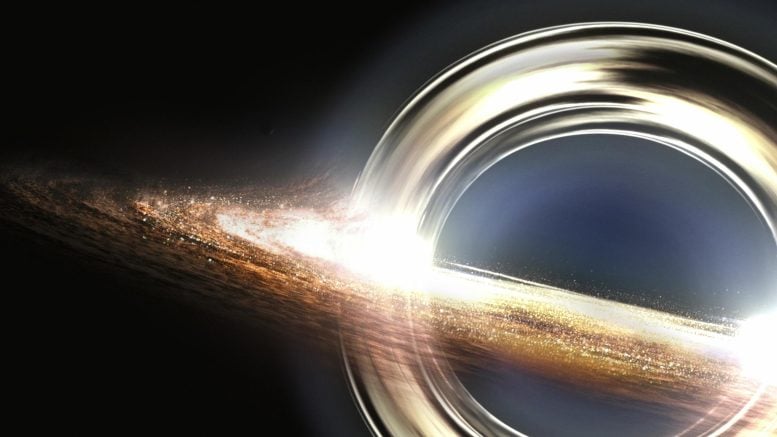
Researchers at Michigan State University investigated the behavior of the supermassive black hole Sagittarius A* at the center of our galaxy, focusing on its consumption of nearby material and the resulting x-ray flares. They used echoes of past flares to study the black hole’s historical activity, revealing that it frequently consumed material and was significantly brighter in the past.
Scientists studied the past activity of Sagittarius A*, the supermassive 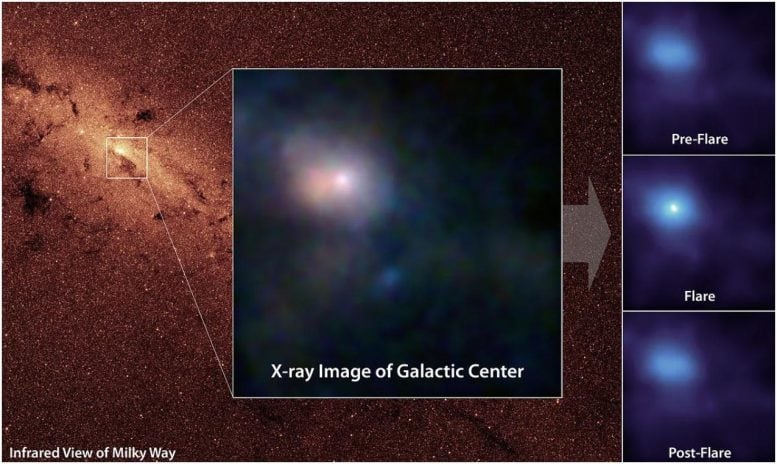
Michigan State University researcher Grace Sanger-Johnson found nine previously undiscovered X-ray flares from Sagittarius A*, the Milky Way’s central supermassive black hole, by sifting through a decade’s worth of X-ray data. This NASA image, published over a decade ago, shows an example of an X-ray flare. Credit: NASA/JPL-Caltech
Two researchers from Michigan State University—Grace Sanger-Johnson and Jack Uteg—studied the flares and their light-echoes in detail. What they found shows activity at Sgr A* in the very distant past when Sgr A* ingested material. X-ray emissions from that activity traveled for hundreds of years from Sgr A* to bounce off of and brighten a nearby molecular cloud. That created a light echo that traveled another roughly 26,000 years before reaching Earth. So, when Uteg and Sanger studied these flares and light echoes, they were literally looking into the past.
Searching for Sgr A* X-ray Flares With NuSTAR
Sanger-Johnson analyzed ten years’ worth of data looking for X-ray flares generated by Sgr A*’s eating habits. During the search, she found evidence for nine more such outbursts.
The flares are typically quite dramatic. Because they’re so bright, they provide astronomers a chance to study the immediate environment around the black hole. The data Sanger-Johnson studied came from the NuSTAR mission. It zeroes in on high-energy X-ray and gamma-ray emissions. These typically come from active regions in the hearts of galaxies, supernova explosions, and other active events.
The data Sanger-Johnson collected and analyzed is now a database of flares from Sgr A. “We hope that by building up this bank of data on Sgr A flares, we and other astronomers can analyze the properties of these X-ray flares and infer the physical conditions inside the extreme environment of the supermassive black hole,” Sanger-Johnson said.
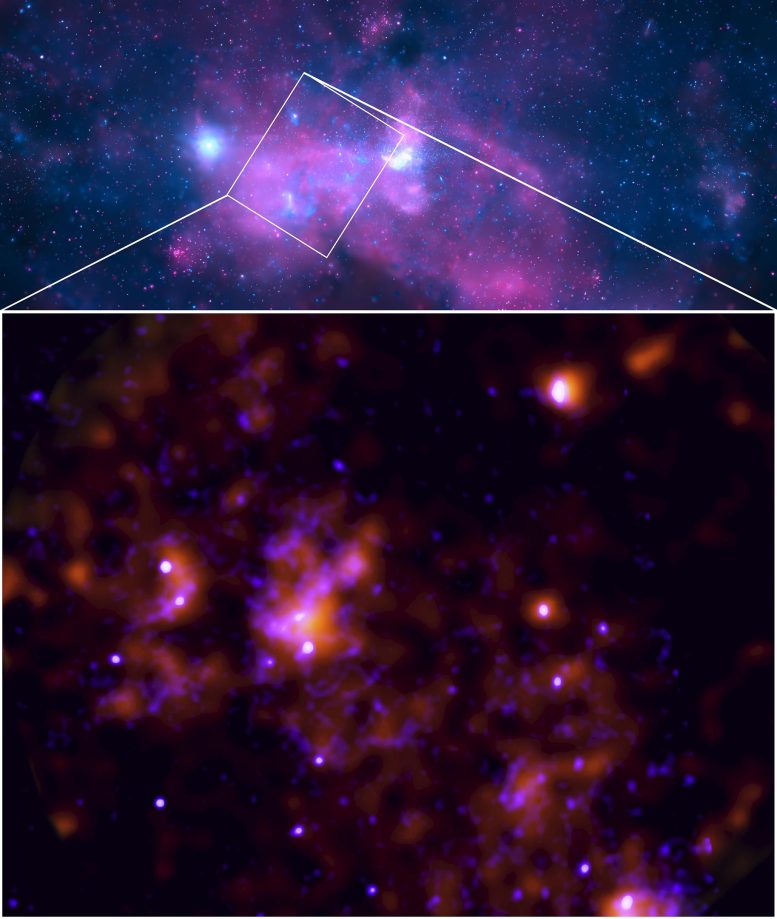
Astronomers do know about outbursts from Sgr A* from other observations. Here’s a view from NASA’s Imaging X-ray Polarimetry Explorer and Chandra X-ray Observatory. The combination of IXPE and Chandra data helped researchers determine that the X-ray light identified in the molecular clouds originated from Sagittarius A* during an outburst approximately 200 years ago. Credit: Chandra: NASA/CXC/SAO; IXPE: NASA/MSFC/F. Marin et al; Sonification Credit: NASA/CXC/SAO/K.Arcand, SYSTEM Sounds (M. Russo, A. Santaguida)
Tracking the Echoes of Flares
While Sanger-Johnson was working with the 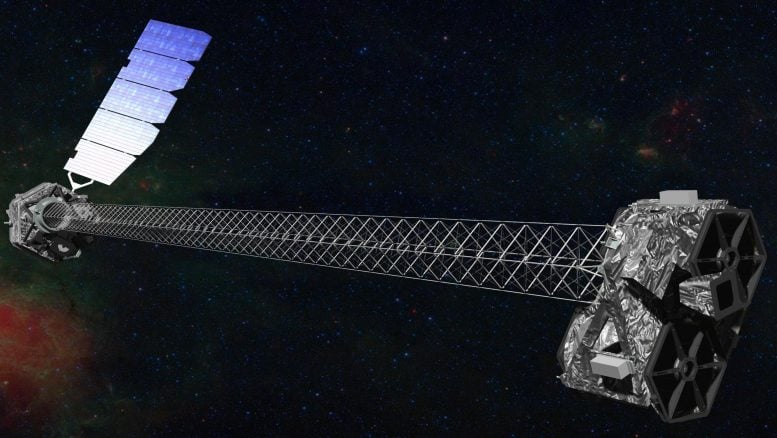
Illustration of the NuSTAR spacecraft, which has a 30-foot (10-meter) mast that separates the optics modules (right) from the detectors in the focal plane (left). This separation is necessary for the method used to detect X-rays. Credit: NASA/JPL-Caltech