
Form, Light, and Arrival: LOriental’s Infinity Wave Theatrical System in motion. Designed to follow the contour of the body carrying it, the piece transforms pass-around service into an interactive element of the room’s lighting and design.
For more than a decade, “experiential” was the defining language of ambitious event design. The premise was simple: guests should do more than enter a decorated space. They should discover something, interact with something, feel momentarily transported.
Then everything became experiential. A branded backdrop was experiential. A photobooth was experiential. A clever tablescape was experiential. Eventually, the word expanded so far that it stopped explaining anything at all.
Look closely at Egypt’s most ambitious events today, however, and a different shift comes into focus. The food itself is moving. Waiters no longer slip quietly through the room as invisible service mechanisms; their entrances are deliberate. Dishes are assembled tableside. Drinks arrive with ceremony. Fire, light, kinetic reveals, and movement are creeping into parts of the evening that were once expected simply to function.
Hospitality is beginning to perform. That may be where the next chapter of luxury events is taking shape: Theatrical Hospitality.
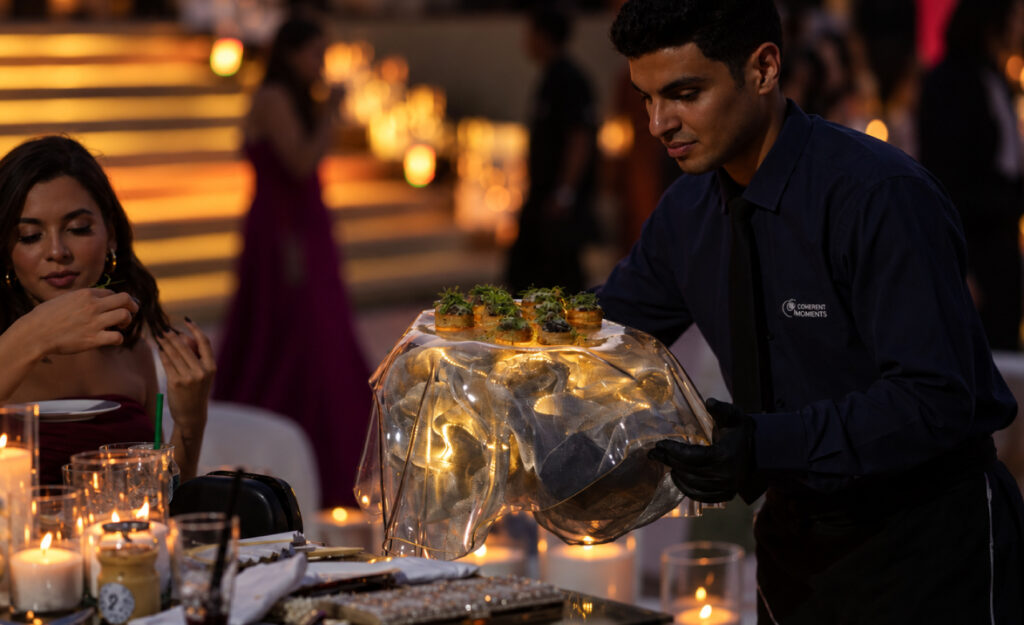
Aether Veil, one of LOriental’s signature Theatrical Hospitality pieces, transforms a traditional canapé pass-around into a moving part of the event’s visual language.
The Archive Hiding in Plain Sight
You don’t find the origin of this story in a launch campaign. You find it scrolling backwards through the Instagram archive of LOriental Moments, an Egyptian catering company with years of its work documented in public view.
There are roughly 2,500 posts and hundreds of reels documenting more than 2,000 delivered events: weddings, diplomatic receptions, corporate launches, cultural events, and private celebrations across the Pyramids, Manial Palace, the Grand Egyptian Museum, and the Cairo Citadel, where LOriental says it has delivered more than 300 events.
Scroll long enough and familiar faces appear too: Youssra, Hussein Fahmy, Anoushka, and Taha Desouky among the guests at events LOriental has catered over the years.
Viewed individually, the posts are just photographs of polished events. Viewed across years, a trajectory emerges: presentation becomes structural, buffets become composed scenography, live stations become interactive stages, serving hardware starts to illuminate, and servers move from the margins of the room into the visual choreography itself.
LOriental isn’t alone in pushing food and service toward more performative territory, but its unusually deep public archive makes the shift unusually easy to trace. Across the years, what begins as a string of creative catering decisions starts to resemble a system.
The term is new. The evidence isn’t.
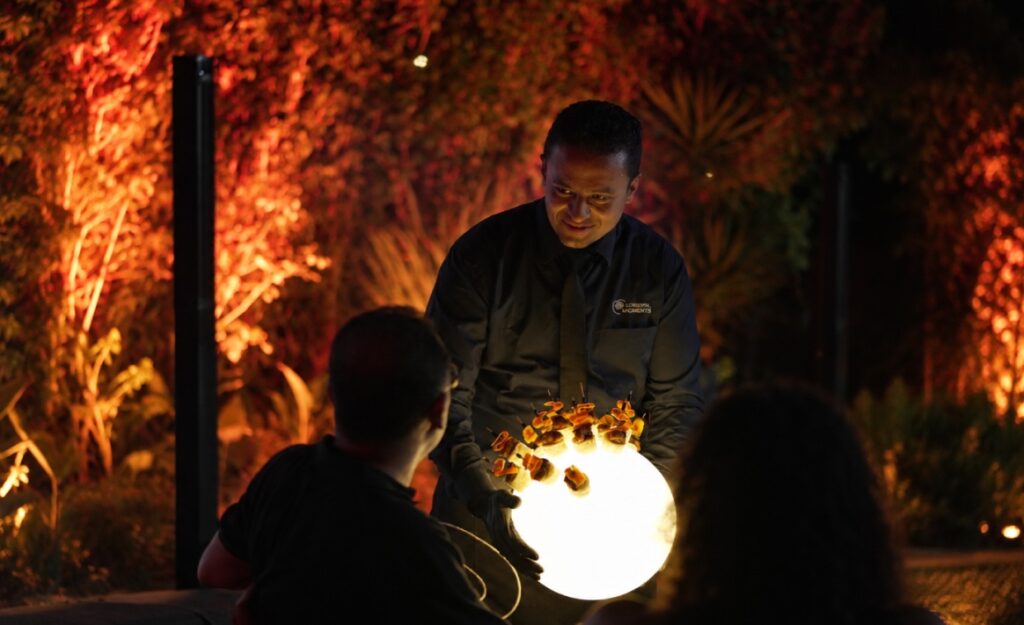
Lumisphere turns illumination into service — a glowing sculptural carrier designed by LOriental to bring movement, light and interaction into the canapé experience.
From Catering to Physical Engineering
LOriental’s culinary model has never been built around a single chef personality. The kitchen treats technique as knowledge to be studied, standardized, and reproduced across the operation. LOriental says its kitchen studies culinary references ranging from Julia Child and Gordon Ramsay to Thomas Keller, alongside classical techniques such as beurre monté, adapting what is relevant for the demands of large-scale events.
That distinction matters. Event catering has to reproduce a dish not once, but hundreds of times, often from temporary kitchens and under unforgiving service conditions. Consistency becomes a systems problem as much as a culinary one.
That same systems mindset eventually moved beyond the food itself. LOriental Cofounder and CEO Sherif Hussein, whose background is in digital transformation and data analytics rather than traditional hospitality, became increasingly interested in everything surrounding the dish: how it enters the room, how it is carried, how guests encounter it, and what happens between the kitchen and the first bite.
And that exposed a contradiction in the way events were being designed.
Lighting was becoming programmable. Florals were turning into massive installations. Entertainment was heavily choreographed. Venues were being entirely reimagined for a single night.
And yet the food could still enter the room on essentially the same silver tray it had arrived on for decades.
“You could completely transform the venue, the flowers, the lighting, and the entertainment,” Hussein says, “and then have the food arrive in exactly the same tired way it did at the last party.”
So LOriental began experimenting with the precise moment between the cuisine and the guest: how something enters the room, what the guest notices first, whether the waiter simply transports the meal or becomes part of the composition.
Somewhere in that experimentation, hospitality stopped being a back-of-house function inside someone else’s production and started becoming part of the show itself.
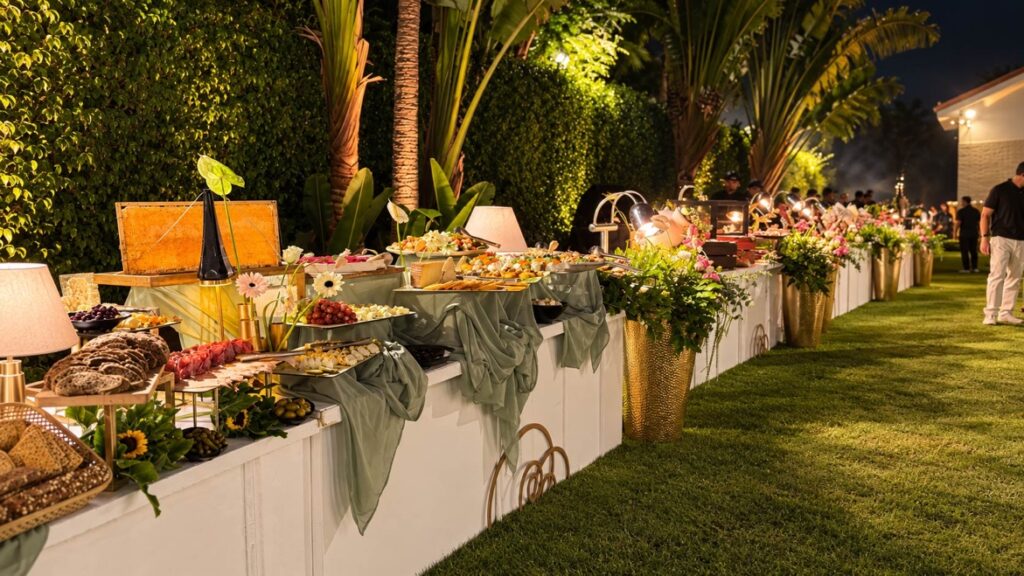
Theatrical Hospitality extends beyond canapé service. Here, the same principles of movement, light, composition and visual drama are applied to the buffet itself, turning a traditional food display into part of the event experience.
Where Theatre Meets Operations
The scale of LOriental’s event history matters here. More than 2,000 events means more than 2,000 opportunities to learn what looks extraordinary in a concept rendering but doesn’t survive a room of 500 people.
Cairo’s historic venues make that gap particularly unforgiving.
Take the Cairo Citadel’s Bir Youssef. Its elongated proportions dictate how guests distribute themselves and how service routes have to be mapped. Outside, the variables multiply further: high winds, uneven terrain, temporary kitchens, power constraints, long pass-through routes.
These are the friction points Instagram never shows, and they’re why a concept that looks magnificent for five minutes can still fail as hospitality: a server who can’t comfortably carry it, a kitchen that can’t replenish it without breaking the experience, a bottleneck it creates around guests.
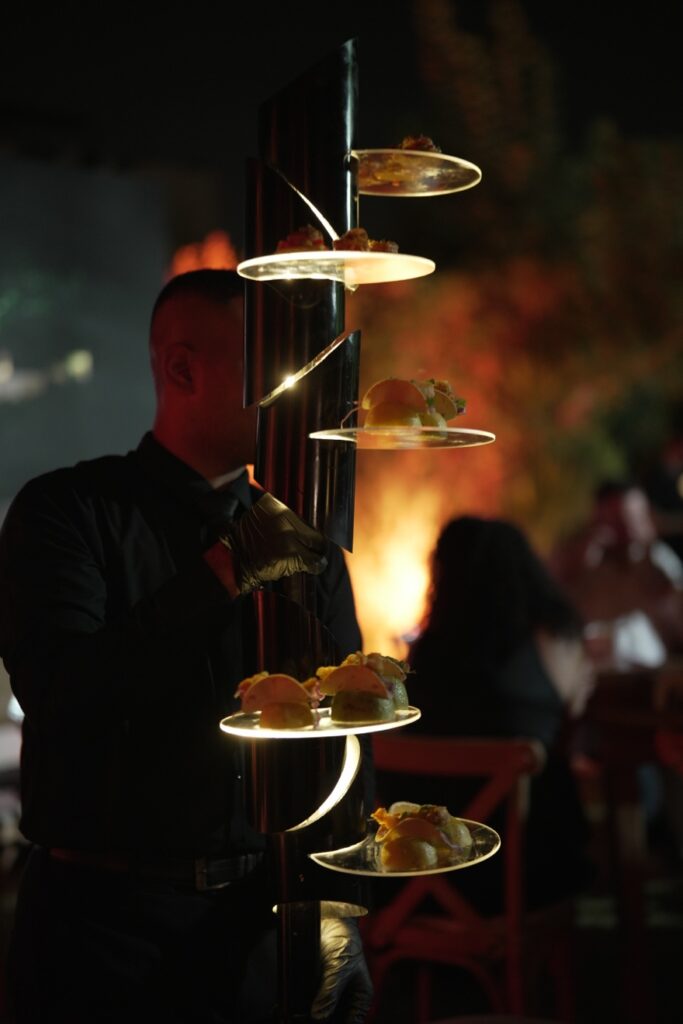
Halo Spire turns vertical form into theatre — an illuminated sculptural carrier that lets canapés appear suspended around the server as they move through the room.
The theatre has to survive the operation, not just the photograph.
One of the clearest expressions of this thinking is the Infinity Wave. Rather than treating the serving tray as invisible utility, LOriental redesigned it as an illuminated, sculptural object contoured to the body of the person carrying it, so that when servers enter the room, guests register light, movement, and form before they register the food.
The waiter stops merely transporting the presentation and becomes part of it.
“People react to how something arrives, not just what’s on it,” Hussein notes. “Once you know that, you can’t design the tray without also designing the walk to the table.”
Other experiments were less forgiving. An early presentation piece incorporated natural rock salt into a translucent structure; under event lighting the visual effect was striking, but during service the weight proved grueling for staff, and the piece went back for redesign.
It’s a small failure, but it explains the underlying philosophy better than any success story does: theatre needs ergonomics behind it, or it’s just costume; it needs service logic behind it, or it’s just decoration.
What Makes Hospitality Theatrical?
The word invites excess: smoke, props, drama for drama’s sake. But that’s styling, not theatre.
The actual distinction is whether hospitality becomes part of the action or the scene: a waiter making an intentional entrance rather than a discreet one, a dish finished tableside instead of arriving complete, a live station that shows its transformation instead of hiding it, a beverage arriving through ritual rather than delivery, or an oversized, maximalist presentation that becomes part of the visual experience.
Experiential describes the ambition to create a memorable event. Theatrical Hospitality describes the moment when hospitality itself carries the narrative, which is also why a beautiful buffet, flowers around a station, or a modestly scaled serving piece sitting static on a table don’t automatically qualify.
Hospitality has to move, transform, reveal, perform, or command the room through scale and composition. Without one of those, it’s just set dressing.
Can the Idea Travel?
One detail suggests the thinking can extend beyond the events that produced it: The Lana in Dubai, part of Dorchester Collection, acquired LOriental’s Infinity Wave system developed in Cairo.
That matters less as an export story than as an early indication of portability. A presentation system shaped through live event service in Egypt was able to leave LOriental’s own operation and still make sense inside another luxury hospitality environment.
The hardware itself isn’t really the point. What matters is that an approach developed through LOriental’s own events could still make sense outside them.
What Comes After Experiential?
Across fashion, retail, and entertainment, performance has steadily escaped the stage. Stores have become immersive installations. Fashion presentations have become performance art. Dining was never going to stay static.
Seen in a single night, these service moments can look like clever ideas in isolation. Seen across thousands of events, they add up to something more deliberate: a body of experimentation developing in public view for years.
LOriental has now begun formalizing that body of practice under a name: Theatrical Hospitality.
Whether the broader event industry adopts the terminology remains to be seen. The behavior it describes is already here.
For years, the mandate was making an event experiential.
The next challenge is more ambitious:
making the service itself worth watching.
Discussion about this post