










As my public equity portfolio sees significant declines due to a heavy investment in technology stocks, I considered revisiting my past job flipping burgers at McDonald’s. However, I paused during the job application process, wiped away my tears, and took a deep breath.
Every seasoned investor understands that survival is paramount. Navigating through market downturns often leads to rewarding opportunities on the other side.
While we currently avoid an official bear market, numerous tech stocks have already plummeted by over 20%. For those heavily invested in these stocks, the index’s classification becomes almost irrelevant.
For retirees and those approaching retirement, it is crucial to discuss the potential benefits of enduring market downturns and to understand their typical duration for better preparation.
The Wealth Effect Was Numbing A Lot Of Pain
Recent midterm elections revealed widespread dissatisfaction with our nation’s leadership, a sentiment that has built over time. The stock market functioned as a buffer against various economic strains.
As long as the stock market remained bullish, rising oil, food, housing, and education costs were easier to bear. After all, an upward-trending brokerage account makes steep gas prices feel less burdensome.
However, that financial comfort fades quickly when investment losses surface. Suddenly, elevated prices feel personal and painful.
When the wealth effect diminishes, consumer spending declines, leading to reduced dining out, vacations, and postponed purchases like a new car. Companies, facing decreased profitability, often resort to layoffs, further tightening spending across the board.
This cycle can persist until economists officially recognize a recession, typically six months after the economic impact is felt.
If you notice early signs of economic distress, proactively negotiating your severance package may yield a better outcome than being swept up in mass layoffs.
Sequence Of Returns Risk Is The Real Fear For Retirees
For newly retired individuals, the greatest concern is the sequence of returns risk—significant losses early in retirement while simultaneously withdrawing funds can jeopardize the long-term viability of a portfolio.
A substantial downturn may force some retirees back into the workforce. No one who has enjoyed retirement wants to return to the constraints of the corporate world.
Retirees dependent on investment income feel the impacts of bear markets more acutely than still-working individuals, who have the safety net of paychecks. Many retirees lack the cash flow to take advantage of dips in the market.
However, if your investments can weather the market correction or bear market, you should maintain a positive outlook during downturns. This perspective is crucial for preserving your freedom from employment.
Assess your preparedness with this simple checklist:
- You have sufficient cash or liquid assets to cover over a year’s expenses, avoiding the need to sell stocks in a downturn.
- Your passive income from investments covers a significant portion of your living costs.
- You can make considerable cuts to discretionary spending without major distress.
- You possess the ability to meet financial obligations even with a further drop in stock value.
How Long You’ll Have To Gut It Out
The impending duration of a market downturn remains a question for many investors. Historical data provides some insights, albeit with a need for patience.
Per Capital Group, the S&P 500 experiences a decline of 10% or more approximately once every 18 months. A 20% bear market occurs roughly every six years.
In considering a 40-year retirement, it’s reasonable to anticipate experiencing around 25 corrections and six to seven bear markets throughout that period. Market declines are an unavoidable aspect of investing.
| Decline | Frequency | Average Duration (days) |
|---|---|---|
| 5% or more | Biannually | 46 (1.5 months) |
| 10% or more (Correction) | Every 18 months | 133 (4.4 months) |
| 15% or more | Every 3 years | 247 (8 months) |
| 20% or more (Bear Market) | Every 6 years | 402 (approximately 13 months) |
Source: Capital Group, S&P 500 data (1954-2025).
According to Hartford Funds and Ned Davis Research, since 1928, the market has experienced 27 bear markets, averaging a 35% decline over 289 days, or roughly 9.6 months.
Notably, bear markets were more frequent during the Great Depression, with 15 bear markets recorded since 1945, at an average frequency of one every 5.1 years.
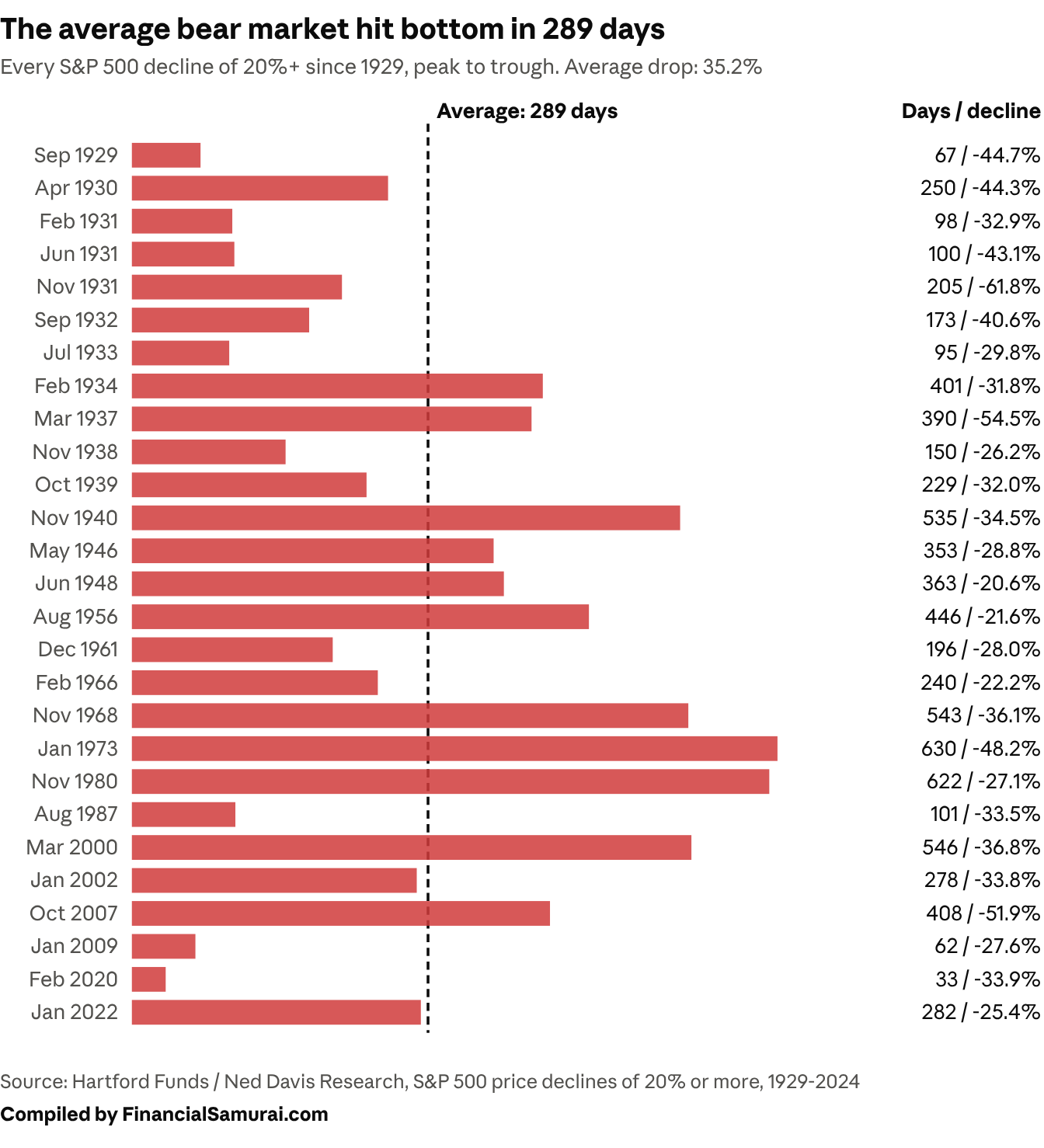
It is essential to note that these statistics account for peak-to-trough measurements. The timeframe for recovery to previous highs often extends longer. Additionally, bear markets, such as those in 1973 and 1980, lasted over 600 days, illustrating that averages can be misleading.
The Stock Market Always Recovers
A comforting aspect for investors is that every S&P 500 correction since 1929 has been followed by recovery, with an average return of 52% within a year of hitting the lowest point. Moreover, recoveries appear to be occurring more swiftly in current market conditions.
According to Hartford, approximately 42% of the S&P 500’s strongest daily gains in the past two decades transpired during bear markets. Panic selling can lead to missed recovery opportunities.
My takeaway: In a realistic worst-case scenario, anticipate enduring roughly 12 to 18 months of market pain, with a subsequent extended recovery phase. Maintaining one to two years’ worth of cash reserves remains a sound strategy, especially as interest rates hold steady.
The Less You Work, The Better You Feel
The central dilemma during bear markets is:
- Should you exert more effort at work, potentially sacrificing financial stability?
- Or should you scale back work to enjoy life more fully, knowing the grind may be counterproductive?
The answer is to prioritize life beyond work, utilizing a concept I term Return On Effort (ROE).
In a bull market, investing less time at work typically enhances your ROE due to flourishing investments. However, during a downturn, additional effort often yields minimal returns.
Excessive effort usually results in increased workloads from layoffs rather than genuine progress. The economic climate, characterized by decreased consumer confidence and rising taxes, mitigates any financial incentives for heightened effort.
Therefore, dialing back your work efforts can help safeguard your overall productivity and return, not out of laziness but rather rationality.
By Definition, Retirees Work The Least
With this reasoning, who tends to work the least? The unemployed, traditional retirees, and those who have chosen early retirement.
Provided that your investments can handle market fluctuations, you will likely endure the downturn with resilience. Retirees should focus more on enjoyment and less on financial worries.
Happiness is a comparative state. During prosperous times, some early retirees may feel envious of their upwardly mobile colleagues. However, in a downturn, the envy often shifts as individuals recognise the burdens facing those who remain in competitive environments.
Silver Linings Of A Bear Market For Everyone
A market downturn brings distinct advantages, regardless of one’s employment status.
1) Prices Drop: A reduction in demand drives lower prices for travel, accommodation, and eventually, real estate. Retirees with flexible schedules can benefit from off-peak travel discounts unavailable to many working families.
2) Opportunities to Buy: Retirees with passive income and cash reserves have the chance to invest while others are forced to sell. Workers also benefit from lower share prices, continually contributing to retirement accounts amid a downturn.
3) Advantage for Future Generations: Market downturns create opportunities for children to begin investing early, potentially shaping their financial futures positively.
4) Tax Efficiency: Tax-loss harvesting can alleviate future tax burdens. Roth IRA conversions during market dips allow for tax-free growth as values recover.
5) A Balanced Perspective on Technology: The struggles faced by AI stocks indicate a more tempered view of the technology sector’s impact on the job market, which can ease concerns for job security.
6) Building Resilience: Overestimating investment savvy during bull markets can be a humbling experience during downturns. Every market correction helps refine your capacity to navigate future challenges, which is critical, especially for professionals maintaining stable emergency funds.
Calm Comes From Control
Factors such as technology volatility, interest rates, and political outcomes remain outside investor control. However, individuals can manage how they utilize their time during economic downturns.
Markets will ultimately recover. Those enduring a downturn with resilience and focus on personal fulfillment will emerge rejuvenated. Survival is paramount.
Considering retirement during a market decline may be advantageous. If your finances remain robust despite a significant market drop, you can confidently transition into retirement.
Conversely, retiring at the peak of a bull market could expose you to immediate losses, dramatically affecting your financial landscape long term.
Enjoy life to its fullest amid downturns. Take opportunities to spend quality time with loved ones, as it is a crucial element of a well-earned retirement.
Reader Questions
Have you found comfort in retirement during this downturn, or has it been more difficult? At what portfolio decline level would you consider returning to work? Do you agree that working less hard during bear markets is a rational choice? How are you managing your investments for your children during this period?
Build Wealth Through Every Market Cycle
For strategies on navigating downturns and emerging with greater wealth, consider reading Millionaire Milestones: Simple Steps To Seven Figures, a bestselling guide offering tips for maintaining investment momentum in challenging times.
To receive email updates for new posts, sign up here. Join over 60,000 subscribers for my ad-free weekly newsletter. With insights drawn from years of experience, I aim to share actionable advice to help others navigate financial landscapes during this downturn.










Discussion about this post