





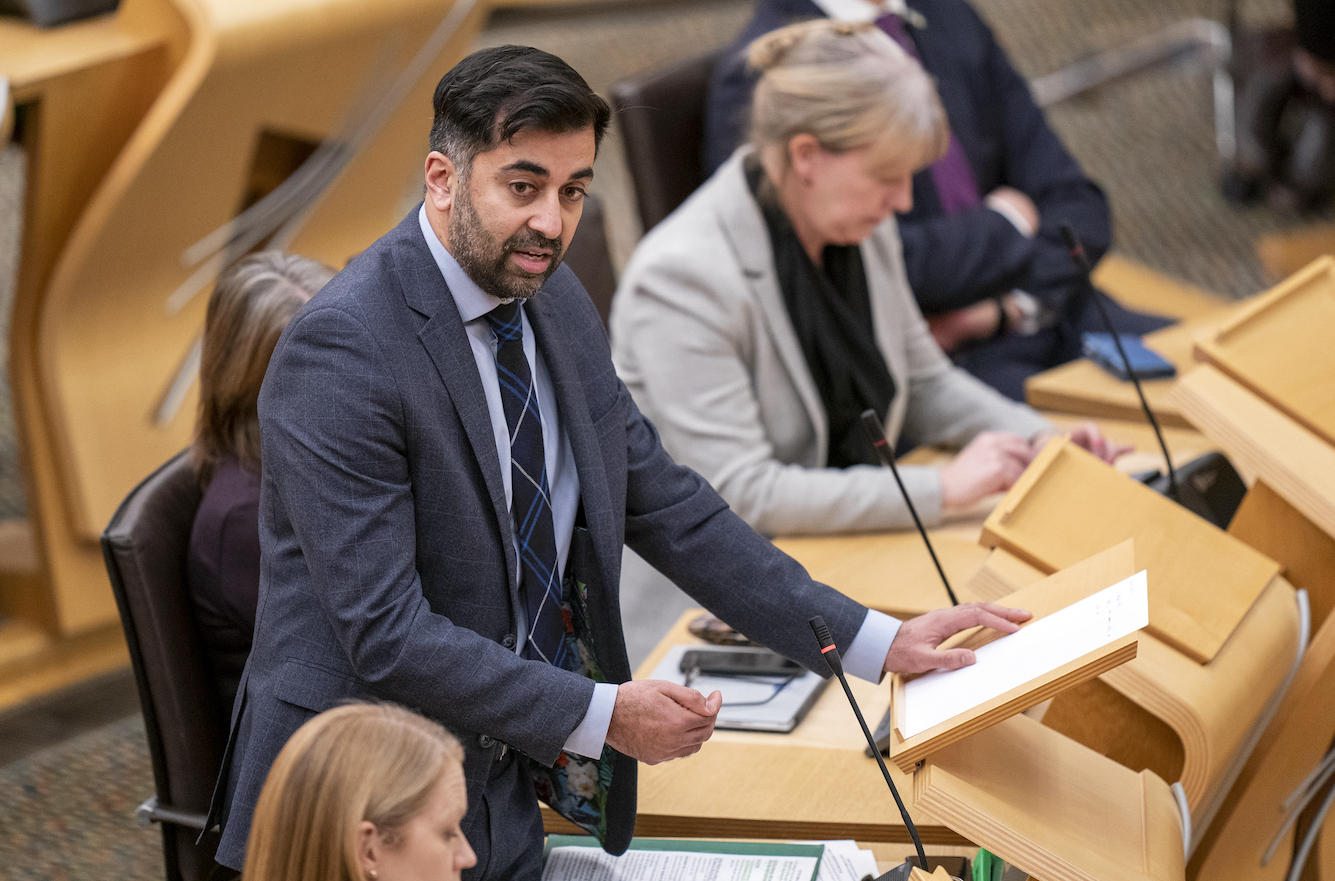
The race to succeed Nicola Sturgeon as SNP leader entered a new brutal phase this week as claimants to the Bute House throne battled for position.
Taking to our TV screens for the first time, the disputable heirs health secretary Humza Yousaf, finance secretary Kate Forbes and former minister Ash Regan upped the ante — and yellow-on-yellow blitz — drastically.
It is no secret that Nicola Sturgeon’s abrupt departure in February has instituted a deep sense of derailment within SNP ranks. “Continuity candidate” or not, a rueful sense of “back to the drawing board” on party strategy has enveloped affairs.
The frostiness, the bad-tempered debates, the side-swiping — it all amounts to a significant breach of the SNP’s internal norms. Not two months ago, few would have wagered positively that Sturgeon’s end was nigh. Now, in the race to succeed her, candidates eye possibility in the rubbishing of her record.
“Ideal time” to install duck nest tubes, says BASC

Firearms licensing is in crisis, BASC tells Parliamentary Committee inquiry
The scenario presents something of a paradox. On the surface, the Sturgeon regime was one of the most successful in recent British history. It won eight elections in eight years without any signal of capitulation to internal or external pressures. It is counterintuitive that such a strong and seemingly stable regime could transpose into a succession crisis characterised by open hostility.
In some senses, the outbreak of disarray is a consequence of the suddenness of Sturgeon’s departure. Her resignation, briefed only to a close inner circle (including Yousaf) the night before, created an immediate power vacuum, quickly allowing inter-party tensions to burst forth.
Equally, the tenor of the debate reflects the inherent restlessness of the SNP’s political predisposition. It is a state-seeking separatist party — political developments are interpreted through a lens of “setback” or “progress” as allied to the assumed teleology of independence. It means the wrong decision in this leadership contest, as the SNP’s activists are too well aware, could forestall the independence dream for a generation. When it comes to single-issue nationalisms, every point of departure becomes existential.
The arc of post-Sturgeon instability reached its apex during the first TV debate hosted by STV. Civility was quickly cast aside as the candidates limbered up; Forbes, especially, did not pull her punches.
“More of the same”, Forbes pronounced during her introductory speech on Tuesday, “is not a manifesto. It’s an acceptance of mediocrity. We can do better”. When presented with the opportunity to cross-examine her rival, Forbes went one further:
Well, Humza, you’ve had a number of jobs in government. When you were a transport minister, the trains were never on time. When you were justice minister, the police were strained to breaking point. And now as health minister, we’ve got record high waiting times. What makes you think you can do a better job as first minister?
Yousaf tried his best to bat back the criticism, but the episode dominated the post-debate coverage. It was not lost on anyone that while this was an attack on Yousaf’s record, it was equally Sturgeon’s government, the much-eulogised ancien régime, that bared the biggest brunt.
The latest televised Nat-off came two days later courtesy of Channel 4. Forbes had notably tuned down the bombast, perhaps haunted by Scottish Conservative leader Douglas Ross’ decision to deploy her attacks at Holyrood. She even clarified that it was a “privilege to serve” alongside Yousaf in government.
But Forbes had already shown her hand. It was now clear that her strategy is to tie Yousaf to the party’s perceived failures in government and put herself forward as a candidate both for change and delivery. It is a pitch that has clear ideological implications.
Forbes wants to remould the SNP as an ideologically “lite” party and appeal across the classes and sectional interests within Scotland. The reemphasising of the party’s secessionist objectives would, for Forbes, come at the expense of its social democratic profile.
The leftward shift of the SNP was instituted under the guiding hand of Alex Salmond through the 1980s and 90s. But Forbes figures that the bolstering of the SNP’s left-wing profile under Sturgeon has alienated indy-curious voters.
The pitch means Forbes’ elected entourage is rather small when compared to Yousaf’s. According to politics.co.uk’s latest count, Yousaf already has just under half (46) of the SNP’s MSPs and MPs backing him, with 48 (just over half) yet to endorse any candidate. This ultimately reinforces Yousaf’s positioning not only as the “continuity candidate”, but also the “establishment candidate”.
Yousaf has no qualms with the party’s left-wing drift under Sturgeon.
Also essential to Forbes’ positioning is that only she can “reach out to No voters and persuade [them] to vote Yes”. She argues that continuity Yousaf’s “more of the same” approach would restrict rather than expand the SNP electoral coalition. It would have problematic consumers for the cause of independence, Forbes reasons.
This is critical, for it shows that among the SNP’s leadership contenders, the left-right and gradualist-fundamentalist splits are deeply intertwined.
Gradualism triumphs?
It is a curious feature of this leadership contest that, despite the mud-slinging on each candidate’s ability to build support for independence, both Forbes and Yousaf share a broadly similar strategical approach.
In consecutive debates, Yousaf has argued that independence must be the “sustained, settled will” or a “consistent, sustained majority” of the Scottish people before another referendum could be held. Equally, Forbes has used the phrase “sustained majority” to describe the political conditions for “IndyRef2”.
It is an admission that Sturgeon’s attempt to straddle the divide between gradualism and “fundamentalism” was ultimately unsustainable.
By way of summary: as part of the SNP’s 2015 election manifesto, Sturgeon first proposed a referendum be held by the end of 2017. This was later scrapped in favour of a “common sense” vote in the autumn of 2018. When this approach was found wanting, Sturgeon talked up the “referendum bill” which would see “IndyRef2” held before the end of the Scottish parliamentary session in May 2021. And finally, Sturgeon took the independence case to the UK Supreme Court in a bid to force through a referendum in late 2023.
It was ultimately this final decision which caused so politically costly for the first minister. The Supreme Court rejected Sturgeon’s view that Holyrood had the competency to legislate for a second independence referendum, leading the first minister to pursue “plan B” and treat the next general election as a “de facto” referendum.
It is telling that Sturgeon’s successors have been so keen to ditch this approach. Simply put: they both recognise that the auld cycle of expectation-creation turn crippling climbdown could spin no longer.
It is worth noting that Ash Regan, the outsider candidate in the race, has stuck to a firmly “fundamentalist” platform. In an attempt to raise the independence standard and rally the grassroots gantry, Regan has expressed support variously for a “voter empowerment mechanism”, an “independence readiness thermometer” and a summit of separatist parties.
But the gut nationalist rhetoric and glib policy belie a dearth in independence strategy from Regan. She is yet to meaningfully lay out how she will win a referendum for Scotland as first minister. As Sturgeon knew only too well, the UK government can simply say “No”. Still, that Regan sits at around 10-11 per cent in leadership polls shows there is space for her argument within the party faithful.
In some sense, her uncompromising campaign is the consequence of the tyranny of expectations incited by Sturgeon’s strategical missteps.
Ultimately, the current leadership contest shows that under Sturgeon, the SNP never fully resolved the tensions between left and right or gradualist and fundamentalist. In the wake of her departure, such have tensions burst forward decisively.
Right now, the SNP is undergoing an extended process of introspection, both ideological and strategical. The problem for the next leader, whomever that may be, is that the SNP more broadly may remain unsettled on what kind of party it wants to be.







Discussion about this post