







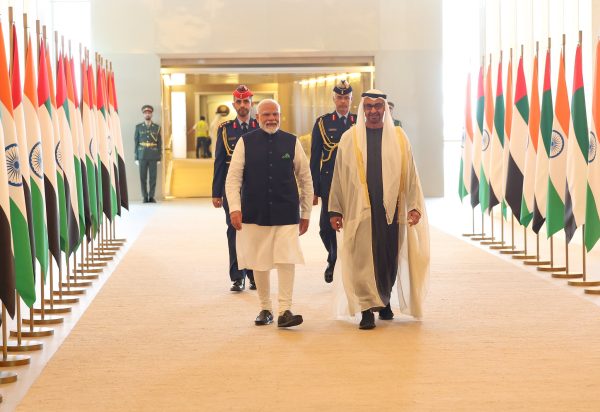
Earlier this month, during his visit to the UAE, Indian Prime Minister Narendra Modi signed an agreement with Sheikh Mohamed bin Zayed on the operation of the India-Middle East-Europe Corridor (IMEC). The corridor, itself the product of an MOU signed on the sidelines of last September’s G-20 summit in New Delhi, promises to transport goods from the west coast of India to Europe via ports on the Persian Gulf, overland links on the Arabian peninsula, and Israeli harbors on the Mediterranean.
The development is somewhat surprising because, following the outbreak of hostilities in Gaza, analysts were quick to point out that it would be very difficult to operationalize IMEC amid regional tensions, a fact even India was willing to admit. The latest agreement, however, comes on the heels of several developments in IMEC over the last few months that suggest that predictions of its death may have been premature. Amid the Houthis’ ongoing attacks against shipping, freight volumes in the Red Sea have declined by nearly 80 percent. The devastating impact on Red Sea shipping, however, has provided a golden opportunity for IMEC to serve as an alternative route around the blockade. Several Israeli firms have already signed agreements with their Emirati counterparts to begin transporting goods overland from Dubai to the Israeli port of Haifa.
The ongoing crisis in the Red Sea has created a strong impetus among IMEC partners to facilitate the project quickly. India has faced difficulties in the last year putting the finishing touches on its other regional infrastructure initiatives, particularly those involving Iran, which may be adding to New Delhi’s sense of urgency. The signing of the agreement between the UAE and India, along with India’s apparent haste at operationalizing the project, only represents a continuation of this trend.
Nonetheless, India’s speed here should not be confused for wisdom. Not only does IMEC face serious long- and short-term challenges, but the fallout from these complications may seriously undermine India’s relationship with other regional partners. This is particularly true of Iran, whose infrastructure initiatives with India serve as a key alternative to IMEC, should the latter fail. By alienating partners like these, India is engaging in a high-risk gambit that may prove disastrous for its interests across the region. Nowhere is this fact more apparent than by simply looking at the route goods will take across the corridor.
The Gulf of Oman
Leaving from the west coast of India, goods bound for Europe must first cross the northernmost part of the Arabian Sea, pass through the Gulf of Oman, and enter the Persian Gulf to unload their wares at the ports on the east coast of the Arabian Peninsula. Although this voyage is relatively short, its position near Iran and the vital Strait of Hormuz makes it a fraught passage. Even prior to the start of the Gaza conflict, Iran had deliberately targeted shipping passing through these waters on at least seven different occasions in the last five years. The fact that some of these ships were directly or indirectly related to Israeli owners give credence to the fact that, even absent the war in Gaza, Iran needs little excuse to target Israel’s shipping interests. Given that IMEC’s success by and large hinges on some degree of Israeli cooperation, this does not bode well for the success of any IMEC initiatives even if the Gaza conflict is resolved in the near future.
Outside that rosy future, however, the prospects for shipping passing through these waters are even more dire. Following the escalation of the naval conflict in the Red Sea, shipping in both in the Gulf of Oman and off the west coast of India either faced suspicious activity from other armed vessels or actual attacks from enemy drones. Although Iran was quick to distance itself from these attacks in the face of U.S. accusations, diplomacy can only take you so far if your actions do not reflect your words. Despite comments from India’s external affairs minister expressing his concern at these attacks during a visit to Tehran back in January, Iran has proven unwilling or unable to address India’s concerns. Recent attacks by the Houthis on an India-bound oil tanker as well as Tehran’s continued interdictions of shipping in the Gulf of Oman demonstrate as much.
It is unlikely that this theater will witness a serious escalation, as the degrees of separation between India and Israel on the one hand and between Iran and its proxies on the other gives both sides space for plausible deniability. Nonetheless, Iran has expressed a desire to sever Israel’s commercial links to the rest of the world. Not only does India’s current encouragement of IMEC directly contradict Iran’s wishes, but New Delhi’s reliance upon transit corridors that Iran has a recent history of disrupting means Iran has the ability to impose a blockade, should it choose to.
India’s reliance, therefore, on IMEC provides a strong incentive to Iran to further destabilize shipping in this theater. This could have wide-reaching consequences on New Delhi’s interests in the region. For one, India just signed a long-term LNG contract with Qatar, their largest to date, to provide energy exports to India until 2048. Such a deal, by dint of geography, relies on a stable Persian Gulf. Furthermore, the presence of millions of Indian migrants across the Persian Gulf, whose livelihoods depend in turn on that same maritime stability, means that India cannot afford to contribute to the destabilization of this region.
Trans-Arabia
After transiting the northern Arabian Sea and the Persian Gulf, goods will be unloaded at the port of Jebel Ali near Dubai. From there, they will begin their long journey across the UAE, Saudi Arabia, Jordan, and Israel to the port of Haifa. This long, trans-Arabian journey is perhaps the most ambitious leg of the IMEC project, and will eventually be serviced by rail links that stretch across the peninsula. The technical difficulties in accomplishing this feat, however, are not the main obstacles on this section. Instead, the political tensions between IMEC participants pose a much greater threat.
For one, crossing Jordan poses a major obstacle, largely related to Israel’s involvement. One in five Jordanians is a Palestinian refugee. As a result, Amman faces significant domestic pressure to increasingly distance itself from Israel, making IMEC such a sensitive issue to Jordan. Over the last month, several protests have taken place across Jordan with the express design of limiting the passage of goods from Jordan to Israel, with some even explicitly targeting the ongoing overland links between the UAE and Israel. The more IMEC partners pursue the project, the more hypocritical Amman appears, and the greater the pressure becomes to curtail cross-border commercial connections with Israel. It is perhaps for this reason that Jordanian officials have been notably silent about their participation in the project. Should India attempt, directly or indirectly, to stimulate the use of the trans-Arabian leg of IMEC any more without substantial movements toward peace in Gaza, it is hard to see Jordan tolerating this pressure for long.
The relationship between the UAE and Saudi Arabia is also another source of potential instability. The two countries are currently engaged in an economic competition, which threatens to seriously undermine the project’s long-term profitability. Not only do Riyadh’s tariff rules limit the degree to which Emirati-produced goods can take advantage of logistical links along IMEC to access new markets, but the aggressive restrictions on the placement of regional headquarters Riyadh enacted earlier this year pose a direct threat to Dubai’s status as a regional logistics hub.
The difficulty is that IMEC both relies upon and bolsters Dubai’s role in this regard. Riyadh does not take this economic preeminence lightly: Saudi Arabia threatened a blockade against the UAE just last year. It is not a stretch to imagine Riyadh might see Dubai’s role in IMEC as economic competition, rather than cooperation. Thus, not only is New Delhi playing a dangerous game by relying on two economic competitors to cooperate, but it is jeopardizing its role in regional stability by inserting itself into economic competition between two of India’s erstwhile security partners.
The Eastern Mediterranean
Finally, after their long journey across the Arabian Peninsula, the goods arrive at the Mediterranean ports of Israel: Ashkelon, Ashdod, and the major port of Haifa. Here they will be shipped on to Europe via the Greek port of Piraeus. These ports represent the final security bottleneck on the journey to Europe, and quite a significant one at that.
For one, the ports are directly threatened by a conflict in Gaza, regardless of escalation by regional actors. In the early days, Ashkelon, Ashdod, and Haifa all suffered rocket attacks launched by Hamas. The attack on Ashkelon, just north of Gaza, was so significant, in fact, that the port had to close until late November. Although Israel’s current ground campaign in Gaza has limited the degree to which these ports can be directly threatened by Hamas, these attacks demonstrate that the local security problems faced by the ports can only be addressed with the occupation of substantial portions of Gaza, an act that most IMEC members oppose in some form or another.
Local security threats, however, are not the primary long-term concern at these ports. Iran and its proxies have expressed repeatedly throughout the conflict that one of their primary aims is to blockade Israel. A key part of this strategy involves disrupting Israeli shipping in the eastern Mediterranean. This sentiment has been expressed by Iranian officials and Iranian proxies alike, and is one that they generally appear capable of executing. Drone attacks on Ashdod in late January and missile strikes on Haifa earlier that month indicate as much. It appears that Haifa, in particular, is a port that Iran is intent on striking. Since the January attacks, the Israel Defense Forces have intercepted suspicious targets in and around Haifa multiple times. This is hardly surprising, considering the size of the port and its relative isolation from the conflict in the south. To effectively execute Iran’s strategy of blockade, Haifa’s connection to the outside world would have to, at the very least, be threatened.
Therein lies the principal danger for New Delhi in its IMEC ambitions. When it comes to Haifa, there are no degrees of separation present between both India and Israel on one side and Iran and its proxies on the other, unlike in the Gulf of Oman. An attack on the Indian-owned Haifa port, a strategy that ran has considered since the early stages of the Gaza conflict, would force New Delhi into a very difficult position: defend the interests of India, and by extension Israel, at the expense of irreparably altering ties with Tehran. Similarly, should an Iranian proxy choose to target Haifa, it would also expose Iran to a stunning hypocrisy if it did not lend its full support to the act. This is not to say that the two are destined to conflict, but rather that this particular issue is one that will be difficult to navigate should it arise.
IMEC will only make this worse: It incentivizes India to be more supportive of the safety and security of Israel’s Mediterranean ports, and it provides a tempting target for Iran to strike in order to blockade Israel. New Delhi will have to carefully calibrate its diplomacy with Tehran if it wants to have its cake and eat it too.
Conclusion
India’s renewed interest in IMEC comes at a profoundly sensitive period in the foreign policy of New Delhi. Amid the Red Sea crisis, India is weaning itself off of Russian oil imports and arms sales and seeking new energy suppliers, like the UAE and Qatar. It is also trying to counter the influence of China, which seems to be surrounding New Delhi by bolstering its ties with new security partners.
Although the temptation to capitalize on the crisis in the Red Sea to advance IMEC might be strong, as outlined above, not only is the success of the project dubious from a political and security perspective, but the failure of the project, especially if it is targeted by Iran or its proxies in the region, threatens to seriously undermine the security of India’s energy and trade partners along the route. That such partners are absolutely critical to India solving its current foreign policy problems underscores the degree to which New Delhi’s current strategy is risky at best, reckless at worst.





Discussion about this post