









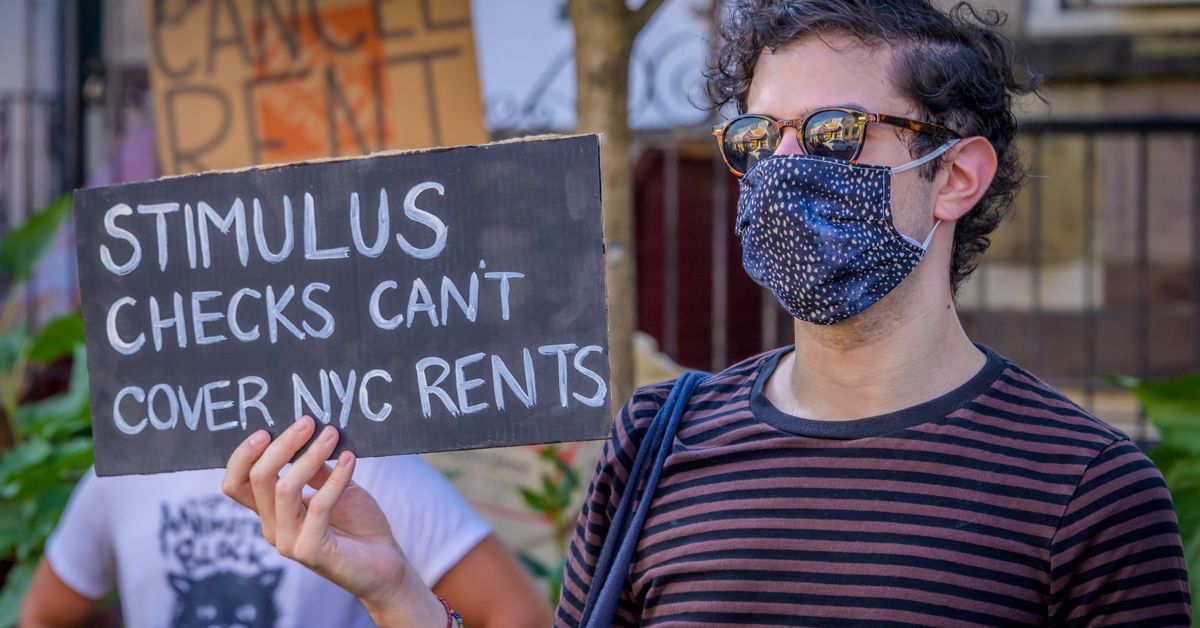
I’m a big fan of cash. Like most of you, I’m pro-people-giving-me-cash, but more generally I think handing out unrestricted currency, whether in paper or digital form, is an underrated and efficient way to help people.
As we’ve covered at Future Perfect, evaluations of cash programs have found that they can function as economic stimulus in one of the poorest regions of Kenya, help a therapy program reduce crime in Liberia, reduce homelessness in Vancouver, fight hunger in areas with food crises, and slash child poverty in the US.
With great enthusiasm comes great responsibility, though — specifically, responsibility to highlight evidence and research that challenges my existing beliefs, even ones that seem as obvious as “getting cash is good.” Recent days have seen the release of three big studies of cash transfers in the US, and those studies found the transfers did … very little.
Getting an extra stimmy in 2020
The first two studies come from the same team, composed of the University of Michigan’s Brian Jacob, Natasha Pilkauskas, Katherine Richard, and Luke Shaefer, and Elizabeth Rhodes of OpenResearch, a lab running a separate long-term cash study. Their papers analyze two different rounds of $1,000 cash grants from the charity GiveDirectly, which distributed the money to American households in May 2020 and again in October that year. The money was targeted at low-income people, with recipients recruited from a mobile app that helps users manage their SNAP/food stamps benefits.
After surveying recipients, as well as a control group of non-recipients, the researchers found no differences between the two groups on any of the five outcomes they were interested in: material hardship, mental health challenges, partner conflict, child behavior problems, and parenting problems.
In the study covering the May 2020 payments, they did find some reduction in material hardship among very low-income households specifically, and some weak evidence that mental health improved. But that was about it. And in October, there weren’t even those silver linings — even in the subgroups, no significant effects were found.
The third study comes from a different team (Harvard’s Ania Jaroszewicz and Jon Jachimowicz and the University of Exeter’s Oliver Hauser and Julian Jamison) and has a slightly different design: their paper analyzed a cash payment program where 1,374 recipients got $500, 699 recipients got $2,000, and a control group got nothing. The median household receiving money earned $1,028 a month or $12,336 a year, below the poverty line for a single person, much less for a family. Like the Michigan researchers’ papers, the funds were disbursed slightly after the pandemic started, but in this case the transfers were made gradually: from July 2020 to May 2021.
(Side note: The paper states that the transfers were funded by “a national non-profit organization that specializes in providing low-income individuals unrestricted cash transfers.” In an email, Jaroszewicz stated that the funder wished to remain anonymous.)
The Harvard/Exeter team came to the same conclusion as the Michigan team: the authors found “no evidence that [cash] had positive impacts on our pre-specified survey outcomes at any time point.” If anything, they found negative outcomes for recipients’ reported financial, medical, and psychological well-being — though the authors argue that this is likely due to study attrition, and are careful to limit their conclusion to “cash did nothing positive” rather than “cash caused harm.”
Why didn’t cash help?
So … what the hell happened? Why didn’t giving very low-income Americans as much as $2,000 lead to them reporting greater financial security, better mental health, even just being happier?
The Harvard/Exeter team posits an interesting reason: getting the money reminded recipients that they were poor, without doing much to change that long-term condition, which in turn led to worse psychological health and lower happiness among recipients. Recipients reported thinking more about money, reported more financial needs in their life, and were likelier to say they were stressed about how to spend the money than people who didn’t get the money. This points to the checks raising the “salience” of people’s financial needs, which in turn caused them distress.
Both teams of researchers bring up survey attrition as a possible explanation: it was common for both recipients and control group members to decline to complete the follow-up surveys, and it was possible that those who didn’t complete the surveys differed systematically from those who did, in ways that affected the results. This is the same kind of problem that led to US electoral polls in 2016 and 2020 being wildly off.
There’s also the fact that 2020, as you may dimly recall, was a weird time. This isn’t just because there was an ongoing pandemic with no vaccine yet, accompanied by severe isolation that significantly affected people’s mental and physical health. Thanks to unprecedented federal actions, low-income Americans were also in an unusually good financial situation.
In all three studies, recipients had gotten stimulus checks worth $1,200 per adult and $500 per child just a few months before. Some of the recipients in the Harvard/Exeter study also received the December 2020 checks worth $600 each and the March 2021 checks worth $1,400 each. Many recipients in all three studies likely benefited from greatly enhanced unemployment insurance payments. UI recipients had median incomes much lower than the general population, especially recipients through the new Pandemic Unemployment Assistance program, making the program highly progressive.
It seems plausible that another one-off payment didn’t register the same way amid much larger federal interventions — especially the UI benefit which offered regular infusions of cash.
And moreover, the US is a rich country! It was, ironically, given the conditions, an unusually prosperous place for low-income people in 2020. If you want to compare GiveDirectly’s cash transfers in the US to those in extremely poor villages in sub-Saharan Africa, the enormous gap in economic outcomes in the two places is very relevant.
The Harvard/Exeter authors note that the $2,000 checks they studied represented about 16 percent of the typical recipient’s annual household income. By contrast, the landmark 2016 paper studying GiveDirectly’s program in Kenya involved a transfer equal to about two years’ worth of household consumption (a number not too different from income, among low-income people without much savings or access to formal loans). A check worth 200 percent of your annual income is obviously very different from one worth 16 percent! Of course the former would have stronger effects.
The studies we need
We also might be getting to a point of diminishing returns on what we can learn from studies of one-time cash drops, especially when the outcome variables of interest are the usual suspects of financial, mental, and physical well-being.
Cash programs have been studied a lot. In 2016, the UK-based Overseas Development Institute (ODI) think tank conducted an evidence review on cash programs that looked at an astonishing 165 different studies. That was six years ago, and the evidence base has only grown since with the vast number of basic income pilots around the world, as well as one-off cash programs like the ones studied above.
You can draw a few conclusions from the vastness of the evidence base on cash. One is that a handful of new studies shouldn’t massively change your views on the topic. If there were only one prior paper anywhere in the world studying a cash drop like those described above, a single new study would double the evidence base. It would be a big deal and should adjust your views substantially. But going from 165 to 166 studies isn’t a radical change.
Secondly, it’s worth asking if the research community is focusing resources toward the most important questions remaining about cash. The ODI report concluded that, on average, cash has a number of beneficial effects in terms of reducing poverty, building assets, and improving health. There may be diminishing returns in rich countries with extensive safety nets, as detailed in the new studies above. But overall the evidence that giving people money reduces deprivation is strong.
Adding nuances to this story, like the point at which diminishing returns set in, is important, and if a group is doing transfers anyway, as seemed to be the case with GiveDirectly, you might as well run a study of the effort alongside it.
But there are major unanswered questions about cash that don’t have nearly this much evidence behind them. Do people, for instance, fare better (on any number of metrics) if they get a large lump sum or if they get smaller monthly payments? Does the method of payment (check v. mobile app v. prepaid debit card) matter? Does knowledge of where the money comes from, whether from the government or a charity or a subnational arm of government, matter? What are the macroeconomic effects of a large cash program? I know of only one major randomized study on the latter question, but it’s very important, and something that ordinary random studies can’t elucidate.
Perhaps the biggest question outstanding about cash programs is about their political economy: if cash programs are, on the merits, often superior to programs giving aid in-kind (in the form of housing or food or what have you), why are they comparatively rare? Why don’t politicians like passing them? Why do programs like the expanded child tax credit in the US fail in legislatures, while efforts like the UK Tories’ to slash cash benefits in 2012 succeeded?
The longtime DC safety-net policy analyst Robert Greenstein has a new paper looking at some of these questions. He tries to locate factors that explain whether a government safety-net program grew or shrank in the US over the last 40 years. Programs tied to work and that extend to the middle class as well as the poor do better; so do ones that are federally funded and administered.
But one key factor is that successful growing programs “provide benefits either in-kind or through the tax code rather than as straight cash,” as Greenstein writes. Programs for the elderly or disabled are an exception to this rule, but generally “straight cash” is bad for a program’s survival. Look at the demise of Aid to Families with Dependent Children, a cash welfare program ended in 1997, and the relative flourishing of food stamps, just as one example.
Greenstein’s paper is not the only one analyzing these questions (see Yale’s Zachary Liscow and Abigail Pershing’s recent study showing in-kind programs are more popular among Americans than cash ones). But this is a line of research that’s crucially important for the fate of cash and has much less in the way of resources behind it than studies looking at cash’s direct effects on recipients.
Again, I’m appreciative of new research on cash’s immediate effects. The three studies above certainly complicated my views a bit. But for people interested in cash programs, they’re the beginning, not the end, of the road. To make progress, the research agenda has to move forward a bit, from what cash does to how to make cash happen.
A version of this story was initially published in the Future Perfect newsletter. Sign up here to subscribe!










Discussion about this post