
Quick Answer: The 2027 military retirement COLA is expected to be 3.6% for most retirees, the same percentage the Social Security Administration announced on October 14, 2026, but it is not 3.6% for every military retiree: a retiree who took the $30,000 Career Status Bonus under the REDUX retirement plan gets the COLA minus one percentage point, which is expected to be 2.6% this year, and under the High-3 and REDUX rules anyone who first became entitled to retired pay during 2026 gets only the inflation measured since the quarter before they retired, which can be small or even zero. DFAS’s published pay schedule has December 2026 retired pay going out on December 31, 2026 and survivor annuities on January 4, 2027, and I could not find a DFAS 2027 COLA notice yet, so the safe plan is to keep budgeting on the check you have now until you see the net deposit that actually posts.
Expert Context: Since I founded Debt Counselors of America in 1994, one pattern has repeated ever since: a household hears an announced raise, treats it as money it already has, and signs up for a payment that only works if the full amount shows up. A COLA is the cleanest version of that trap, because the headline number is public months before anyone’s own number is. This post is about finding your own number before you spend it.
The headline number is 3.6%, but the number that decides your January is the one that posts on December 31, and for some military retirees it is smaller.
Key Terms Defined
COLA (cost-of-living adjustment): The yearly increase in a benefit meant to keep up with inflation. Military retired pay has its own COLA under federal law, effective December 1 each year, based on how much the price index for the base quarter, the calendar quarter ending September 30, exceeds the price index for the base quarter of the most recent adjustment (10 U.S.C. 1401a(b)(1), (b)(2) and (g)).
Each weekday I send one short email: one story that caught my attention, why it might matter to you, and one manageable thing you can do with it. A couple of minutes, and a dad joke.
In the latest issue (Oct 16): The check that looks like a scam may be real
Free. I sell nothing. Unsubscribe any time.
Or read a few issues first
Career Status Bonus (CSB) / REDUX: A retirement option under which a member took a $30,000 bonus at 15 years of service in exchange for reduced retired pay and a COLA reduced by one percent (DFAS).
Entitled to retired pay: The point your retired pay begins. For a first COLA, the law measures inflation from the calendar quarter before the one in which you became entitled (10 U.S.C. 1401a(d)).
SBP annuity: The Survivor Benefit Plan monthly payment to a surviving spouse or other beneficiary of a retiree, which rises at the same time as retired pay (10 U.S.C. 1451(g)).
What You Need to Know: Most Retirees Get the Full 3.6%, and a Few Groups Do Not
The Social Security Administration announced on October 14, 2026 that “Nearly 72 million Social Security beneficiaries will see a 3.6 percent cost-of-living adjustment (COLA) beginning in January 2027.” Military retired pay is a separate COLA. Federal law says that “Effective on December 1 of each year, the Secretary of Defense shall increase the retired pay of members and former members entitled to that pay” by the percent the Consumer Price Index for the “base quarter,” which the statute defines as “the calendar quarter ending on September 30,” exceeds the same quarter’s index from the last adjustment (10 U.S.C. 1401a(b)(1), (b)(2) and (g)). Last year DFAS told retirees that “there is a 2.8 percent Cost of Living Adjustment (COLA) for most retired pay and Survivor Benefit Plan (SBP) annuities effective December 1, 2025” (DFAS, December 2025 newsletter). Notice the word “most.”
On October 15, 2026, Military.com’s 7 Things Veterans and Military Retirees Should Know About 3.6% COLA for 2027 put it plainly: “Not everyone will receive the full 3.6%.” It names two groups, the statute backs both of them up, and DFAS’s CSB/REDUX page backs the first. When I checked on October 16, I could not find a DFAS notice of the 2027 COLA yet, so the 3.6% for retired pay is, for now, what Military.com reports and what the SSA figure points to, not a DFAS announcement. DFAS’s own pay schedule is the part that is already published.
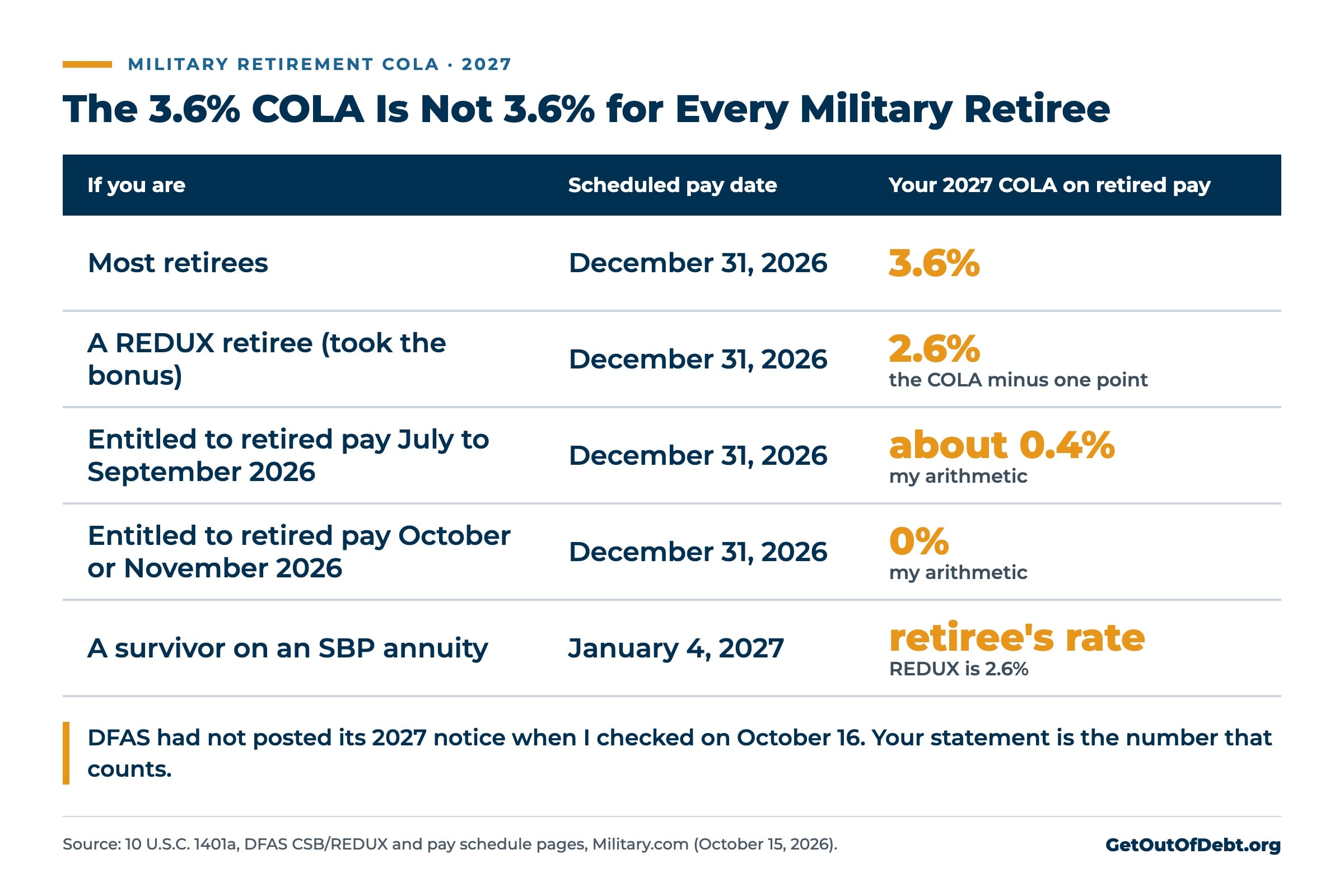
Group one: REDUX retirees get 2.6%, not 3.6%
If you took the Career Status Bonus, your COLA is cut by one percentage point every year. The statute says that when the COLA is more than 1 percent, a retiree who “first became a member on or after August 1, 1986, and has elected to receive a bonus” gets “the difference between” the regular percentage “and 1 percent” (10 U.S.C. 1401a(b)(3)). DFAS says the same thing in plain words: “Cost of Living Adjustments (COLA) are also reduced by one percent” (DFAS, CSB/REDUX). Military.com, citing the Defense Department, puts this year’s number at 2.6%.
Here is the part that surprises people. For a regular, non-disability REDUX retiree, DFAS says retired pay is restored to the High-3 amount at age 62, and “Full COLA rates will be applied to your new computation, but the COLA will continue to be applied at the reduced rate each year following.” The yearly cut does not end at 62. If you retired for disability and took the bonus, DFAS says the multiplier for your disability retired pay was not reduced, but you “will receive the reduced COLA for the rest of” your life, so there is no age-62 restoration to plan around. Reserve and Guard retirees who took the bonus are “subject to the 1 percent COLA reduction” too (DFAS, CSB/REDUX). The statute also has an exception for people who participate in the modernized retirement system (10 U.S.C. 1401a(b)(5)), so if you moved into the Blended Retirement System, ask DFAS which rate applies to you.
The Daily Money Brief — Free, at 10 AM
Money you may be owed, scams to dodge, and the fine print decoded — the consumer money news that affects your wallet, every weekday.
By my arithmetic, on $2,500 a month in gross retired pay, 3.6% is $90 a month and 2.6% is $65 a month. That is $25 a month, or $300 a year, of difference that nobody put on the news.
Group two: if you retired during 2026, your first COLA is partial
Military.com says “Service members who retired during 2026 receive a prorated first COLA based on the quarter in which they retired.” The statute explains how: for most retirees the first increase is measured from “the price index for the calendar quarter immediately before the calendar quarter during which the member became entitled to retired pay” (10 U.S.C. 1401a(d)). If you took the bonus and retired in 2026, your first COLA is no higher and usually lower, because the statute also subtracts “one-fourth of 1 percent for each calendar quarter” in that stretch, and if the subtraction is bigger than the increase, “such an increase shall not be made” (1401a(e)). A smaller group whose retired pay is based on final basic pay rather than High-3 has a different first-year rule again (1401a(c)), so ask DFAS if that is you.
To show the size of the effect, I ran it with the CPI-W quarterly averages from the Bureau of Labor Statistics, which are 320.288 for January through March 2026, 327.482 for April through June and 328.746 for July through September, the base quarter that produced the 3.6%. By my arithmetic, for a High-3 retiree who did not take the bonus, someone who became entitled in April through June gets about 2.6% (the same figure as the REDUX rate only by coincidence), someone who became entitled in July through September gets about 0.4%, and someone who became entitled in October or November gets no increase this December because the quarter before theirs is the base quarter itself. I could not estimate January through March, because that group is measured from October through December 2025 and BLS shows October 2025 as “Data unavailable due to the 2025 lapse in appropriations,” so if that is you, ask DFAS. These are estimates, and DFAS computes the real number; the statute names the Consumer Price Index (all items, U.S. city average), and I used the CPI-W series that produced the 3.6%, so treat them as a sense of scale. DFAS’s December 2025 newsletter pointed retirees to the Defense Department’s COLA page for the official memorandum, so check there for the 2027 one before you rely on any estimate. It is also not a penalty. It is the law counting only the inflation that happened after you retired.
Survivors: the SBP annuity follows the retiree’s rate
By statute, an SBP annuity is increased “by the same percent as the percent by which the retired pay of the person providing the annuity would have been increased at such time if the person were alive” (10 U.S.C. 1451(g)(1)). So the survivor of a REDUX retiree follows the reduced rate, and the survivor of a High-3 retiree follows the full one. If a REDUX retiree died before 62 and would have had retired pay recomputed at 62 (a regular, non-disability retiree), the law recomputes the annuity once, on the first day of the month after the retiree would have turned 62, as if the full COLA had applied all along (10 U.S.C. 1451(i)), which is a bigger planning date than this year’s percentage. If the retiree’s pay was never going to be restored at 62, ask DFAS before counting on that. DFAS’s pay schedule has annuitants paid on January 4, 2027 for the December entitlement, so a bill set to autopay December 31 through January 3 can come out before that deposit, depending on how the biller handles the holiday and weekend; move the date or set the cash aside now. If you also, or only, receive VA Dependency and Indemnity Compensation, that part is on the VA timetable below, not this one.
If you are the retiree and you pay SBP premiums, the premium is a percentage of your SBP base amount, and the law raises that base amount “at the same time” your retired pay rises (10 U.S.C. 1451(h)(1); 1452), so the premium goes up a little too and your net increase is smaller than the gross one.
VA disability: the same percentage, with one more step
There is no automatic VA increase: VA’s compensation page says it is “required by law to match the percentage of cost-of-living adjustments” made to Social Security, and the law that does the matching is a bill Congress passes each year. This year’s is S. 4487, the Veterans’ Compensation Cost-of-Living Adjustment Act of 2026, which would raise disability compensation and Dependency and Indemnity Compensation for survivors “by the same percentage as” Social Security effective December 1, 2026. It was introduced May 11, 2026 and referred to the Senate Veterans’ Affairs Committee, and Military.com reported on October 15 that this year’s bills were still working through committees, while noting that lawmakers have passed the adjustment every year for decades. So the VA number is expected, not final, until that bill passes.
Why You Need to Know It: A Raise You Commit Before It Lands Is a Debt You Chose
I am not worried that you will be shocked by a number. I am worried about what happens in the weeks between the headline and the deposit. A household sees “3.6%” and quietly builds a plan: a new truck payment, a bigger phone plan, a subscription, a credit card balance that gets “taken care of with the raise.” Then the deposit arrives and it is $65 instead of $90, or $10 instead of $90, or the whole thing is eaten by something else on the statement. A payment you signed up for does not shrink when the raise does.
The timing makes this easier to get wrong, because the dates are staggered. Federal law makes the increase effective December 1, but DFAS pays retirees for December on December 31, 2026 and annuitants on January 4, 2027, because of the weekend and holiday rule on its pay schedule page. Last year DFAS said retirees “will see the change in their December 31, 2025 payment and SBP annuitants in their January 2, 2026 payment,” so the pattern points to a December 31 deposit this year, though DFAS has not confirmed that for 2027. Social Security, by contrast, increases with the December 2026 benefits, payable in January 2027. Military.com reports VA disability compensation is scheduled for December 31 under the Treasury’s payment calendar, and the new VA rate can only be in it if Congress has passed the increase by then.
If you also draw Social Security, there is one more number you do not have yet. SSA’s announcement says your 2027 Medicare premium will be available in your my Social Security message center starting in late November, and I covered what Medicare’s hold-harmless rule does and does not protect in this post on the 2027 COLA and Medicare. For the benefit-program side of the same raise, including SNAP and housing help, see what the 3.6% can quietly cost you.
Things to Consider: What Is Solid, and What I Could Not Verify
- Solid: SSA’s 3.6% and its January 2027 timing, the statute’s December 1 effective date, the one-point COLA reduction for CSB/REDUX retirees, the first-year rule for new retirees, the SBP rule, and DFAS’s December 31 and January 4 pay dates are all in the sources linked above.
- Not confirmed: a DFAS notice of the 2027 COLA for retired pay (I could not find one on October 16), whether the December 31 payment will show the new rate for every retiree, and the final VA numbers, which depend on Congress passing this year’s bill.
- My arithmetic, not an official calculation: the $90 versus $65 example and the 2.6%, 0.4% and 0% first-year estimates for High-3 retirees who did not take the bonus. The statute names the Consumer Price Index (all items, U.S. city average) and I used the CPI-W series SSA uses, so treat those as a sense of scale and ask DFAS for your real figure.
- Not tied to the COLA at all, per Military.com: active-duty basic pay (set through the defense bill), Post-9/11 GI Bill housing allowances (which follow Basic Allowance for Housing on an August-to-July calendar) and Chapter 35 education benefits for survivors and dependents (which have their own rate schedule).
- If you get both retired pay and VA disability: DFAS says the law requires a retiree to “waive a portion of their gross DoD retired pay, dollar for dollar, by the amount of their Department of Veterans Affairs (VA) disability compensation pay” (DFAS). The waiver still applies; CRDP or CRSC may then make up part or all of it. CRDP requires a VA rating of “not less than 50 percent,” and a Chapter 61 disability retiree also needs 20 years of service under 10 U.S.C. 1405 or 12732 (DFAS, CRDP). The two payments come from two agencies on two timetables, so check each one separately, and if you have a waiver, do not spend either increase until both have posted.
The Claim: “The COLA is 3.6%, so my check goes up 3.6% in December.”
The Reality: For most retirees that is close to right, but 3.6% is the headline for the group, not a promise for each retiree: a REDUX retiree is at 2.6% by law, a 2026 retiree gets only the inflation since the quarter before retirement, and what posts to your account is the net deposit after everything DFAS takes out and adds. Your own statement is the only number that counts.
One thing I will say plainly: a smaller-than-expected raise is not a mistake you made, and it is not a sign something is wrong with your pay. It is the rule you retired under, and the only mistake available here is spending the difference before you knew it.
What to Think About Doing: A Short List Before December 31
- Find out which group you are in. Did you take the Career Status Bonus at 15 years? Did you become entitled to retired pay in 2026? Are you a survivor on an SBP annuity? If you are not sure, your Retiree Account Statement on myPay is, in DFAS’s words, “a description of what you can expect on the next pay date” (DFAS), and askDFAS can tell you which rule applies.
- Do the math for your group. If you were already retired before 2026, multiply your gross monthly retired pay by 0.036, or by 0.026 instead if you took the Career Status Bonus; on $2,500 that is $90 or $65. If you became entitled to retired pay in 2026 and did not take the bonus, do not use either figure: use the first-year estimate for your quarter from the section above only as a sense of scale, and it can be 0%. If you became entitled January through March 2026, or took the bonus and retired in 2026, there is no estimate here: budget on the check you have and ask DFAS. Either way, plan on the lower number.
- Budget on the check you have now until the new net deposit actually posts. No new payment, no financing and no plan that only works at the full raise before you have seen the money in your account. Debt is math wrapped in emotion, and a raise is the easiest emotion there is.
- When it posts, compare it with your math. If the net deposit is off from what you calculated, ask for the Retiree Account Statement and call DFAS retiree customer service at 800-321-1080 (Monday through Friday, 8:30 a.m. to 4:30 p.m. Eastern, per DFAS) before you assume it is a mistake or a permanent change.
- If it is real money, decide where it goes once, on purpose. My view is that a raise is best used to take something off your plate instead of putting something on it. That could be the highest-interest balance you have, because that is where the math pays you back fastest, or a first month of emergency cushion if you have none, which can matter more if one surprise would put you behind. Those are two reasonable answers, and you pick. If your debts are bigger than a raise can touch, the Find Your Path quiz will show you every option, including ones nobody else is going to bring up.
- If you are a veteran with VA disability, wait for VA’s number. Treat the 3.6% on that side as expected until VA publishes the final rates. If collectors are part of your picture, I wrote about whether debt collectors can take VA disability, and about whether the government can take Social Security for an old Military Star Card. For the wider picture, see Veterans in Financial Crisis.
Key Takeaways
- Most military retirees are expected to get the same 3.6% as Social Security, but DFAS had not posted its 2027 notice when I checked on October 16.
- REDUX (Career Status Bonus) retirees get the COLA minus one percentage point, expected to be 2.6% this year, and the reduction continues past age 62.
- If you became entitled to retired pay in 2026, your first COLA covers only the inflation since the quarter before you retired.
- Retired pay is scheduled for December 31, 2026 and SBP annuities for January 4, 2027, per DFAS, though DFAS has not yet confirmed the new rate will be in those payments.
- Budget on the current check until the new net deposit posts, and send real extra money to the highest-interest debt or the emergency cushion, not a new monthly payment.
The Bottom Line
If you read the 3.6% headline and felt a little relief, or a little suspicion, you read it correctly, because the number is true for the group and not always true for you. The reframe is that a COLA is not a promise to your wallet, it is a rule applied to your file, and you can find your rule before the money moves. Debt is math wrapped in emotion, and this math is small, knowable and yours. Check your group, plan on the lower number, wait for the deposit, and let any extra money take something off your plate. You have more control over January than the headline made it sound.
Frequently Asked Questions
Do all military retirees get the 3.6% COLA in 2027?
No. Most retired pay is expected to rise 3.6%, matching the Social Security COLA, but retirees who took the Career Status Bonus under REDUX get one percentage point less (2.6%), and anyone who first became entitled to retired pay during 2026 gets a partial first COLA based on the quarter they retired. DFAS had not posted its 2027 COLA notice when I checked on October 16, 2026.
Why do some military retirees get a 2.6% COLA instead of 3.6%?
Federal law reduces the COLA by one percentage point for members who first joined on or after August 1, 1986 and took the Career Status Bonus (the REDUX retirement plan), and DFAS says the reduced rate continues in the years after age 62. If the full COLA is 3.6%, that makes their COLA 2.6% this year.
When will military retirees see the 2027 COLA in their pay?
The increase takes effect December 1, 2026. DFAS’s pay schedule has December 2026 retired pay going out on December 31, 2026 and survivor annuities on January 4, 2027, and last year’s pattern suggests the new rate will first appear in those payments, though DFAS has not confirmed it for 2027. Social Security increases begin with benefits payable in January 2027.
Will VA disability and SBP annuities also go up 3.6%?
SBP annuities rise by the same percentage as the retiree’s retired pay, so a survivor of a REDUX retiree gets the reduced rate. VA disability and survivors’ Dependency and Indemnity Compensation rise only when Congress passes the yearly bill that matches them to the Social Security COLA, and as of Military.com’s October 15 report this year’s bill was still in committee, so treat the VA figure as expected until VA publishes final rates.
What should I do with a COLA raise if I have debt?
Wait until the new net deposit actually posts, then send the extra to the highest-interest debt or to a small emergency cushion rather than a new monthly payment. A new payment sized to the full raise can leave you short if your deposit is smaller than the headline.
If you know a military retiree, a survivor or a veteran who has been planning around “3.6%,” send them this before their first deposit. A little warning is the difference between a plan and a surprise.
This is what I’m telling friends like you over coffee. Take it as input, not instruction, because you know your own situation and I don’t. But remember, you do you.

Discussion about this post