
LAWRENCE, N.Y. — “Are people going to care about one little house?” asked Elizabeth Waytkus, who had been alerted some weeks ago to the possibility that a once-celebrated house by the architect Marcel Breuer would be demolished. She is the executive director of Docomomo US, a nonprofit organization that promotes the preservation of modern structures.
People did care, it turns out. She has received an outpouring of dismay and grief at the news that the 1945 Bertram and Phyllis Geller House in Lawrence, at the southwestern edge of Nassau County, had been demolished without warning on Jan. 26 by the current owners, Shimon and Judy Eckstein, who Waytkus said had assured her only three weeks earlier that they had admired it and had no plans to take it down.
It was a handsome composition of three cedar-sided single-story wings, that zigzagged among the trees and shrubs of a spacious site, each wing topped with a low-sloped roof that gave the house an undulating silhouette. The house had been significantly, but not irreversibly, altered, according to pictures on a real estate website.
Her question makes a larger point, however. The Geller house was rapturously covered by the press at its debut because it appealed to an America that was obsessed with making a better life after enduring sacrifices of World War II and the grinding bleakness of the Great Depression. It was “among the most famous houses of the period,” said Barry Bergdoll, a Breuer expert, who teaches architectural history at Columbia University and was the chief curator of architecture at the Museum of Modern Art. Yet it had fallen into a kind of obscurity, well known mainly to aficionados.
Preserving individual houses is difficult and expensive, explained Waytkus, first because they are private. Docomomo’s modest resources are mostly focused on the preservation of commercial, cultural, and civic buildings because they are generally accessible to the public. In large-lot suburbs like Lawrence, the loss of a single house is less jarring because it is not perceived as part of an ensemble, as a row of Manhattan mansions or imposing brownstones might be.
Suburbs often resist local preservation ordinances, especially those aimed at midcentury or later modern buildings. The taste for modernism is not universal, and suburban officials often avoid enacting landmark ordinances that require owners to become unwilling custodians of an important cultural resource.
“There aren’t very many tools to aid the preservation of these houses,” Waytkus explained. The best activists can do, she says, is promote the value of postwar architecture to the community, as well as to sellers. Then try to find buyers willing to preserve them.
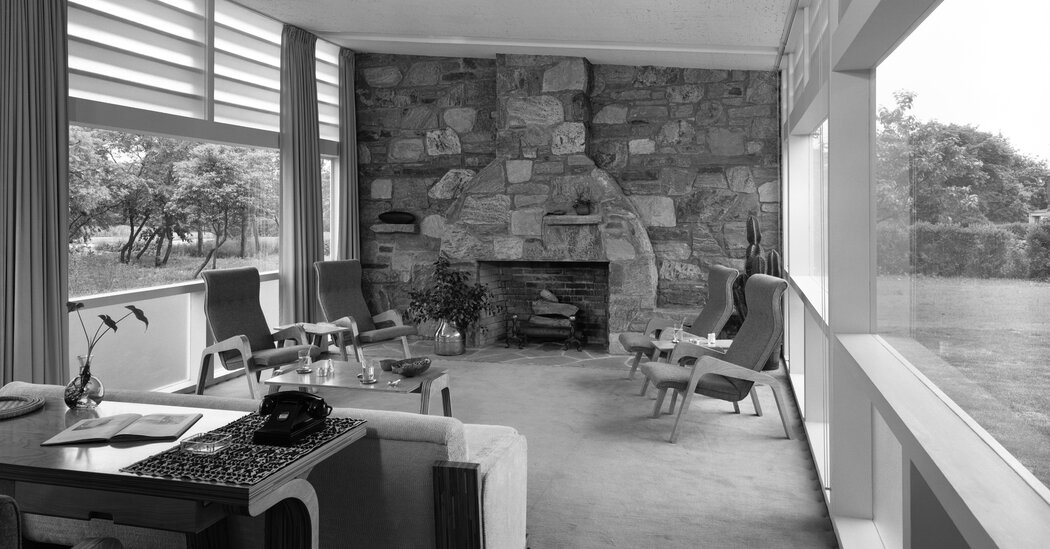
The Geller house received a great deal of attention when it was built because it confidently embodied the new values of suburbia: technological progress, and an informal, unshowy lifestyle built around children, with easy access to outdoor play and relaxation. It is an emblem of a time that has absolutely vanished: when postwar suburbs, at their best, were places of possibility, of innovation and new ideas. The architecture of single-family houses expressed those aspirations and embodied that emerging lifestyle.
The Geller house was described as binuclear, a rather self-important way to underscore the primacy of child rearing that informed the design. The visitor entered an enclosed breezeway that separated wings for family activities from a bedroom wing. Two of the children’s bedrooms faced a playroom that ran the full width of that wing, which opened directly to a lawn for outdoor recreation.
On the other side of the breezeway, the kitchen, dining and living areas flowed into each other in a relaxed manner — emblematic of the greater informality families sought. The owners did not treat the house as a showpiece. Joe Geller, one of the Geller’s four boys, told Caroline Rob Zaleski, the author of “Long Island Modernism: 1930-1980,” that his mother “didn’t mind us as young children running indoors to outdoors, and from room to room with all our
friends.”
The upward sloping roofs in both wings conferred a generosity to the rooms’ modest dimensions, as did extensive floor-to-ceiling window walls that splashed sunlight across the flagstone floors and opened to the greenery outside.
Marcel Breuer, born in 1902, made his way from Hungary to study in Vienna, then entered the Bauhaus school at Dessau, Germany, where he would later run the furniture studio. He designed two celebrated chairs, the Cesca and the Wassily — both were framed in chromed tubular steel and succinctly captured the Bauhaus synthesis of abstract geometries and industrial techniques.
With the rise of the Nazis, Breuer, who was Jewish, would move several times, finally settling in Cambridge, Mass., in 1937, where he practiced and taught with his Bauhaus colleague Walter Gropius at Harvard. Gregarious and charming, “Lajko” became close friends with many clients, including the Gellers, who would hire him to design another house in Lawrence, in 1967. (For this reason the original Geller house is now known by preservationists as Geller I.) The house has been added to but remains largely the way it was built.
In a series of houses with Gropius, Breuer would soften the crisp cubic forms, white plaster or metal surfaces, and dramatic cantilevers of his Bauhaus work. Geller was designed as Breuer was parting ways with Gropius and moving to New York.
In this house, Breuer more fully merged his stylistic tendencies with American building techniques. The conventional wood construction was clad in vertical cedar siding that gave a sleek planar feeling. Inside, he used thin panels of varnished plywood and contrasted them with expanses of saturated paint colors in the mode of Modern artists. Jackson Pollock made one of his early drip paintings — sold long ago — for the house.
Breuer anchored this lightweight architecture to the earth with a living-room wall and massive fireplace of fieldstone. Low stone walls projected into the landscape to demarcate places for play and relaxation. You could argue that the old-fashioned masonry harkens to traditions Americans cling to — or that the stone is simply a sensual counterpoint to the sleek planes of the rest of the design.
Many of the ideas Breuer had refined in Geller would appear in a house he designed that was built in MoMA’s garden in 1949, broadcasting its ideas to an international audience. “Both the Geller and MoMA houses were intended to be replicable,” said Bergdoll, “a house that a local contractor could build.”
While many other architects, including émigrés like Gropius, Ludwig Mies van der Rohe, and Richard Neutra, as well as the architects of the California Case Study Houses, brought fresh ideas to rapidly expanding suburbs at this time, aspects of Breuer’s MoMA design — and, by extension, Geller — appeared around the country, massaged to suit local conditions by talented so-called regionalists, in the Carolinas and Texas, California and the Pacific Northwest. A clean break from the past, the houses celebrated the modesty and thrift people carried from the Depression.
I would argue that the Geller house is more important now than it was when built, precisely because the qualities that made the era unique have largely vanished. As the government underwrote the suburban highways, cities emptied, with some later coming back, largely by drawing people to return to underappreciated neighborhoods, held together by those who didn’t leave, with superb but neglected architecture. The ideas and the optimism began to come from cities again.
Suburbs now struggle to tame traffic. Some have grown poorer. Thrift and modesty now seem quaint. Land in desirable locations has become unaffordable and tear-downs epidemic — in what were once middle-class suburbs as well as enclaves of innovative houses commissioned by adventurous clients — as the house as investment vehicle triumphs over the home as shelter. (In Lawrence, houses that appear to be three to four times as large as the long-time mix of modest ranch houses and substantial summer “cottages” from the early 1900s are rising along the coastal salt marshes and golf course fairways.) Zaleski, the author, estimates that more than two thirds of the houses she showed in her 2012 book have either been demolished or radically altered.
As working from home frees people from commuting, the indoor-outdoor focus and the innate flexibility of the Geller house and its ilk seem ideal, a reprieve for people glued to screens in dim rooms all day. Regrettably, the lessons such houses teach are lost as they grow fewer all the time.


Discussion about this post