









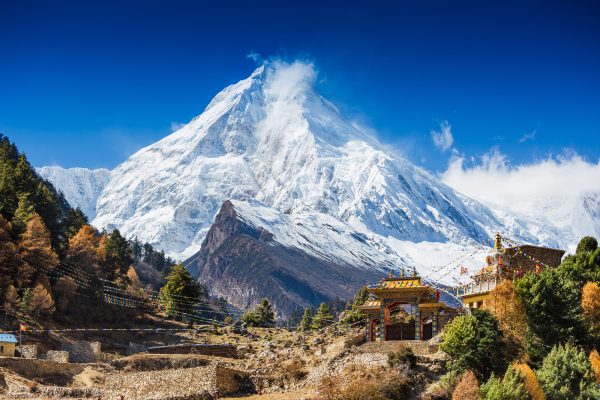
On November 12, at the 29th Conference of the Parties (COP29) to the U.N. Framework Convention on Climate Change (UNFCCC) in Baku, Azerbaijan, the leaders of six Hindu Kush Himalaya countries met to discuss the climate crisis that has reached epic proportions. Out of the eight countries – namely Afghanistan, Bangladesh, Bhutan, China, India, Myanmar, Nepal, and Pakistan – only Taliban-ruled Afghanistan and Myanmar, now under a military junta, were perhaps justifiably absent.
The broader Himalaya region, called the “Third Pole,” which includes the Tibetan Plateau, is a global biodiversity hotspot and has the largest reservoir of freshwater outside the two Arctic and Antarctica polar regions, among other important features. In view of the dangers of a Himalayan meltdown, the meeting – hosted by Bhutan’s Prime Minister Tshering Tobgay – vehemently expressed the need for “coordination and support” at global forums to “represent and amplify” regional concerns that have global implications.
However, two factors highlight the complications and even the inadequacy of holding vital meetings in such an almost incidental manner: One is the general declining trust in multilateral climate conferences amid low political will. This year it was particularly apparent because of the lack of attendance of the heads of state of major powers and some of the biggest carbon emitters, including Brazilian President Luiz Inacio Lula da Silva, Chinese President Xi Jinping, Indian Prime Minister Narendra Modi, German Chancellor Olaf Scholz, and outgoing U.S. President Joe Biden.
In addition, the election of Donald Trump – a well-known climate change skeptic who withdrew the United States from the Paris Climate Accord during his first term – as the next U.S. president has undone any hope there was left in securing international climate solidarity. And that’s not to mention the inherent ethical dilemmas of having two big, influential oil producers hosting back-to-back COP summits (the UAE in 2023 and Azerbaijan in 2024). It highlights that countries with clout – including China, which continues to “elevate its position” at the U.N. bodies – have dominated the global climate forums.
The second problem is the absence of core Himalayan issues in the main UNFCCC agenda, which is governed not just by financial intricacies and inconveniences but unfortunately by “the very worst of political opportunism,” as the Marshall Islands’ climate envoy put it. In particular, the acute marginalization of Tibetan representation in these multilateral climate forums, where China reigns supreme, has only hampered regional concerns from being truly voiced, let alone amplified.
Against such a scenario, what more can the multilateral forums do? How should the global community – including India – respond to China’s apathy for the climate crisis in Tibet?
The COP29 Upside: 11th Hour Consensus as the Sole Face-Saver?
COP29 was dubbed the “climate finance COP,” formally known as the New Collective Quantified Goal on Climate Finance (NCQG). After two weeks of intensive negotiations and several years of preparatory work, the new financial goal is a “course correction” on global climate action. It has tripled the finance to developing countries, from the previous goal of $100 billion annually announced in 2009 to $300 billion a year by 2035. COP29 also pledged to continue efforts to harness all actors from public and private sources to scale up finance to developing countries to $1.3 trillion per year. The climate framework intends to cover all greenhouse gases and all sectors to keep the 1.5 degrees Celsius warming limit within reach.
The new commitment builds on significant strides forward in global climate action at COP27 and COP28. A historic Loss and Damage Fund was agreed upon at COP27, while COP28 delivered a global agreement to transition away from all fossil fuels in energy systems, triple renewable energy, and boost climate resilience.
An agreement on carbon markets is another significant step. The final building blocks that set out how carbon markets will operate under the Paris Agreement Crediting Mechanism have been agreed upon. This includes the standards for a centralized carbon market under the U.N. (Article 6.4 mechanism) to operationalize country-to-country trading and a carbon crediting mechanism. It entails clarity on how countries will authorize the trade of carbon credits and how registries tracking this will operate.
Furthermore, the transparent process of technical reviews would ensure environmental integrity. This includes mandatory checks for projects against strong environmental and human rights protections. It ensures that a project cannot proceed without explicit, informed agreement from Indigenous peoples. It also allows anyone affected by a project to appeal a decision or file a complaint. This will benefit developing countries receiving new flows of finance and the least developed countries by providing capacity-building support to get a foothold in the market.
In terms of concrete steps aimed at the Himalayan ecosystem, there were a few high-level plenary sessions at COP29 such as the “Resource Mobilization for Climate Adaptation in Asia’s High Mountains,” which stressed the “urgent need for increased investment in climate adaptation” in this region. These seem mostly ineffectual, in-name-only steps. In contrast, the launch of G-ZERO – a forum of carbon-negative and carbon-neutral small countries, which prominently includes Bhutan (also its permanent secretariat) – at COP29 is truly inspirational. Such actions that aim to “enhance carbon sinks and promote nature-positive pathways” will go a long way to build a positive ideology needed to counter climate change in the Himalayas.
As far as Tibet’s participation in COP29 goes, the two Tibetan delegates – Dechen Palmo and Dhondup Wangmo – raised environmental concerns at some events. They even launched a campaign to raise awareness about the risks posed by hydropower projects in China, particularly the Derge Dam – a hugely controversial project that had resulted in mass protests and a brutal crackdown by the Chinese government earlier this year. Yet the token participation of two Tibetans in a few events at the sidelines of the summit is clearly not enough.
The fact of the matter is that despite the adoption of the “Baku Workplan,” which took a decisive step forward to elevate the voices of Indigenous peoples and local communities in climate action, neither the Hindu Kush Himalaya region nor its peoples, including Tibetans, have been included in the mainstream discussion and, more importantly, in policymaking on climate change.
China’s Tibet Apathy: Accelerating Regional Climate Risks
That climate change is wreaking havoc in the Tibetan Plateau is old news: For years, it has been established that global warming is not only causing Tibet’s glaciers to melt and permafrost to thaw at an alarming rate but also accelerating several extreme weather events such as flash floods. In 2019, a special report by the Intergovernmental Panel on Climate Change (IPCC) warned that up to two-thirds of the region’s glaciers would disappear by the end of the century if carbon emissions were not cut drastically.
On top of the challenges due to global warming, China’s so-called “unprecedented” development policies have hastened Tibet’s climate crisis. China’s relentless pursuit of infrastructure, including helipads, rails, and road networks, as well as dual-use military facilities is causing environmental degradation. That’s on top of the human costs that come with the displacement of nomadic and farming communities due to the (over)damming and diversion of Tibet’s rivers.
China’s Tibet policy is driven by its need to fill the demands of Han-majority regions, including access to Tibet’s water or mineral resources (reportedly also including rare earths). It also has a larger securitization angle: building excessive military infrastructure to not only clamp down on all separatist activities but also create conditions for a heavily militarized border, particularly against India. China’s increasing militarization in Himalayan territories and influence in countries such as Pakistan and Nepal also have repercussions for the instability of the South Asian region as a whole.
China is also using its control over Tibet’s water resources to slowly develop into a water hegemon. Ten major rivers, from the Mekong to the Yarlung Tsampo (Brahmaputra in India) originate in Tibet, and China is planning or has already executed major dams on a number of these rivers. Beyond the impact on Tibet’s people and environment, such actions have given rise to concerns about China’s intent to block access to water to downstream countries.
This has heated up the already tense geopolitical climate in South and Southeast Asia. China stands accused of using financial incentives as well as economic coercion to clamp down either dissent or disagreement over China’s “core national interests,” as well as to fulfill its various strategic goals.
The Imperative for Climate Solidarity: Beyond Multilateral Unity?
Undoubtedly, the future of Asia’s high mountains depends on the decisions of the global climate bodies and the collective efforts taken to build climate-resilient communities and protect these vital ecosystems. A unified effort to combat these challenges would mean moving beyond the business-as-usual approach and focusing on targeted investments and mobilization of international support. There is a need to quantify economic costs for loss and damage to the specific ecosystem to drive new investments and support stronger policy coordination.
In the Himalayan region, as raised by the Himalayan ministers’ council at COP29, tackling transboundary issues with a common approach has to be given the spotlight. Some of these issues include but are not limited to cryosphere risk monitoring, disaster preparedness, increasing air pollution, biodiversity conservation, and innovative financing solutions.
Support at global forums like the U.N. climate conferences to represent and amplify common issues and concerns is critical in attracting global attention to the Himalayan region. This would hopefully also allow access to global funds, such as the Global Environment Facility, which is a partnership of 18 agencies (including United Nations agencies, multilateral development banks, national entities, and international NGOs) and U.N. financial mechanisms such as the Adaptation Fund and Green Climate Fund (GCF), as well as other potential innovative financing solutions. Such an imperative will go a long way to fulfill the funding need that was highlighted by Bhutan’s Secretary of the Ministry of Energy and Natural Resources Karma Tshering at COP29.
Moreover, the multilateral partnership must prioritize the Himalayan climate crisis in their common agenda. Four years earlier, at the height of the COVID-19 pandemic, the 2020 Ministerial Mountain Summit had declared some common goals, including holding a biennial summit for the eight Hindu Kush Himalaya countries and creating a task force to monitor and assess the calls for action. This needs to be taken forward with renewed momentum at the COP30 to be held in Brazil.
While multilateral cooperation is a must, there is also a need to amplify the voices of the marginalized and suppressed communities in the high mountains. Particularly, the Tibetan Plateau and its people need the international community, including India and the West, to check China’s growing inroads into the Tibetan landscape. Be it China’s excessive damming of Tibetan rivers, mining, or construction of dual-use military infrastructure (e.g., roads and helipads), China’s actions in Tibet belie its claims of adhering to the United Nations’ Sustainable Development Goals. Then there are also the human rights aspects of the Tibetan occupation, which also lends to the climate change acceleration as the original settlers are “relocated.” In this context, India and the West need to collaborate to bring the Himalayan concerns into the emerging Indo-Pacific regional architecture agenda. A common security agenda might help consolidate climate action.
This piece is part of the Stockholm Center for South Asian and Indo-Pacific Affairs at ISDP’s research project on the Climate Crisis in Tibet.
Dr. Jagannath Panda is the Head of the Stockholm Center for South Asian and Indo-Pacific Affairs at the Institute for Security and Development Policy, Sweden; and a Professor at the University of Warsaw.










Discussion about this post