










Tipping elements within the Earth system are increasingly well understood.
Scientists have identified more than 25 parts of the Earth’s climate system that are likely to have “tipping points” – thresholds where a small additional change in global warming will cause them to irreversibly shift into a new state.
The “tipping” of these systems – which include the Atlantic Meridional Overturning Circulation (AMOC), the Amazon rainforest and the Greenland ice sheet – would have profound consequences for both the biosphere and people.
More recent research suggests that triggering one tipping element could cause subsequent changes in other tipping elements, potentially leading to a “tipping cascade”.
For example, a collapsed AMOC could lead to dieback of the Amazon rainforest and hasten the melt of the Greenland ice sheet.
However, the interactions between individual tipping elements – and the ways they might trigger each other – remain largely underexplored.
In a review study, published last year in Earth System Dynamics, we unpack the current state of scientific understanding of the interactions between individual tipping elements.
We find that scientific literature suggests the majority of interactions between tipping elements will lead to further destabilisation of the climate system.
Existing research also indicates that “tipping cascades” could occur even under current global warming projections.
Scientific understanding of individual tipping elements is continuously improving, but more research on their interactions is needed.
An emerging field
The history of tipping elements as an object of investigation is relatively short. As a result, they are only partially accounted for in current climate models.
For the Intergovernmental Panel on Climate Change (IPCC), the possibility of abrupt changes in the Earth system was first mentioned in its third assessment report in 2001. At the time, climate scientists expected these changes only in scenarios where temperatures rose to 4-5C above pre-industrial levels.
The term “tipping elements” was first used in the context of the climate system in 2008, in a foundational paper in the journal Proceedings of the National Academy of Sciences (PNAS).
Since then, significant progress has been made on tipping element research.
For instance, the 2023 global tipping points report – co-authored by more than 200 researchers from 90 organisations in 26 countries – recognised that five “major” tipping elements – the Greenland and West Antarctic ice sheets, the warm-water coral reefs, the North Atlantic Subpolar Gyre and global permafrost regions – are already “at risk of being crossed due to warming”.
However, tipping elements have so far largely been studied in isolation. Most research has neglected the interactions between different tipping elements which could further destabilise the climate system – and eventually even lead to tipping cascades.
Tipping cascades
Interactions between tipping elements clearly exist.
For example, we find robust evidence that an influx of freshwater into the North Atlantic caused by the disintegration of the Greenland ice sheet would destabilise the AMOC and could trigger its slowdown. (This, in turn, could result in the ocean currents moving less heat from equatorial regions to higher latitudes, leading to significant cooling in Europe.)
In worst-case cascading scenarios, the tipping of one system directly leads to the tipping of another. In less dramatic cases, it only reinforces destabilisation of other systems.
So, what additional effects are to be expected from these interactions?
The map below shows how 13 out of 19 tipping element interactions analysed in our review study are expected to lead to further destabilisation. The arrows indicate destabilising (red), stabilising (blue) or competing (grey) effects, while the dashed lines show where there is only limited evidence for a connection.
A prominent example of a tipping point that leads to further destabilisation is the impact of changes to the AMOC. The weakening or collapse of the system of ocean currents may lead to accumulation of warm ocean water in the Southern Ocean, which could, in turn, contribute to a destabilisation of the West Antarctic ice sheet.
It has also been suggested that a weaker AMOC could promote El Niño events by increasing the temperature difference between the equator and the poles, which would strengthen trade winds. (While the El Niño-Southern Oscillation, or ENSO, is not a tipping element, it may play an important role as a propagator of disturbances.)
There are also a few examples – two out of 19 interactions – where a tipping point can help stabilise another system. For example, the weakening of AMOC could lead to an interrupted flow of warm water from equatorial to the polar Atlantic regions. This would drastically cool large parts of the polar region and could therefore stabilise the Greenland ice sheet.
A conceptual model
While scientists have gathered evidence for tipping points from observations, models and proxy data from the distant past, we still need more research to study interactions.
Our ongoing research aims to quantify the risk of tipping cascades using a conceptual computational model.
The model is “conceptual” in the sense that it is not grounded in physical or chemical processes, such as heat transfer or circulation patterns. Instead, a range of measurements – such as global average temperature, tipping temperature and temperature overshoot trajectory – serve as “modelling parameters” that can be varied to study a large range of possible scenarios.
To date, the model is limited to simulating the Amazon rainforest, the AMOC and the West Antarctic and Greenland ice sheets – tipping elements whose respective interactions are relatively well established.
However, using this model we can investigate – among other things – tipping risks under different so-called temperature “overshoot” scenarios.
This is where global warming peaks at a certain temperature level – for example, 2C – before declining to a lower long-term stabilisation temperature. (The subsequent decline is assumed to be the consequence of a global roll-out of negative-emission technologies, as assessed in several recent publications.). The difference between the peak temperature and the long-term stabilisation temperature is the overshoot.
Evaluating millions of scenarios, our model calculates “tipping risks” for fixed combinations of a particular overshoot and stabilisation temperature.
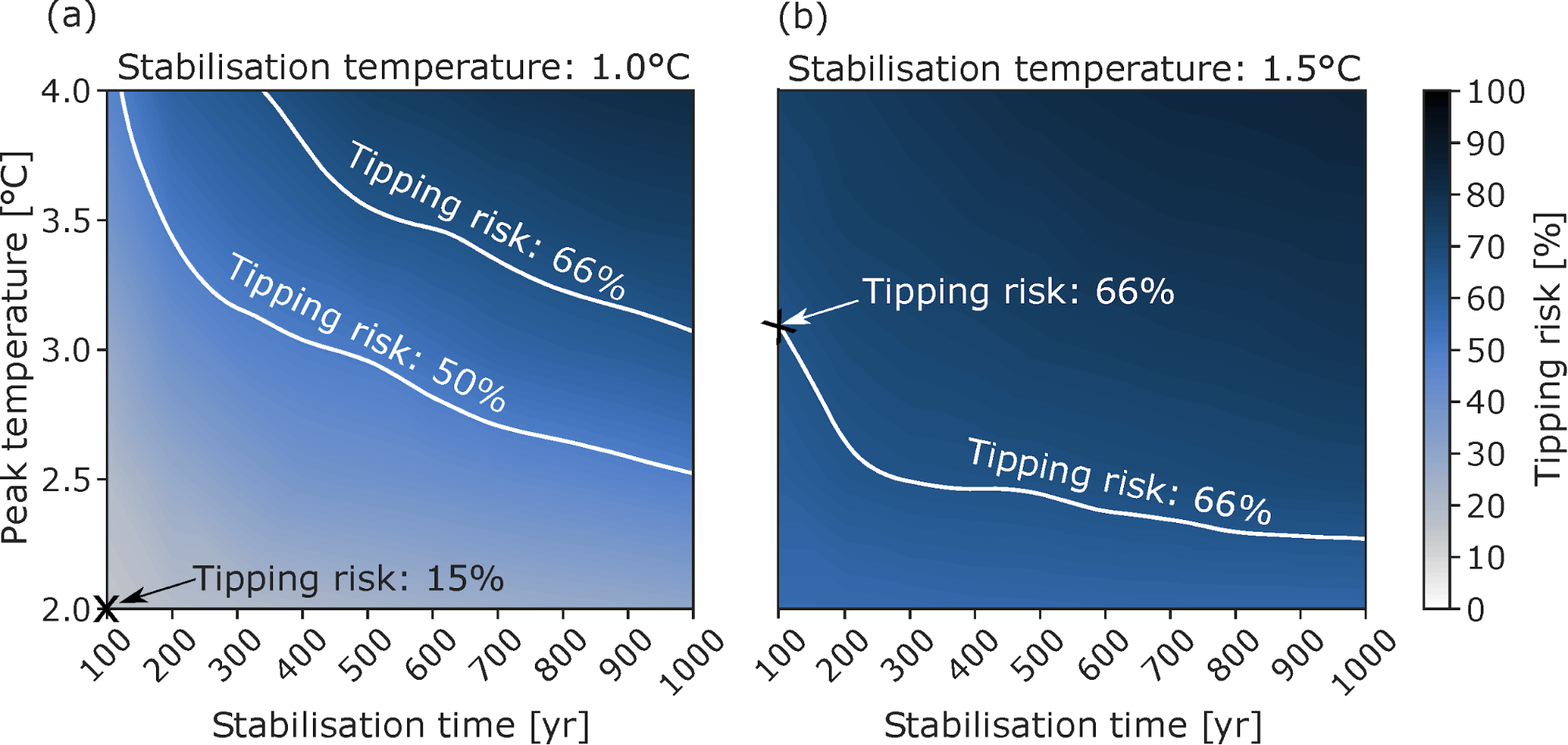
The main finding of the research is that long-term tipping risks are in the order of 15% if warming peaks at 2C and then stabilises at 1C.
In contrast, in a scenario where the peak warming reaches 3C and stabilises at 1.5C in the 22nd century, there is a 66% probability that at least one of the four modelled tipping elements would lose stability.
The figure below shows tipping risks where warming peaks at between 2C and 4C (“peak temperature” on y-axis) and takes 100-1,000 years to stabilise (“stabilisation time” on x-axis).
The figure on the left shows tipping probabilities where temperatures eventually stabilise at 1C and the figure on the right where temperatures settle at 1.5C. Darker colours represent higher tipping risks.
The figure shows how tipping risks increase with higher peak and stabilisation temperatures, as well as with longer stabilisation times.
While solidly calculated and based on recent scientific literature, our results can not count as projections of future climate due to the conceptual nature of our underlying model.
Nevertheless, the findings are useful and complement findings from traditional climate models, known as General Circulation Models (GCMs).
GCMs have only started to fully address the dynamics of tipping elements and their interactions. For example, most do not yet feature fully interactive ice-sheet dynamics, nor their interactions with global oceans.
In a paper published last November, we used our conceptual model to show that neglecting interactions between the Greenland ice sheet and the AMOC can alter the expected number of tipped elements by more than a factor of two.
In addition, the high cost of running GCMs means researchers cannot run large “ensembles” of multiple model simulations to account for uncertainties in knowledge of key parameters. Our simplified conceptual model, on the other hand, can account for this uncertainty.
By drastically reducing physical complexity, we are able to compute several million – and up to a billion – ensemble members in large-scale Monte Carlo simulations.
Historical tipping events
While our results need to be confirmed by more complex Earth system models, such as GCMs, they hint at the need for scientists to examine interactions between tipping elements and potential tipping cascades more closely.
The study of abrupt climate changes of the distant and not-so-distant past is critical to convince researchers of the existence and significant impact of tipping cascades.
A potential candidate for investigation is the Eocene–Oligocene transition. This took place roughly 34m years ago and led to the formation of a continent-scale ice sheet on Antarctica which buried the region’s forests.
The transition likely involved the interaction of several tipping elements, including global deep-water formation, the Antarctic ice sheet, polar sea ice, monsoon systems and tropical forests. The monsoon-like climate of the Antarctic content at the end of the Eocene would have had to change drastically – or tip – to allow for glaciation during the transition to the Oligocene.
Since the events at that time were also linked to a major loss of mammal species, mostly in Europe, the Eocene–Oligocene transition might even have involved a climate-ecology tipping cascade.
Heinrich events, which took place in the last ice age – around 120,000 to 11,500 years ago – as well as the mid-Holocene, could also be especially revealing around what we can expect in the near future.
These events, which involved the release of icebergs into the North Atlantic, resulted in a fresh water inflow that substantially weakened the AMOC. This, in turn, led to the drying of northern Amazonia and the retreat of the rainforest. Today’s melting of the Greenland ice sheet could have similar consequences for the AMOC.
While these climate changes in the past happened through natural drivers, humans are potentially forcing these rapid changes now in the modern era through emissions of carbon dioxide, possibly on a much faster timescale.
Updated climate models
The science of interacting tipping elements and tipping cascades is in its early stages – and there is significant debate within the scientific community on the topic.
Some consider a global reorganisation of the climate system induced by tipping elements and cascades to be speculative, given that recent observations are not available and proxy data is scarce.
Additionally, there is scientific uncertainty of how tipping processes may play out across different spatial scales, as well as how to increase the resilience of tipping elements against perturbations.
Therefore, significant work is underway to investigate tipping processes in complex Earth system models. The Tipping Points Model Intercomparison Project (TIPMIP) and European Union-funded projects ClimTIP or TipESM are among a raft of such initiatives.
Although these initiatives are largely looking at tipping elements in isolation, they will also shed more light on the interactions between these important parameters of the Earth’s climate system stability.
Wunderling, N. et al. (2024): Climate tipping point interactions and cascades: a review, Earth System Dynamics, doi:10.5194/esd-15-41-2024.










Discussion about this post