








Remittances from Egyptians Abroad Surge to $47.3 Billion
In the fiscal year 2025/26, Egyptians working overseas transferred an impressive $47.3 billion back home, as per preliminary balance-of-payments data from the Central Bank of Egypt (CBE). This marks a significant increase of 29.6% from the previous year’s total of $36.5 billion. During the same period, tourism generated an income of $18.4 billion, while Suez Canal transit fees contributed another $4.4 billion, underscoring that remittances alone represented roughly double these two income streams combined.
Increase in Remittances for Early 2026
Calendar-year statistics further illustrate growth, with the CBE reporting $33.9 billion in remittances from January to August 2026—a rise of 27.2% compared to $26.6 billion during the same timeframe in 2025. Notably, August 2026 alone accounted for $4.2 billion. This marks a reversal from recorded inflows that had been sharply declining three years prior.
Factors Behind the Decline in 2023 Remittances
The World Bank reported a decline in recorded remittances to Egypt, with totals of $31.5 billion in 2021, $28.3 billion in 2022, and a sharp drop to $19.5 billion in 2023. These figures correspond to calendar years and differ from the fiscal-year data provided by the CBE.
The World Bank suggested that disparities between the official exchange rate and the parallel market likely contributed to this decrease, as many remittances went unreported. Their December 2023 review highlighted that these discrepancies probably caused a substantial portion of remittance flows to remain outside official estimates. In June 2024, the World Bank reiterated that this divergence influenced the choice of channels for transferring money.
Impact of March 2024 Reforms on Remittance Flows
On March 6, 2024, the CBE implemented a 600 basis point increase in its policy rate, a move supported by the International Monetary Fund (IMF) as part of a lending agreement. This policy also included the unification of the official and parallel exchange rates, seen as a transition towards a more flexible exchange-rate system.
By June 2024, the World Bank noted a rebound in official remittance flows to Egypt following the rate unification. Its annual tracking indicated a rise to $29.6 billion in 2024 and an impressive $41.5 billion in 2025, the highest amount recorded in their series since 1977. In 2025, remittances constituted 11.4% of Egypt’s gross domestic product, a substantial increase from 4.9% in 2023.
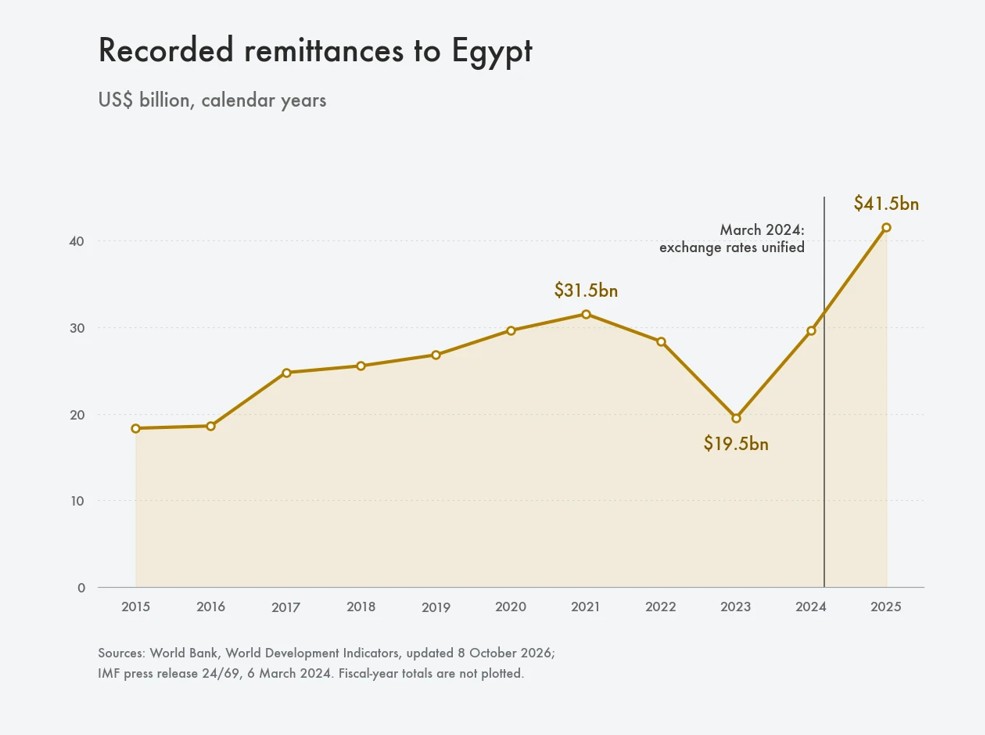
Source: World Bank, World Development Indicators, updated October 8, 2026. Reform date: IMF press release 24/69.
Cost of Sending Money to Egypt
When sending remittances, costs can include upfront fees and exchange rate margins. The World Bank’s “Remittance Prices Worldwide” survey assesses these expenses for sending approximately $200. In the third quarter of 2025, average costs to send money to Egypt were as follows:
| Sending Country | Average Total Cost |
| Kuwait | 3.33% |
| United Arab Emirates | 3.70% |
| Saudi Arabia | 5.15% |
| United States | 5.36% |
The global average cost for the same period was 6.36%. The G20 aims to reduce remittance costs to no more than 3% by 2030, with nothing above 5% for any corridor. However, routes from Saudi Arabia and the United States still exceeded these targets. The figures presented are averages and do not reflect individual transfer quotes.
Steps to Take When an International Bank Transfer is Delayed
If an international bank payment sent via Swift encounters delays, the sender should provide the Unique End-to-end Transaction Reference (UETR) found on the payment confirmation. This 36-character identifier remains consistent as the payment is processed through various intermediary banks. Note that a money transfer company’s reference number differs from the UETR.
It is important to distinguish between the payment reaching the receiving bank and the subsequent crediting of the beneficiary’s account. Swift indicates that 75% of cross-border payments are completed within ten minutes; however, domestic processing can take a considerable amount of time. These overall figures do not guarantee a specific timeframe for payments to Egypt.
Recipients can utilize uetr.ai’s guide for tracking international wire transfers to find the necessary reference and verify the payment status. This independent tracking service allows a free status check, though it does not replace a trace request through the sending bank.
If the funds do not appear in the recipient’s account, they should contact their receiving bank while the sender requests a trace from their own bank. For example, Banque Misr’s complaint procedure provides a reference within two working days and a response within 15 working days, though cases involving third parties may take longer.
Should a recipient disagree with the response, they must notify Banque Misr in writing within 15 working days. The bank will then have another 15 working days to review and respond. If the second response is unsatisfactory, there is an option to escalate to the CBE if the bank fails to reply within the specified timeframe.







Discussion about this post