









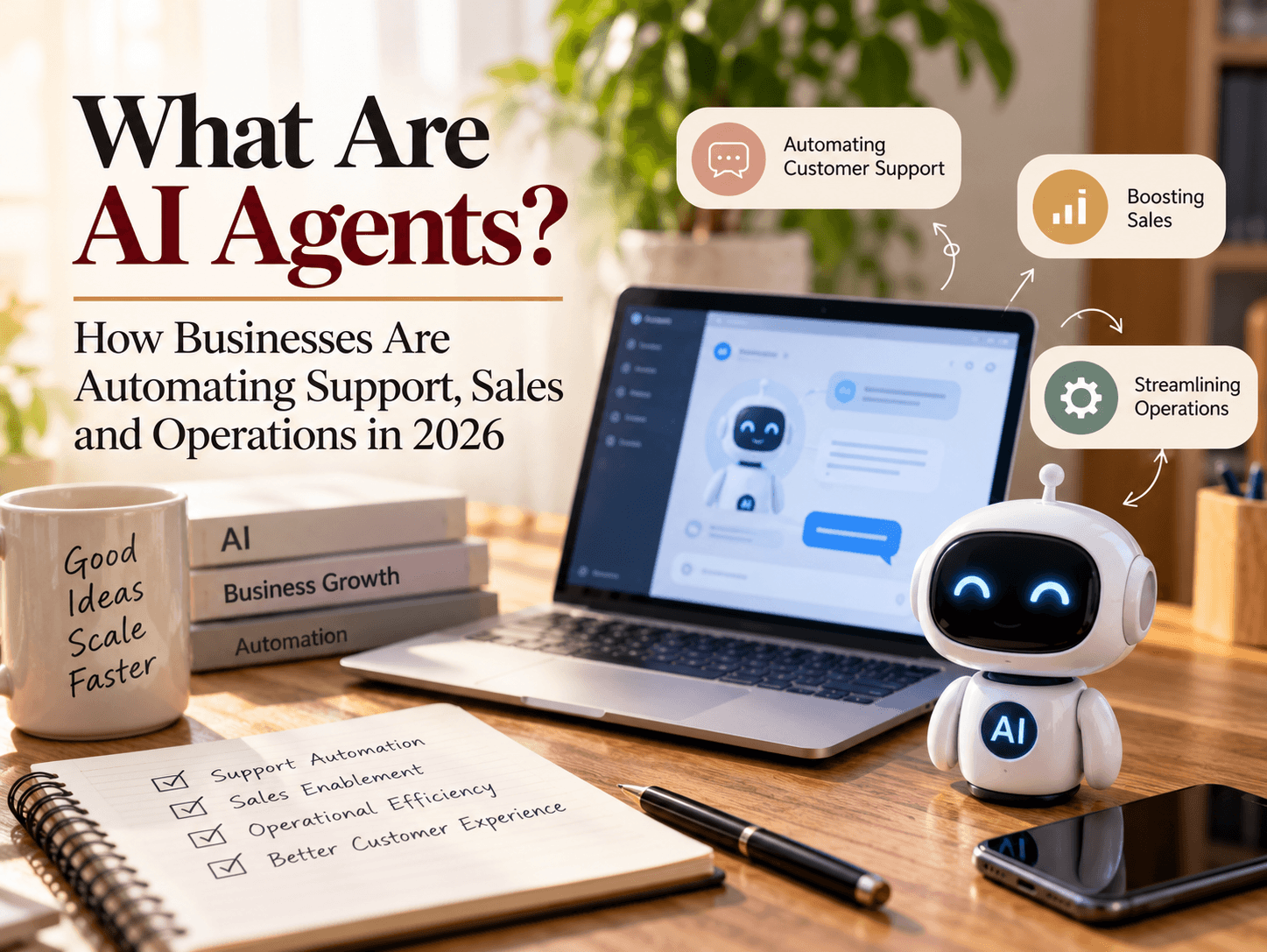
The Emergence of Autonomous AI Agents in Business Operations
In 2026, a significant evolution in business technology is set to take place with the rise of AI agents. These advanced systems not only comprehend objectives but also autonomously make decisions, leverage various business tools, and execute tasks with minimal human oversight. This shift is vital for startups, eCommerce platforms, and enterprise teams seeking to enhance efficiency and reduce manual workload.
This comprehensive guide delves into the essence of AI agents, their operational mechanics, the value they add to businesses, and practical steps to implement them effectively without overspending.
What Is an AI Agent?
An AI agent represents an intelligent software solution harnessing artificial intelligence, particularly large language models (LLMs), to pursue defined objectives independently. Unlike standard chatbots, AI agents can:
- Comprehend requests in natural language
- Formulate a plan to achieve the desired outcome
- Interact with essential tools like CRM, email, databases, and payment systems
- Execute actions and validate results
- Learn from feedback to enhance performance
For instance, when a customer states, “I wish to return my order for a refund,” a conventional chatbot might redirect them to the return policy, whereas an AI agent would automatically verify order eligibility, generate a return label, initiate the refund, and notify the customer—all without human intervention unless a complication arises.
AI Agent vs Chatbot vs Automation: Distinctions Explained
These terms often cause confusion but are fundamentally different from one another:
| Feature | Rule-Based Automation | Traditional Chatbot | AI Agent |
|---|---|---|---|
| Operates Based On | Fixed rules | Scripts and FAQs | Goals and context |
| Handles Unexpected Situations | No | Limited | Yes |
| Integrates With Business Tools | Sometimes | Rarely | Yes, as a key feature |
| Initiates Actions | Predefined only | Primarily responds | Plans and executes tasks |
| Improves Over Time | No | Limited | Yes |
In essence, traditional automation follows directives, chatbots engage in conversation, while AI agents think, decide, and take action. If you’re contemplating between a chatbot and an AI agent, our team is available to guide you through the selection process with our AI and software development services.
How Do AI Agents Function?
The underlying architecture of most commercial AI agents includes several fundamental components:
- Language Model (The Brain): Models such as GPT, Claude, or Gemini perform comprehension and reasoning tasks.
- Memory and Knowledge: The agent sources information from your documentation, product catalog, policies, and previous interactions, often utilizing retrieval-augmented generation (RAG) for accurate responses.
- Tools and Integrations: The agent interfaces with APIs to access and update systems like CRM, ERP, helpdesk, and payment gateways.
- Guardrails: Established rules govern the agent’s permissible actions, dictate when human approval is needed, and determine handover protocols.
- Monitoring: Analytics dashboards allow for real-time decision reviews, accuracy assessments, and performance enhancements.
Business Applications of AI Agents in 2026
1. Customer Support
Customer support serves as the primary entry point for many companies due to the high volume of repetitive queries. AI agents can:
- Provide 24/7 responses to product, order, and policy inquiries in various languages
- Monitor order status, manage returns, and update customer records
- Identify customer frustration and escalate to a human with a detailed conversation summary
- Assist human agents by drafting responses for review
Impact on Business: Enhanced response times, lower ticket costs, and the ability for support teams to focus on challenging cases.
2. Sales and Lead Generation
AI sales agents function as diligent first-line assistants in sales, capable of:
- Welcoming website visitors and posing intelligent qualifying inquiries
- Evaluating leads based on budget, needs, and deadlines
- Scheduling meetings directly into the sales team’s calendar
- Sending customized follow-ups and rekindling cold leads
- Automatically updating CRM entries
Impact on Business: No missed opportunities, expedited follow-ups, and a sales team engaging only with qualified leads.
3. eCommerce
In the eCommerce sector, AI agents recommend products, respond to questions about sizing and delivery, recover abandoned carts, and manage inventory alerts. When integrated into a well-designed online store, these capabilities can significantly enhance conversion rates and average order values. If you’re considering launching a new store or upgrading an existing one, explore our eCommerce development services to incorporate AI-driven recommendations and automation.
4. Operations and Back Office
Operations teams frequently contend with time-consuming manual tasks. AI agents can:
- Extract data from invoices, forms, and contracts
- Align records between disparate systems
- Create daily and weekly reports
- Manage approval workflows and send reminders
- Monitor processes and flag irregular activities
Impact on Business: Decreased errors, quicker turnaround times, and employees redeployed to higher-value projects.
5. HR and Internal Support
Internal AI agents can field employee inquiries regarding leave, policies, and IT concerns, as well as screen resumes and organize interviews, thereby freeing up HR and IT professionals for more strategic functions.
6. Industry-Specific Applications
AI Agents in Mobile Applications
Customers increasingly expect assistance directly within mobile applications. In-app AI agents can facilitate onboarding, address queries through voice or text, personalize user content, and rapidly complete tasks like booking or reordering. If you wish to integrate this functionality into a new or existing app, consider our mobile app development services or collaborate with a dedicated mobile app developer for your project.
Key Advantages of AI Agents
- Round-the-Clock Availability across various time zones and communication channels
- Reduced Operational Costs by automating mundane tasks
- Accelerated Response and Resolution times for both customers and employees
- Consistent Quality in line with your established policies
- Scalability to manage seasonal fluctuations without the need for rapid hiring
- Enhanced Data insights as every interaction is recorded and analyzed
Considerations for Safe Implementation
Given their powerful capabilities, the responsible implementation of AI agents is crucial:
- Accuracy: Ground the agent in verified data and conduct rigorous testing prior to deployment.
- Security and Privacy: Regulate data access the agent can utilize and adhere to applicable industry regulations.
- Human Oversight: Mandatory approvals for high-risk actions, such as significant refunds or contract alterations.
- Brand Voice: Ensure that the agent is trained to communicate in your specific tone to maintain brand consistency.
- Change Management: Prepare your team to see the agent as an assistant rather than a competitor.
Getting Started: A 6-Step Roadmap
- Select a High-Impact Use Case: Begin with a repetitive, high-frequency task, such as status inquiries or lead evaluations.
- Define Success Metrics: Establish quantifiable goals, such as response times, resolution rates, or leads converted.
- Organize Your Data: Structure FAQs, policies, product information, and processes.
- Develop a Pilot: Launch it with a limited audience, connect essential tools, and include human fallback options.
- Assess and Optimize: Review interactions, address gaps, and tighten protocols.
- Scale Up: Gradually roll out to additional channels, teams, and workflows once efficacy is confirmed.
Cost Implications of AI Agents
The cost associated with implementing an AI agent is influenced by factors like complexity, integrations, data readiness, and security requirements. A focused single-purpose agent is considerably less expensive than a multi-functional system interacting with multiple enterprise platforms. The recommended approach is to initiate with a small pilot project to demonstrate return on investment before scaling. Contact our team for a customized quote.
Why Collaborate with VerveLogic?
VerveLogic is an AI-centric software development enterprise established in 2011, boasting over 1,000 completed projects and a global presence with offices in India, the USA, the UK, and the UAE. Our expertise encompasses AI agents, generative AI, chatbots, machine learning, computer vision, mobile applications, web platforms, and SaaS solutions, ensuring you receive comprehensive strategy, design, development, and support from a single partner.
To explore our experience, peruse our portfolio or case studies. Discover further insights on the VerveLogic blog.
Additionally, if your goal is to enhance your brand’s visibility within AI-generated responses from tools like ChatGPT, Gemini, and Claude, consider our product BrandStratIQ, designed to optimize AI search visibility.
Frequently Asked Questions
What is an AI agent in simple terms? An AI agent is a software tool capable of understanding objectives, determining appropriate actions, and completing tasks utilizing your business resources with limited human assistance.
Are AI agents equivalent to chatbots? No. While chatbots primarily provide responses, AI agents can also take decisive actions, like processing refunds, scheduling meetings, or updating records in a CRM.
Will AI agents take over my workforce? Typically, they handle repetitive tasks, allowing your employees to concentrate on more complex, creative, and relationship-centric activities.
Are AI agents secure for managing business data? Yes, provided they are correctly designed with access controls, encryption, audit trails, and human approvals for sensitive transactions.
What is the timeline for developing an AI agent? A targeted pilot initiative can often be prepared in a few weeks, whereas larger enterprise solutions may require additional time based on integrations and testing.
Who benefits most from AI agents? Any organization burdened with high volumes of repetitive tasks, including those in eCommerce, healthcare, finance, logistics, education, and SaaS.
Conclusion
AI agents are transitioning from experimental tools to everyday business necessities. Organizations that act now, armed with a clear objective, organized data, and prudent safeguards, will be positioned to deliver superior customer service, optimize sales processes, and streamline operations.
Interested in developing your own AI agent? Connect with the VerveLogic team for a complimentary consultation and tailored roadmap for your needs.
(Visited 24 times, 1 visits today)








Discussion about this post