








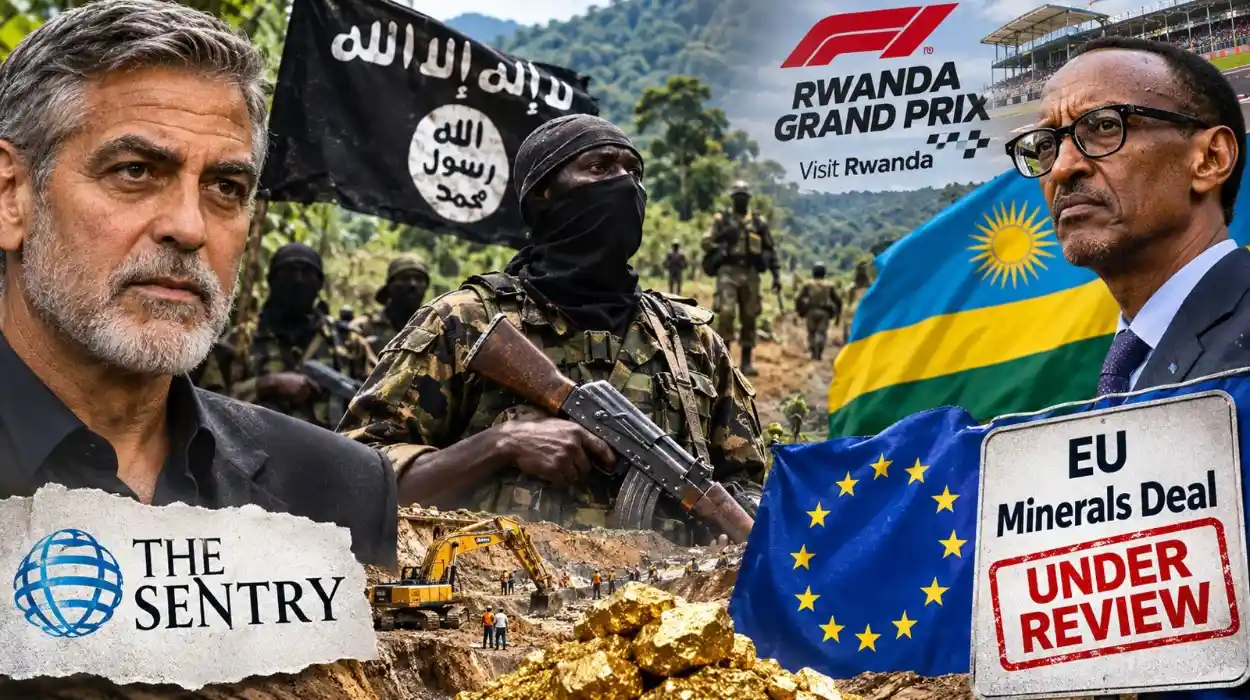
A recent investigation into the activities of the Islamic State’s Central African faction has reignited scrutiny over Europe’s mineral agreements with Rwanda.
The investigation conducted by The Sentry, a Washington-based investigative organization co-founded by George Clooney and John Prendergast, reveals that an affiliate of the Islamic State in eastern Congo is leveraging the ongoing conflict involving Rwanda-backed rebel forces to expand its operations.
The findings, which have garnered attention from British media in recent days, emerge nearly two years after EU foreign ministers agreed to review a vital raw materials partnership with Rwanda, a review that has yet to reach a conclusion.
The Sentry Report
The report, titled “Gold-Backed Brutality,” outlines the actions of the Allied Democratic Forces (ADF), which serves as the Islamic State’s Central Africa Province. The ADF was responsible for over 1,370 civilian deaths in 2025, making it the second-deadliest non-state armed group globally. Reports include horrific accounts of attacks on church vigils and funerals, along with testimonies from former captives about beheadings and widespread sexual violence.
Following U.S. sanctions that disrupted Islamic State’s financial operations in late 2024, the ADF has shifted towards conflict gold as its primary revenue source. Much of this gold is reportedly smuggled out through Uganda, with The Sentry estimating potential earnings of $1 million to $1.6 million annually from a single mining site.
Rwanda’s Connection
The report indicates that the ADF is taking advantage of the Congolese military’s focus on the M23 rebel group, which the UN alleges is supported by Rwanda. As military resources are diverted to the M23 conflict, ADF operations have reportedly escalated.
Investigators have documented movement logistics for the ADF through Goma, an area under M23 control. Notably, an ADF affiliate was apprehended in September 2025 while attempting to procure explosives in Goma, with military uniforms traced from the city to Beni.
“While these incidents do not establish direct collaboration, they indicate permissive transit corridors, tolerated movement, or gaps in M23 territorial control that may indirectly facilitate ADF logistics.”
(The Sentry, Gold-Backed Brutality)
UN experts referenced in the report suggested that the M23 sought a non-aggression pact and safe passage with the ADF in 2024, although the ADF reportedly declined the offer. Despite sharing a lengthy frontline and no reported conflicts between them, the two factions appear to maintain a cautious distance.
The Sentry emphasizes that while it did not uncover compelling evidence of an alliance between the two groups, its most pointed critiques are directed at Uganda’s military efforts against the ADF. Meanwhile, Rwanda has consistently rejected allegations of support for the M23. Following new U.S. sanctions, government spokesperson Yolande Makolo stated that Washington’s commitments towards neutralizing the FDLR militia have yet to materialize.
Europe’s Exposure
In February 2024, the European Commission entered into a memorandum of understanding with Rwanda concerning raw material supply chains. However, a year later, the European Parliament overwhelmingly voted to suspend the agreement, albeit foreign ministers chose to conduct a review instead. The Commission has defended the continuation of the agreement, cautioning that termination could prevent future partnerships. By February 2026, a coalition of human rights organizations, including Amnesty International, highlighted that the promised review was still pending.
Further investigations by Global Witness revealed that traders operating in M23-controlled mines are required to pay levies of $4 per kilogram to the rebels and $3 to the Rwandan government before the ore is exported as Rwandan.
Additionally, the EU had previously allocated approximately €40 million through the European Peace Facility to assist Rwandan forces combating an Islamic State-affiliated insurgency in Mozambique; however, this support was terminated in May 2026 without plans for renewal.
In March 2025, the EU imposed sanctions on three senior Rwandan military officers and the Gasabo Gold Refinery in Kigali. Following suit, the U.S. implemented more extensive sanctions against Rwanda’s Defense Force, the same refinery, and, as of October 28, the Ministry of Defense and Zigama Credit and Savings Society, accusing them of facilitating the movement of gold from M23-held territories. U.S. Treasury Secretary Scott Bessent remarked,
“Rwanda must halt its support for M23 and withdraw its troops from eastern DRC.”
What’s Next?
On October 13, Formula 1 announced a decade-long agreement for an African Grand Prix sponsored by Visit Rwanda, which also supports numerous European football clubs, including Paris Saint-Germain and Aston Villa. Clementine de Montjoye from Human Rights Watch has urged international stakeholders to reevaluate their support for the Rwandan government, citing widespread human rights violations.
“Rwanda’s partners should open their eyes and see Kigali’s wide-reaching human rights abuse for what it is: the consequence of three decades of impunity for the ruling Rwandan Patriotic Front.”
The Sentry has called for the EU, UN Security Council, United States, and United Kingdom to investigate the gold supply chains connecting eastern Congo to Ugandan traders, refiners, and exporters. As of now, EU member states have yet to determine whether they will align with Washington’s sanctions against Rwanda’s defense ministry, and no timeline has been provided for concluding the review of the raw materials partnership.






Discussion about this post