









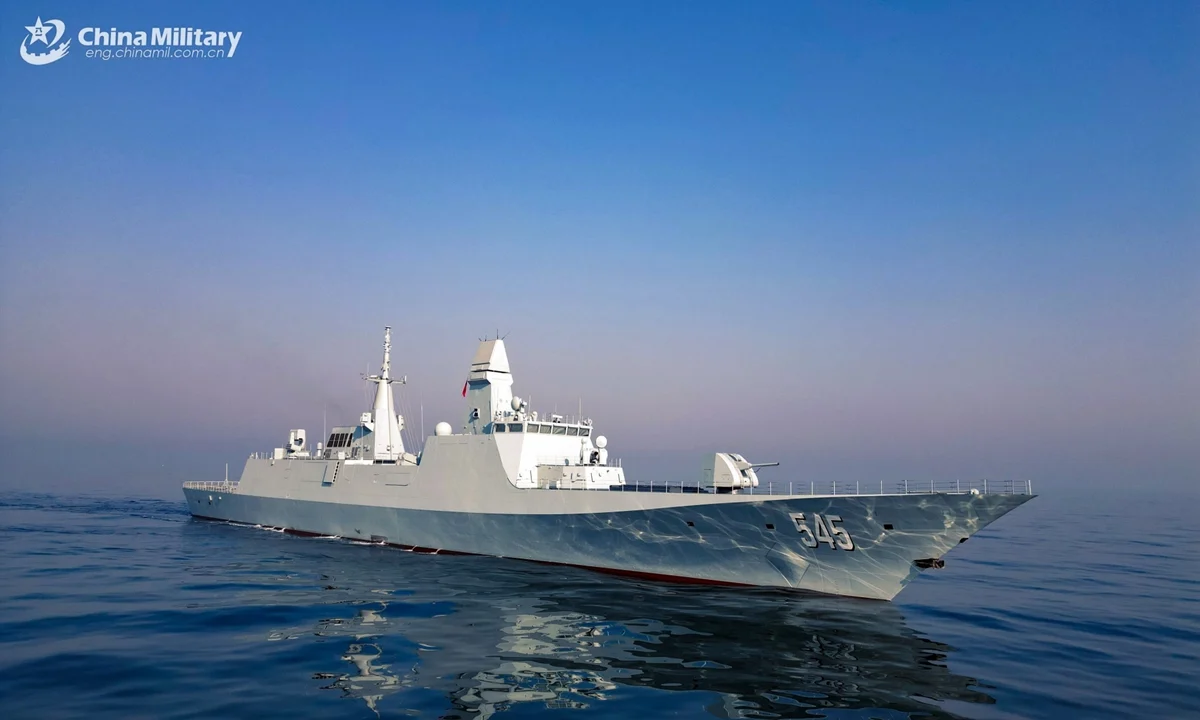
Shanghai / Hudong-Zhonghua — The People’s Liberation Army Navy (PLAN) has commissioned the initial two Type 054B frigates, each equipped with a 32-cell vertical launch system (VLS), as of January 2025. Recent commercial satellite imagery captured on June 28, 2026, by Vantor, and subsequently reported by the South China Morning Post, reveals a different configuration for a hull currently under construction at Hudong-Zhonghua. This ship features a six-module design, suggesting a total of 48 cells, representing a 50% increase in missile capacity compared to the earlier models.
1. Confirmed Specifications and Observations
Confirmed:
- Luohe (545) was commissioned for the North Sea Fleet in January 2025, followed by Qinzhou (555) for the South Sea Fleet.
- Both initial vessels are confirmed to have 32 VLS cells in the bow.
- The new hull at Hudong-Zhonghua, as indicated by the June 2026 imagery, suggests a more extensive bow VLS structure.
Not Confirmed: The precise cell count for the new ship, the specific missile types intended for these cells, or whether the Huangpu shipyard will adopt the same expanded layout. The six-module design indicates a straightforward calculation of missile capacity, though alternative arrangements remain a possibility until the ship is seen at sea.
2. Rationale for Increasing Cell Capacity Mid-Class
Frigates serve as the backbone of naval operations. While destroyers and aircraft carriers often capture the spotlight, frigates fulfill the essential role of escorting and supporting larger vessels. The Type 054A has already seen extensive production, and the 054B aims to enhance this class with improved radar technology, a quieter hull design, and a helicopter deck suitable for the Z-20, all while maintaining cost-effectiveness compared to destroyers.
While 32 cells may suffice when operating alongside a Type 055 destroyer, 48 cells become crucial for independent operations, providing robust local air defense against various threats, including drones and cruise missiles. Commentary following the satellite imagery has emphasized that this adjustment is aimed at enhancing regional air defense capabilities without introducing a new ship class.
Adapting an existing design is generally more economical than creating a new one, albeit at a higher cost than retaining the original specifications for the first two ships. The decision reflects a calculated risk by the navy that the investment in expanded missile capacity justifies splitting the production into two configurations for a limited time.
3. Expectations from the Shipyard
Hudong-Zhonghua and Huangpu shipyards are actively engaged in the construction of the Type 054A series. Extending the VLS entails:
- A modified bow structure to accommodate the increased number of cells, necessitating new weight distribution and damage control measures.
- Continued use of existing missile types, such as HQ-16 surface-to-air missiles and Yu-8 anti-submarine weapons, or the potential integration of various universal VLS munitions.
- Upgraded combat system software capable of managing 48 cells without hindering operational efficiency.
Currently, specific details regarding these modifications remain indeterminate, but the yard’s ability to adjust the design mid-production is noteworthy in the context of Chinese naval shipbuilding practices.
4. Context within the Fleet Structure
Even with 48 cells, the Type 054B does not reach the capabilities of the Type 052D or Type 055 vessels, which feature larger launchers and advanced radar systems. The enhancement of the frigate’s missile capacity aims to bolster overall fleet strength, permitting increased missile readiness without depleting destroyer resources. This change reflects strategic fleet management, allowing a higher number of capable escort vessels.
Comparisons with the U.S. Navy’s Constellation class, which currently includes 32 Mk 41 cells, highlight the evolving dynamics of naval capabilities, although they do not definitively establish superiority in construction timelines.
5. Future Developments to Monitor
- Photographic evidence of the new Hudong hull post-launch or during initial sea trials to verify the cell count.
- Whether Huangpu will adopt the six-module configuration for its upcoming 054B or adhere to the original 32-cell design.
- Consideration of whether the first two ships will remain as a separate class or undergo future modifications to align with the new standard.
- The total number of 054B hulls constructed by both shipyards through 2027, as the significance of increased magazine capacity hinges on production volume.
The satellite imagery provides insight into ongoing developments within the shipyard. China appears to be evolving its primary frigate design while still early in the production phase, indicating a shift towards greater missile capacity rather than waiting for a completely new design. The ultimate question remains whether the 48-cell configuration will become the new standard or remain an isolated experiment.
Sources: Vantor satellite imagery of Hudong-Zhonghua dated June 28, 2026, as reported by the South China Morning Post (August 2026); PLAN commissioning reports for Luohe (545) and Qinzhou (555); open-source class specifications. The figure of 48 cells is derived from imagery analysis and not an official PLAN specification.





Discussion about this post