









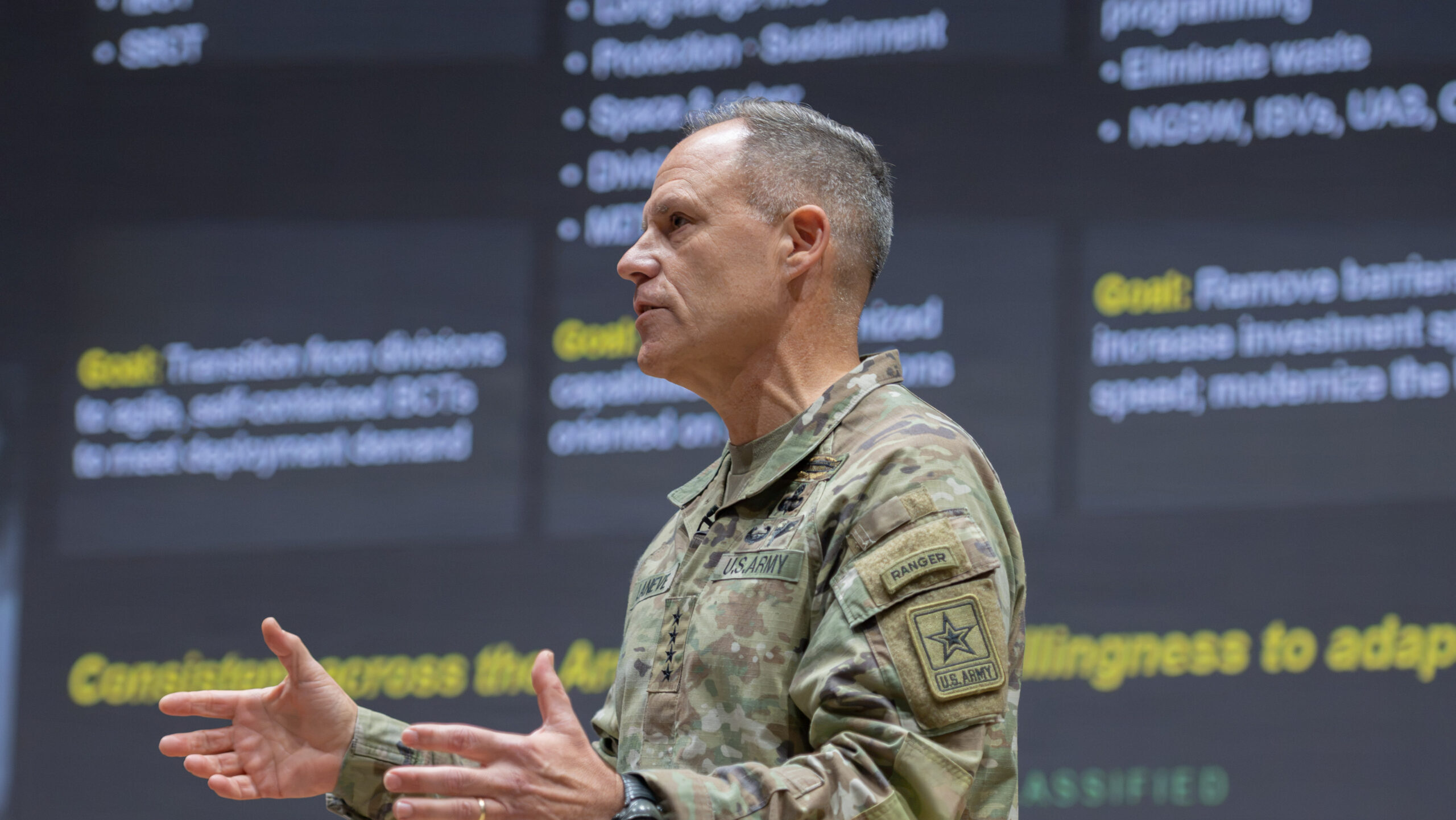
Army Chief Shifts Focus to New Campaign Plan Amid Soldier Burnout Concerns
WASHINGTON — General Christopher LaNeve, the U.S. Army’s highest-ranking officer, has decided to transition from the Army’s “Continuous Transformation” campaign plan to a new directive that emphasizes top-down guidance. This strategic shift is partly attributed to concerns about soldier burnout, as revealed by one of LaNeve’s senior advisors in a recent interview with Breaking Defense.
Introduction of “How the Army Fights” Plan
The preliminary version of the new campaign plan, titled “How the Army Fights,” was unveiled last month. If officially ratified, it will fundamentally alter the current strategy, as noted by Colonel Pete Walther, one of LaNeve’s special assistants, during a November 17 discussion.
Top-Down Guidance to Standardize Operations
Contrary to the previous “bottom-up” approach, which often lacked clear objectives across different levels, the new guidance aims to provide a standardized framework for the Army’s operations and training. This initiative is designed to enhance alignment within the service, ensuring a more coherent approach to combat readiness and strategy.
“‘How the Army Fights’ is essential for our Army. It establishes a clear vision for our direction and unifies our efforts around a shared understanding of our role within the Joint Force,” LaNeve stated at the annual AUSA conference in October. He emphasized that the plan defines the operational environment while illustrating how tactical maneuvers connect with broader strategic goals.
Implementation Timeline and Transition Details
The guidance is set to become the Army’s official campaign plan by February 1, replacing the “Continuous Transformation” framework initiated by former Army Chief General Randy George, who was dismissed by Defense Secretary Pete Hegseth in April. Currently, “How the Army Fights” is in the “execute order” phase, which precedes its formal adoption as the Army’s guiding document.
LaNeve’s spokesperson emphasized that the initiative is focused on organizational change rather than individual leadership. This suggests that even if LaNeve does not receive Senate confirmation, the transformations outlined in the new plan will remain relevant.
Shift in Modernization Strategy
This transition indicates a significant change in the Army’s approach to modernization and experimentation. Under the previous “Continuous Transformation” campaign, the Army engaged in extensive initiatives like the Army Transformation Initiative (ATI), which involved reallocating resources and restructuring priorities. The effort also encompassed Transformation in Contact (TiC), which aimed to rapidly integrate new commercial technology into soldiers’ gear during Combat Training Center (CTC) rotations.
Despite the benefits of bottom-up experimentation, Walther noted that this approach sometimes resulted in a lack of clear directives from Army leadership, which hindered operational effectiveness.
Focus on Higher Echelons of Command
“General LaNeve is concentrating on divisions, corps, and theater armies, whereas previous initiatives focused heavily on lower-level units,” Walther explained. “While those efforts were valuable, the next logical step is to enhance capabilities at higher command levels.”
Currently, soldiers at various echelons lack clearly defined responsibilities, which obstructs the Army’s objective of achieving operational maneuverability. LaNeve aims to ensure that battalion and brigade commanders concentrate on close combat operations, while the division level focuses on convergence and strategic integration.
Modernization Continues with New Directives
Although initiatives like ATI and TiC will conclude, the Army remains committed to modernization, according to LaNeve’s spokesperson. “‘Continuous Transformation’ was motion, but ‘How the Army Fights’ is direction,” they stated.
Under the new plan, decisions about experimental technology will shift from lower-level commanders to division-level leadership or higher, with commanders required to report back on the performance of these technologies.
Conclusion of TiC and Its Implications
Walther acknowledged that while TiC yielded valuable insights and increased tactical lethality, its bottom-up experimentation also led to tech fatigue among soldiers, who became overwhelmed by the influx of new equipment without adequate training or understanding of its intended uses.
“The intention was good, but it ultimately proved counterproductive for brigade commanders and their teams,” Walther remarked. “We need to transition to a more structured modernization strategy.”
New 180-Day Mandate for Technology Integration
One of the major reforms under “How the Army Fights” is the introduction of a requirement that soldiers receive new technology for experimentation at least 180 days prior to CTC exercises. This change aims to give units ample time to integrate and train on new equipment before entering high-stakes training scenarios.
Lt. Gen. James Isenhower explained that this adjustment will allow the rotational force to focus on their operational processes rather than struggling to understand unfamiliar technology during critical training exercises. The opposition force will also receive new technologies to familiarize themselves ahead of CTCs, promoting a more balanced approach to experimentation.
Ultimately, LaNeve’s strategy with “How the Army Fights” seeks to ensure that soldiers are well-prepared for the integration of new technologies into their operations, fostering a clearer understanding of their roles and responsibilities within the Army’s broader mission framework.








Discussion about this post