









NASA’s DART Mission Achieves Milestone in Asteroid Defense Technology
In 2021, NASA launched an ambitious initiative aimed at testing planetary defense capabilities by sending a spacecraft to collide with one of two asteroids in a binary system. The objective was to evaluate whether such an impact could effectively alter the asteroid’s orbit.
The motivation behind this mission is to assess whether similar techniques could be employed to redirect any asteroids that might pose a threat to Earth. (Currently, there are no known asteroids on a collision trajectory with our planet.)
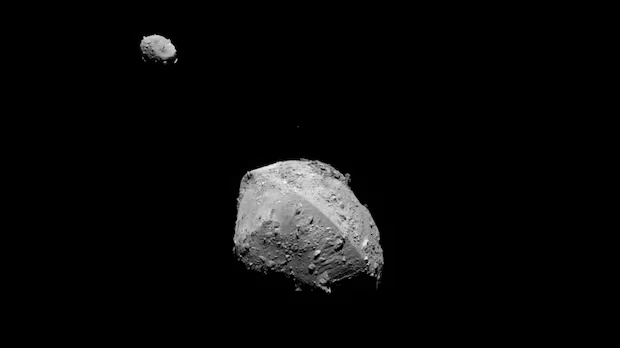
The double-asteroid system comprises Didymos and its smaller companion, Dimorphos, which orbit a shared center of mass. NASA’s mission focused on impacting Dimorphos to observe any changes in its orbit around Didymos.
By September 2022, the Double Asteroid Redirection Test (DART) successfully shortened Dimorphos’s orbit around Didymos by approximately 33 minutes, surpassing NASA’s initial expectation of a 10-minute alteration.
While Earth-based telescopes monitored the aftermath, the European Space Agency (ESA) had its own mission, known as Hera, planned to investigate further. Recently, ESA unveiled close-up images and videos of the asteroid duo, four years post-DART.
Examination of the new images reveals a significant flattening of Dimorphos, which is now characterized by a large crater nearly as expansive as the asteroid itself. Sabina Raducan, a planetary scientist involved with the Hera mission, expressed excitement, stating, “It’s hard to describe in words all the excitement to finally see what happened.”
Unexpected Discoveries from the Hera Mission
Hera has uncovered additional surprises during its exploration. Naomi Murdoch, a planetary scientist from ISAE-SUPAERO at the Université de Toulouse and a member of the Hera science team, noted, “Every space mission has surprises. But there was a particularly big one in store for Hera.”
Hera has documented hundreds of boulders varying in size from centimeters to meters moving around the two asteroids. An image created from 11 long-exposure shots depicts these boulders as if they were fireflies dancing around Didymos and Dimorphos.
The origins of these boulders remain uncertain. Murdoch stated, “We’re still really trying to characterize them,” suggesting ongoing efforts to determine whether they were generated by the 2022 impact or were pre-existing components of Didymos.
Having been in orbit around the binary system for the past three weeks, Hera’s mission has six months remaining, and scientists are eager for further discoveries.
Transformation of Dimorphos and Didymos
The images reveal that Didymos resembles a giant walnut, distinguished by a prominent ridge across its 700-meter width. Murdoch explained that this feature likely results from the asteroid’s rapid rotation, causing surface material to flow toward the equator.
Furthermore, the impact has led to a chaotic tumbling motion of Dimorphos as it orbits Didymos. Raducan noted, “Before the DART impact, Dimorphos was more like our own moon, always showing the same face to Didymos. Now it’s very chaotic.”
DART’s Success Exceeds Expectations
Not only did DART alter Dimorphos’s orbit around Didymos, but it also impacted the pair’s orbit around the sun. A March study published in Science Advances reported that the impact modified the 770-day orbital period around the sun by a fraction of a second, marking a historic moment in which a human-made object has changed the orbit of another celestial body.
In the upcoming months, Hera will continue to gather data on the binary asteroid system to uncover additional changes. The mission will deploy two CubeSats for in-depth exploration of Dimorphos’s mineral composition and conduct radar sounding on the asteroid.
Subsequently, Hera will also descend to the asteroid’s surface upon mission completion. Astronomers are keen to learn what the next six months will reveal about this intriguing system and the viability of asteroid redirection as a planetary defense strategy.
“We learned from DART that we can send a spacecraft to hit an asteroid, and now with Hera, we can observe the effects,” Raducan concluded. “The next question is to determine how efficient this deflection was as we gather more data.”










Discussion about this post