
[ad_1]
SINGAPORE AIRSHOW: Air Force Official Looks for Robotic Jet Partnerships in Asia, Talks F-35 Woes
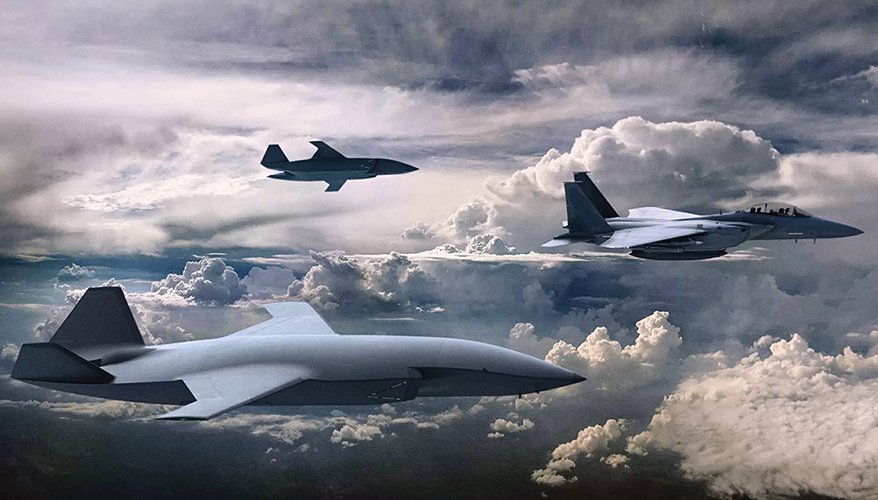
SINGAPORE — The U.S. Air Force has held discussions with Japan and other allies regarding the possibility of partnering on the service’s Collaborative Combat Aircraft program, the Air Force’s top acquisition official said Feb. 20.
The Air Force envisions the Collaborative Combat Aircraft, or CCA, as autonomous platforms that would operate in tandem with manned systems, such as the service’s Next Generation Air Dominance fighter. The service currently has contracts with five companies — Lockheed Martin, Boeing, Northrop Grumman, General Atomics and Anduril — for increment one of the CCA program, and is planning to select at least two vendors to move forward to the next phase.
At the same time, the service is actively engaging with international allies and partners about either exporting the autonomous aircraft or providing them the means to build similar platforms, said Andrew Hunter, the Air Force’s assistant secretary for acquisition, technology and logistics.
CCA is being developed with a “family of systems approach, and fundamental to that family of systems approach is a reference architecture … the government controls that defines standards and interfaces and interoperability among platforms,” Hunter said during a media roundtable at the Singapore Airshow.
That reference architecture is “shareable,” and the Air Force has “already begun the process of sharing with international partners,” which “opens up the possibility that whether or not we would necessarily do a traditional export type arrangement, countries would be able to build towards the same standard and have inherently interoperable platforms, and platforms that could readily adopt” U.S.-made “mission systems and other things,” he said.
There’s almost no limit to what missions the CCA platforms could tackle, including intelligence, surveillance and reconnaissance, air-to-air combat, strike and electronic warfare, he said. Increment one has a “very defined set of capabilities that we’ve asked” industry to address, “and I feel comfortable with their ability to provide the kinds of capabilities that increment one is expected to produce,” he said. And with multiple vendors progressing to the next stage of the program, there’s a possibility multiple variants are produced, he added.
Air Force Secretary Frank Kendall announced last week the service will initiate increment two of the CCA program in fiscal year 2025 — “obviously pending Congress providing a budget,” Hunter noted. As part of increment two, the Air Force will be “deeply exploring options for significant partner involvement” from international allies, Hunter said.
“That’s not to say that we might not eventually export increment one as is to certain partners if there’s interest in that,” he added. “That’s something we’ll definitely look at.”
One potential partner for the CCA program is Japan, which has “substantial industrial base capacity — that is something that we look to leverage,” Hunter said. “We’re definitely having dialogue with them about partnership on key programs — including potentially Collaborative Combat Aircraft in the future.”
Boeing Australia — in partnership with the Royal Australian Air Force — is developing the Ghost Bat unmanned jet fighter and officials in Canberra have openly touted the platform as a candidate for the CCA program.
Hunter said one key factor in a platform’s exportability is cost. The Air Force’s price point goal for CCA when the aircraft is “in production, and in production at rate” is around “a quarter to a third of the cost of an F-35.” In its “Weapon Systems Annual Assessment” released in June 2023, the Government Accountability Office estimated the F-35’s unit cost as $177 million in fiscal year 2023 dollars.
The F-35 program has faced pointed criticism for its rising costs and developmental delays from GAO, which in a December 2023 report described the aircraft as the Defense Department’s “most expensive weapon system program,” with an estimated cost of over $1.7 trillion to buy, operate and sustain.
Despite the high price point, the F-35 has remained a popular platform among international allies — including Singapore, which has committed to purchasing 12 F-35B variants.
“If you look at the long arc of the F-35 program, the price of an F-35 … is definitely in the target range of what we’ve been envisioning” since the program entered the engineering and manufacturing development phase, Hunter said. “So I think on production, we’ve really reached a place where the affordability objectives of the F-35 program are largely being met.”
Hunter acknowledged the program has had challenges with its latest modernization effort known as Block 4. GAO stated in the December report Block 4 has been marred by developmental delays and an increasing price tag as more capabilities have been added to the upgrade plan.
The struggles with fielding Block 4 are not a “price issue,” but rather “more about supply chains and getting through some of the testing required to incorporate new capabilities into an existing production line, which is always a tricky thing to do,” Hunter said. “I think on price … we’re in a pretty good place. We do have to deliver, and the place where I think there’s obviously still room for growth is in the cost of sustaininment.”
The F-35 Joint Program Office is “working extremely hard to get after the cost of sustainment — and had quite a bit of success actually in the early going,” he said. “There’s a number of initiatives we’re looking at to cut down the cost of sustainment for the F-35.”
Topics: Air Force News, Global Defense Market, International
[ad_2]
Source link